
Furniture Placement Small Living Room Layouts That Work

That cramped, crowded feeling in a small living room? It's a common headache, but the fix is often simpler than you think. The real secret to smart furniture placement in a small living room is all about creating clear walkways, picking pieces that are the right scale, and using a few visual tricks to make the space feel bigger. It’s about making every single square inch work for you without giving up on comfort or style.
Creating Space Where It Matters Most
Don't look at a small living room as a limitation. See it as a chance to be really intentional and clever with your layout. The goal is to design a space that works for your everyday life but still feels warm and welcoming when you have people over. It's a delicate balance—you want enough seating, but you also need to keep that open, airy vibe.
The right arrangement can completely transform a tight spot into a cozy, stylish hub. This all starts with understanding a few core ideas of space planning. For example, a lot of people make the mistake of pushing all their furniture flat against the walls. This can actually make a room feel boxy and static. Try pulling your sofa just a few inches away from the wall; you'll be surprised at the sense of depth it creates.
Establish a Clear Focal Point
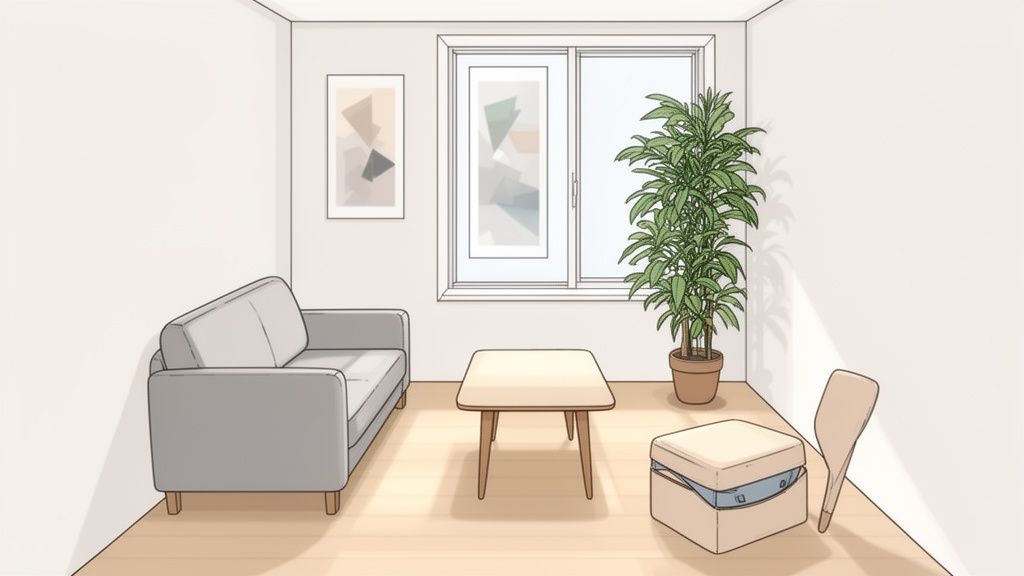
Every great room design starts with an anchor, and in a small living room, this is absolutely non-negotiable. Your focal point could be something architectural, like a fireplace or a large window with a great view, or it could be a stunning piece of art. Arrange your main seating, like your sofa, to face that point. This single decision immediately gives the room a purpose and directs the flow, making every other choice so much easier.
If your room doesn't have a natural focal point, you can easily create one. A beautiful media console from a premium brand like Barclay Butera, for example, can become the star of the show. And with our easy financing options, investing in that perfect centerpiece is well within reach.
A well-defined focal point acts like a compass for your room's layout. It tells you where to start and ensures all other pieces have a logical place, preventing the layout from feeling random or chaotic.
The Power of Multifunctional Design
In a small space, every single piece of furniture needs to pull its weight. This is where multifunctional design really shines. Think of an ottoman that opens up for hidden storage, a set of nesting tables you can pull out when company comes over, or a chic sleeper sofa that’s ready for overnight guests. You can find more of our favorite tips on how to make a small room feel big in our other expert guides.
Looking for even more ways to tame the clutter? Exploring some clever small apartment organization ideas can give you some fresh strategies. Here at Willis Furniture, we're all about this smart, practical approach to design. Our Virginia Beach showroom is full of inspiration, from amazing budget-friendly decor at the Willis Outlet to one-of-a-kind pieces you can dream up with our Design Center team. We're here to help your small living room live large.
Your Foundational Blueprint For Success
Diving in and shuffling furniture around without a plan is a classic mistake. It's like trying to bake a cake without a recipe—you'll get something, but it probably won't be what you envisioned. The single most important thing you can do for successful furniture placement in a small living room is to create a solid blueprint first. This one step takes all the guesswork out of the equation, helping you sidestep costly mistakes and making sure every piece you bring home fits like a glove.
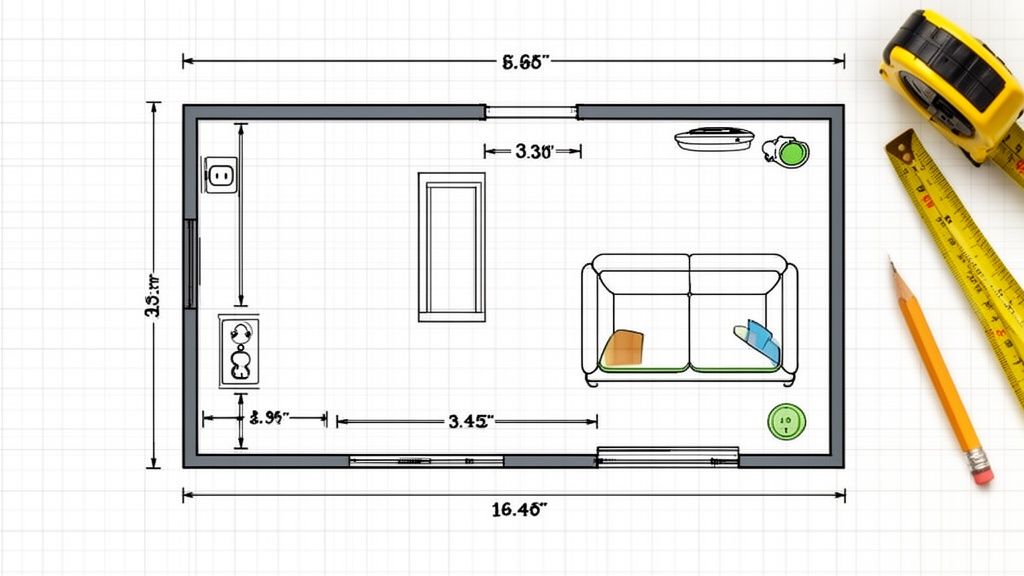
Honestly, this part is easier than it seems. Just grab a tape measure and a notepad. Start by getting the room's basic length and width, then measure any of the furniture you know you’re keeping. But don't just stop there. The magic is in the details.
Documenting The Fixed Elements
Your room isn't just an empty box; it has quirks and permanent features that will absolutely dictate where furniture can (and can't) go. You need to jot down the precise location and size of every single one of these on your sketch:
- Doors and Entryways: Note which way the door swings open and how much clearance you need to leave.
- Windows: Measure their height from the floor. This is key to avoiding that beautiful new console table that completely blocks your natural light.
- Outlets and Vents: Mark every last one. There’s nothing worse than arranging everything perfectly, only to realize you’ve covered the only usable outlet or are blocking a crucial heat vent.
- Architectural Features: Don’t forget about the fireplace, any built-in shelves, or radiators that will eat into your usable floor space.
Think of this detailed map as your secret weapon. It’s what stops you from falling for a gorgeous sofa that completely obstructs a window or buying a media center that renders your outlets useless.
Think of your floor plan as a personalized puzzle board. By knowing the exact shape of every piece—from the room itself to the furniture—you can see how they all fit together before you do any of the heavy lifting.
With these numbers ready, you can sketch out a simple to-scale floor plan. Old-school graph paper works great (let one square equal one foot), or you can play around with one of the many free room planner tools online. This visual is a game-changer. It lets you test-drive different layouts digitally, saving you from the back-breaking work of pushing a heavy sofa around five times. For a deeper dive, check out our detailed advice on how to plan a room layout.
Translating Your Blueprint Into Reality
Getting this planning stage right has never been more critical. The global market for small-space furniture hit an incredible USD 23.4 billion in 2023 and is expected to soar to USD 41.2 billion by 2032. Why the boom? It’s driven by the reality of city living, with 54% of global urban residents calling spaces under 1,000 square feet home. In these cozy settings, thoughtful furniture placement isn't just a style choice; it’s a necessity that can make a room feel up to 40% larger.
Your blueprint is the perfect launchpad, but turning those lines on a page into a functional, beautiful room is where the real art comes in. This is exactly where professional guidance can make all the difference. At the Willis Furniture Design Center, our expert consultants are true masters of space planning.
Bring us your measurements and your floor plan. We’ll work right alongside you, helping you select perfectly scaled pieces from our American-made collections that don’t just fit your space but truly reflect your style. We’re here to bridge that gap between your foundational blueprint and a living room you’ll absolutely love.
Choosing Your Scaled and Multifunctional Furniture
With your floor plan in hand, it's time for the fun part—choosing the actual furniture. The secret to smart furniture placement in a small living room is about more than just where you put things; it's about what you choose in the first place. You want pieces that are scaled correctly and, ideally, can do more than one job. That’s how you create a space that feels open and genuinely useful.
You’ve probably seen it before: a huge, overstuffed sofa crammed into a tiny room. It just swallows up all the available space and makes the whole area feel cramped. The goal here is to think smaller and smarter. Swapping out those heavy, bulky items for lighter, more versatile pieces is a total game-changer.
Embrace The Power Of Scale And Proportion
When we talk about scale, we're not just talking about the measurements on a tape measure. It's about visual weight, too. Think about a sofa with enormous, puffy rolled arms versus a sleek, modern one with clean lines—even if they're the same length, the first one feels much bigger and heavier.
This is where apartment-sized sofas and armless chairs become your best friends. They give you all the seating you need without the extra bulk, saving you precious inches.
Another trick I love is using "leggy" furniture. Any piece that’s raised off the floor—a console table on slim legs, a mid-century modern chair—creates an illusion of space. When you can see the floor underneath, the room instantly feels lighter and less crowded.
Here are a few workhorses for smaller living rooms:
- Apartment-Sized Sofas: These are designed specifically for compact spaces, offering the comfort of a standard sofa but with a shorter length and depth.
- Armless Chairs: Ditching the arms can shave off several inches, letting you tuck a comfy chair into a tight spot.
- Nesting Tables: An absolute classic for a reason. Stack them to save space day-to-day, then pull them out for extra surfaces when company comes over.
- Slim Consoles: A narrow console table can slip in behind a sofa or against a wall, giving you display space without jutting into your walkway.
Trying to find furniture with the perfect scale can feel overwhelming, but that’s exactly what our Design Center specializes in. Our consultants know which collections are built for smaller homes and can even help you create custom upholstery in light, airy fabrics that make your Virginia Beach home feel just right.
Make Every Piece Work Harder
In a small room, a piece of furniture that only does one thing is a wasted opportunity. You need your furniture to be clever. Multifunctional pieces are your secret weapon for getting the most out of every square foot without adding a bunch of clutter.
The most successful small living rooms are curated with pieces that are both beautiful and clever. An ottoman with hidden storage, for example, is far more valuable than one without, as it elegantly solves both seating and clutter problems in a single stroke.
A storage ottoman is the perfect example—it’s a footrest, an extra seat for a guest, and a place to stash blankets and remotes. Or consider a lift-top coffee table that doubles as a desk or a spot for a casual dinner. If you want to dive deeper into this idea, our ultimate guide to multifunctional furniture is full of inspiration.
Finding The Right Fit For Your Budget And Style
Creating a beautiful, functional small living room shouldn't mean you have to break the bank or sacrifice quality. We truly believe high-end living should be within reach for everyone in our community.
Maybe you’ve been dreaming of the incredible comfort of a Stressless recliner but are working with a specific budget. Our flexible financing options make it possible to invest in that kind of lasting quality without the large upfront expense.
And for those who love the thrill of a great find, the Willis Outlet is a must-see. It’s where you’ll find budget-friendly decor, floor models, overstock pieces, and unique furniture that’s perfectly scaled for smaller rooms—all at amazing prices. It's the perfect place to discover that stylish accent chair or slim console to complete your space without blowing your budget.
Proven Layouts For Common Living Room Shapes
Once you’ve found furniture that’s the right scale, the next piece of the puzzle is arranging it to make the most of your room. Every small living room has its own quirks, but most fall into a few common layouts. What works for a long, narrow room is completely different from what you'd do in a perfect square.
Figuring out the furniture placement for your specific room shape isn’t about following rigid rules. It's about understanding flow, balance, and what you need the room to do. The goal is always to create a space that feels natural and intentional, turning the room's unique dimensions into an asset.
This is where the principles of selecting the right furniture really come into play. Focusing on scale, visual lightness, and versatility is the foundation for any great small-space layout.
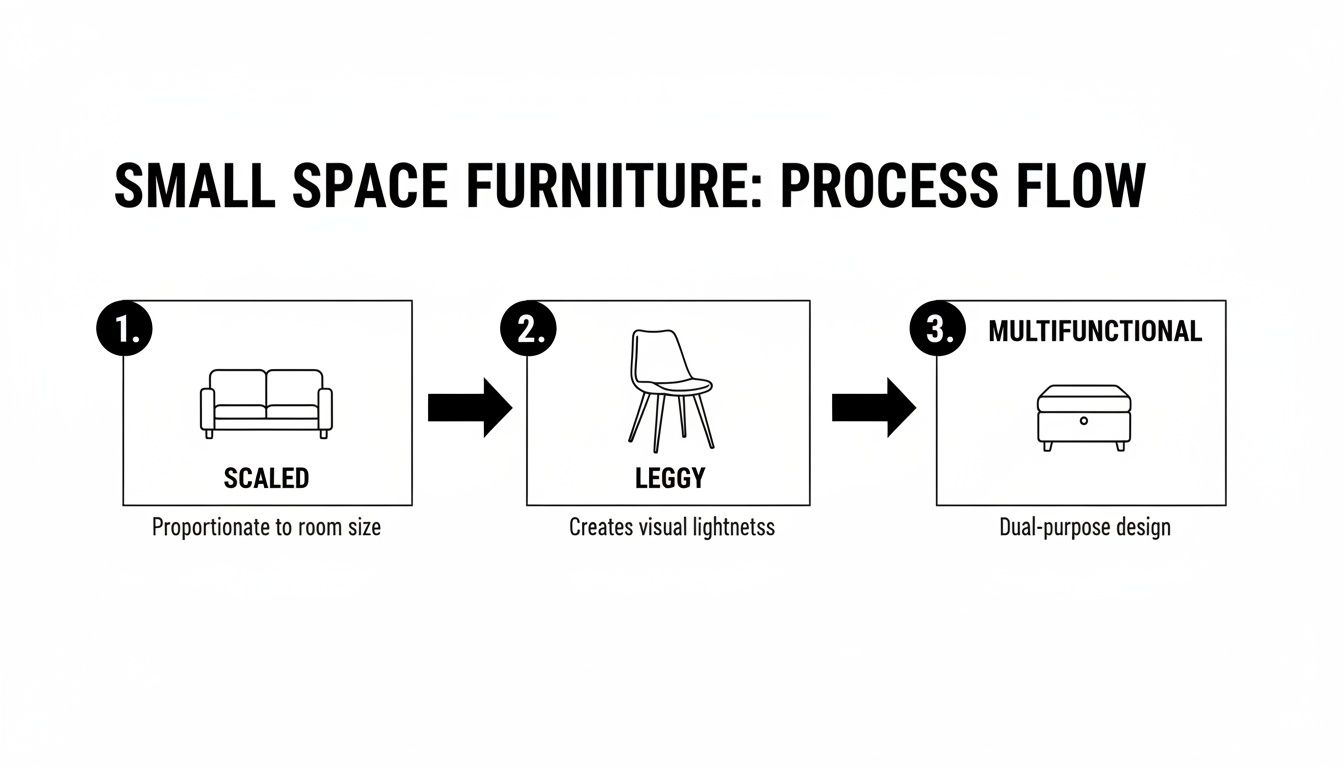
Before you even think about arrangement, getting these core furniture choices right—scaled, leggy, and multifunctional—sets you up for success.
The Long, Narrow Rectangular Room
Ah, the "bowling alley" living room. It’s one of the most common challenges we see. If you just line everything up against the two long walls, you end up with a tunnel that feels more like a hallway than a cozy living area. The trick here is to break up the length.
Think in terms of distinct zones. By using your furniture to divide the space, you can give the room multiple purposes. You might have your main seating area at one end, with a small reading nook or a slim workspace at the other. This is a design trend our Design Center can help you master, customizing pieces that create clear, functional zones even in tight spaces.
Here’s a simple way to pull that off:
- Float Your Sofa: Don't push it against a wall! Instead, position it perpendicular to the long walls. This little move instantly creates a "wall" with your furniture.
- Add a Console Table: Tuck a slim console table right behind the floating sofa. It helps define the back of your seating zone and gives you a handy surface for a lamp or a few decorative items.
- Anchor with a Rug: Use a great area rug to clearly mark the main conversation area. Just make sure the front legs of your sofa and chairs are sitting on it.
This strategy cleverly disrupts that long, straight sightline, making the room feel wider and much more thoughtfully designed. For more ways to tackle tricky spaces, check out these smart living room layout ideas.
The Balanced Square Room
A square room sounds easy, right? But it can quickly feel static and boxy if you’re not careful. Pushing all your furniture against the walls is the single biggest mistake people make here. It just deadens the space.
The goal is to encourage conversation by creating an intimate grouping that pulls everything toward the center. This makes the layout feel far more dynamic and welcoming.
In a square room, imagine a circle in the very middle and arrange your furniture around its edge. This design secret softens the room's harsh angles and creates a much more natural, conversational vibe.
Try a classic, balanced layout like this:
- Place your sofa against one wall to serve as the main anchor.
- Position two matching accent chairs directly across from the sofa.
- Center a round or square coffee table in the middle to tie it all together.
You've instantly created a perfect spot for conversation. If you have the space, a slim bench or a pair of small ottomans opposite the main doorway can complete that "circle" without blocking the path.
The Awkward L-Shaped Room
An L-shaped room can feel awkward at first, but it actually has a fantastic, built-in advantage: zoning. The challenge isn't creating the zones, but making them feel connected. The key is to treat the two parts of the "L" as separate but related spaces.
Typically, the larger arm of the L becomes the main living and seating area. That smaller nook? It’s perfect for a secondary function, like a small dining spot, a home office, or a cozy reading corner.
The trick is to create a visual thread that links the two zones. You can do this with consistent flooring, a unified color palette, or by repeating certain materials, like a particular wood tone or metal finish. A large area rug will anchor the main seating area, while a smaller, complementary rug can define the secondary nook. You can explore more of our living room arrangement ideas for some great inspiration.
Getting this kind of strategic placement right is more important than ever. The global living room furniture market is projected to grow from USD 231.8 billion to USD 339.6 billion by 2035, largely driven by smart designs for smaller homes. Here in Hampton Roads, that trend hits close to home. The median living room in an updated Virginia Beach house is around 165 square feet, where expert placement—like leaving 18 inches between a sofa and coffee table—can improve traffic flow by 30%.
No matter what shape your room is, remember that our white-glove delivery team does more than just drop off your beautiful new pieces. They’re trained to assemble and place everything according to your layout plan, making sure your vision comes to life perfectly, without you having to lift a finger.
Finishing Touches That Amplify Your Space
Getting the furniture placement right is the groundwork, but it's the finishing touches that really make a small living room sing. Once your sofa, chairs, and tables are set up for the best possible flow, it's time to layer in the details that make the space feel bigger, brighter, and truly pulled together. This is where you go from a well-arranged room to a thoughtfully designed home.
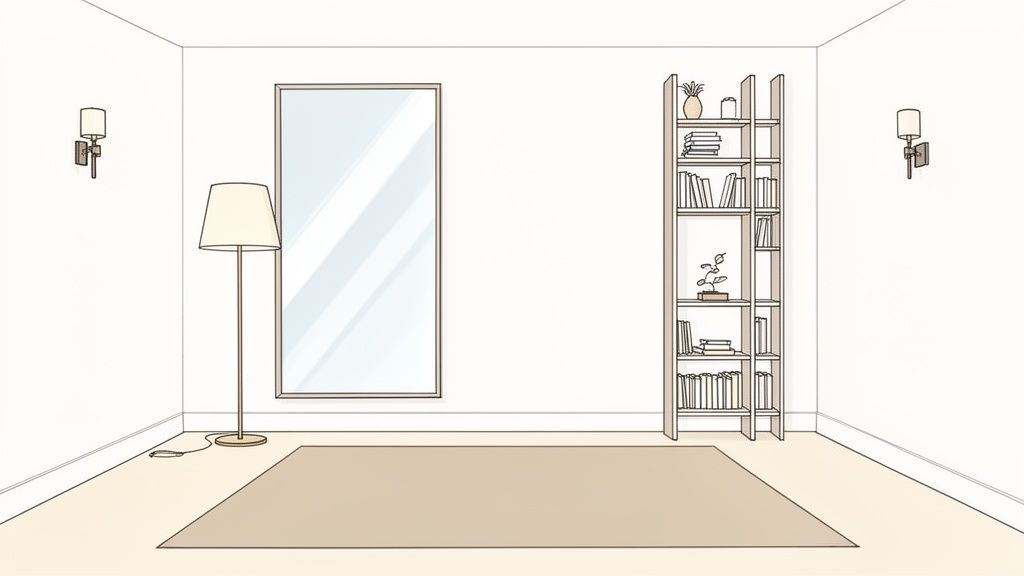
This isn’t just about adding pretty things. It's about smart, strategic choices that solve the classic small-space dilemmas. A well-placed mirror, for instance, does so much more than fill a wall—it bounces light everywhere, creating an illusion of depth that can completely change the feel of the room. In the same way, the right area rug anchors your entire layout, making every piece of furniture feel connected and intentional.
Draw The Eye Upward And Outward
One of the oldest tricks in the book for a small living room is to play with the perception of scale. By drawing attention vertically and using reflective surfaces, you can trick the eye into seeing a much more expansive space.
A large, beautifully framed mirror is non-negotiable in my book. Place it opposite a window, and you’ve essentially doubled your natural light and given yourself another "view." It’s a simple move that makes a compact room feel instantly more open and airy.
Here are a few other ways to expand your space visually:
- Go Vertical: A tall, narrow bookshelf pulls the eye upward, making ceilings feel higher. Stay away from wide, bulky bookcases that just eat up floor space.
- Light it Right: Instead of a chunky table lamp that hogs surface area, try a slim floor lamp tucked into a corner. Wall sconces flanking a sofa are another fantastic option. They add that crucial ambient glow without taking up an inch of table space. We have more expert advice on how to put your living room in the best light if you need more ideas.
- Show Some Leg: We’ve touched on this before, but it’s worth repeating. End tables, consoles, and chairs with visible legs let you see more of the floor, which is key to enhancing that feeling of spaciousness.
Think of mirrors and vertical decor as your secret weapons against a cramped feeling. They work by creating visual pathways that extend beyond the room's physical boundaries, making the entire space feel less confined.
Anchor Your Layout With The Perfect Rug
Nothing ties a room together like the right area rug. In a small living room, the rug’s job is critical: it defines the conversation area and makes the entire furniture arrangement look deliberate, not just like pieces floating in a room. But I see this mistake all the time—choosing the wrong size can actually make your room feel smaller.
A rug that’s too small looks like a postage stamp in the middle of the floor, visually shrinking your layout. The golden rule? Pick a size that allows at least the front legs of your sofa and any chairs to sit comfortably on it. This single guideline connects everything and creates a cohesive, unified look.
I know that picking a rug can be overwhelming, with endless choices in size, material, and pattern. That’s exactly why we created the Willis Rug Market right here at our Virginia Beach campus. It’s a huge space dedicated to helping you find that perfect final piece. Our experts can walk you through hundreds of options, making sure you find a rug that not only fits your style but is also perfectly scaled to anchor your new layout. It's the final, critical touch that completes the transformation.
Bringing Your Small Space Vision To Life
Getting the furniture placement in a small living room just right isn't about memorizing a rulebook. It's about making smart, intentional choices that feel right for your home. Now that you've got the hang of measuring your space, choosing properly scaled furniture, and planning for flow, you can see how these ideas work together to turn a cramped room into an inviting retreat.
The best part is taking that spark of an idea and making it real—and you don't have to go it alone. Bring your notes, your measurements, and your inspiration down to our in-house Design Center. Our expert consultants live and breathe this stuff. They’ll help you translate that vision in your head into a beautiful, functional layout that actually works.
Making Your Dream Home Accessible
We’ve always believed that incredible design should feel within reach. While you’re picking out the perfect American-made pieces for your new layout, our team can show you some flexible financing options through our Synchrony HOME™ program. We’ve found it helps make the process of investing in your home’s comfort and style feel smooth and totally manageable.
This whole approach—being smarter with our spaces—is part of a much bigger picture. The market for minimalist furniture, which is perfect for small rooms, swelled to USD 52.6 billion in 2024. This isn’t a coincidence; it reflects a worldwide move toward smaller homes. In fact, 77% of consumers now lean toward open layouts because smart furniture placement can make a room feel up to 35% larger. You can read more about the rise of minimalist furniture on grandviewresearch.com.
Ultimately, creating a beautiful living room is about making the most of what you have. Your small space is a canvas for creativity, not a limitation.
Once you’ve found the pieces you love, our white-glove delivery service takes care of the rest, making sure the final result is as flawless as you imagined. We’d love for you to come visit our Virginia Beach showroom and start the conversation. Let’s create a living room that feels spacious, stylish, and completely you, no matter the square footage.
Common Questions About Small Living Rooms
Even the most perfectly laid out plan can hit a snag. When you're trying to furnish a small living room, a few tricky questions always seem to pop up, and getting clear answers can give you the confidence to pull it all together.
Here are a few of the most common dilemmas we help people solve every day in our showroom.
What Is The Biggest Mistake In Small Living Room Layouts
Hands down, the most common mistake we see is pushing every single piece of furniture right up against the walls. It’s a gut reaction—you think you’re maximizing floor space, right? But what it actually does is create a strange, empty void in the middle of the room, making everything feel disconnected and a little sterile.
Try this instead: float your sofa just a few inches off the wall. It’s a simple move, but it creates instant breathing room and a sense of depth that makes the entire space feel larger and more intentional. Our experts at the Design Center can show you exactly how this small tweak can make a huge impact in your home.
Can I Use A Sectional Sofa In A Small Living Room
You absolutely can! It’s a total myth that sectionals are only for sprawling family rooms. The trick is to choose a modern, "apartment-sized" sectional that’s scaled correctly for your room’s footprint.
An L-shaped sectional, for instance, can be a brilliant way to define a corner and pack in the maximum amount of seating without visually choking the layout. We carry a huge range of customizable sectionals from top American-made brands, and our flexible financing options through Synchrony HOME™ make it easier to get the perfect high-quality piece without compromise.
How Do I Choose The Right Rug Size For My Space
Another classic misstep is picking a rug that’s too small. A little rug floating like an island in the middle of your floor just makes the whole seating area—and the room itself—feel cramped and fragmented.
As a rule of thumb, your rug should be large enough for at least the front legs of your main furniture (like the sofa and armchairs) to sit on it comfortably. This one guideline does wonders to anchor your conversation area, pulling everything together into one cohesive, inviting space.
If you’re feeling stuck, head over to the massive Rug Market at the Willis Outlet. Our team can help you find the perfect size and style to visually open up your room.
What Coffee Table Works Best In A Small Room
When it comes to coffee tables, think “visually light.” You want pieces that don’t feel heavy or bulky. Tables with glass tops, slender metal legs, or a light wood finish keep the sightlines open and maintain an airy, uncluttered vibe.
You could also consider a set of nesting tables or even a versatile storage ottoman. Both offer incredible flexibility for when you need more surface area or a place to stash throws and remotes. The team in our Design Center is amazing at helping clients find that perfect piece that blends smart function with beautiful form.
Ready to stop planning and start doing? The design experts at Willis Furniture & Mattress are here to help you bring your vision to life. Visit our Virginia Beach showroom today!


