
How to Arrange Bedroom Furniture: Simple, Practical Tips for Your Space

Arranging your bedroom furniture is really about one thing: creating a space that helps you rest and makes your daily routine feel effortless. The secret isn't just about filling the room, but about establishing a clear focal point, making sure you can walk around comfortably, and choosing pieces that are the right scale for your space.
Let’s walk through how to turn any bedroom into your own personal sanctuary.
Creating Your Ideal Bedroom Sanctuary
Ever stood in an empty bedroom—or a cluttered one—and felt completely stuck? Whether you're dealing with a quirky room shape or just don't know where to begin, you're not alone. Figuring out how to arrange bedroom furniture is more than just a logistical puzzle; it's about crafting a retreat that truly supports the way you live.
A well-designed bedroom doesn't just look beautiful, it feels right. It’s a space that encourages you to unwind and recharge. The real goal is to strike that perfect balance between function and beauty, where every piece, from your bed to your nightstands, serves a purpose and adds to the room's peaceful vibe. It's an art, but it's also a science. If you're looking for more ways to make your space feel just right, check out these tips on how to make your home cozy.
The Foundation of a Restful Room
A thoughtful layout is the cornerstone of a serene bedroom. How you place your furniture directly affects your day-to-day life, from navigating the room on a dark morning to how quickly you settle in at night.
Did you know that the right furniture arrangement can actually improve your sleep quality by up to 25%? It’s true. Sleep experts have found that simple things, like placing your bed against a solid wall instead of under a window, can improve airflow and reduce disturbances. The result is deeper, more restorative sleep.
Your bedroom should be the most personal space in your home, a place where you can truly shut out the world. The right furniture arrangement is the first step in creating that sense of peace and order.
Bridging Inspiration and Action
It's one thing to have a vision, but it's another to bring it to life. Whether you're working with cherished family heirlooms or are ready for a complete refresh, we can help you turn inspiration into reality. You can get started by exploring different styles and learning more about designing a relaxing bedroom.
If you’ve been dreaming of a high-end look with premium, American-made collections from premium brands like Barclay Butera, our flexible financing options make that luxury more attainable than ever. For those on the hunt for stylish, budget-friendly decor, the Willis Outlet is your go-to. And when you need an expert eye to pull it all together, our team at the Willis Furniture & Mattress Design Center is here to help you create a space that’s both beautiful and perfectly livable.
Mapping Your Space for a Flawless Layout
Before you even think about moving that heavy dresser, let’s talk about the single most important step in arranging your bedroom: making a plan. I’ve seen it time and time again—people get excited, start pushing furniture around, and end up with scraped walls and a layout that just feels off. A few minutes with a tape measure now will save you hours of heavy lifting and frustration later.
Think of yourself as a detective gathering clues about your space. The goal is to intimately understand every dimension and obstacle. This isn't just about the room's length and width. You need to know the exact location of every window, door, outlet, and any architectural oddities like a low-hanging ceiling or a bulky radiator. These are the fixed elements of your room; your layout has to work with them, not against them.
Taking Accurate Room Measurements
Grab a piece of paper and sketch a quick bird's-eye view of your room. It doesn't need to be a work of art—a simple rectangle will do just fine. Now, measure the length of each wall and jot it down. Next, get specific: measure from each corner to the edges of window and door frames. Don't forget to note the height of your windowsills and which way your doors swing open. These little details make a huge difference when you're trying to figure out if that tall headboard will block a window.
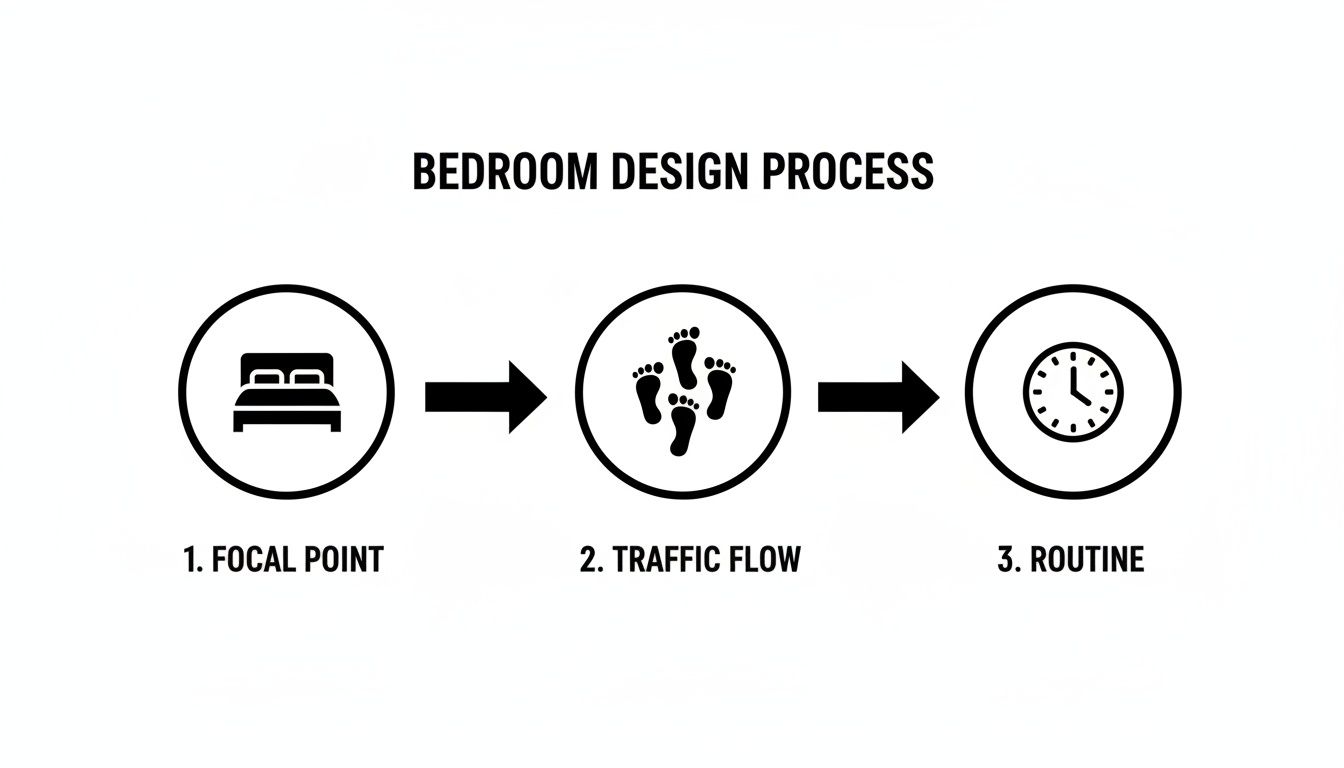
This simple flow—establishing a focal point, planning for traffic, and considering your daily routine—is the secret to a layout that’s not just beautiful but genuinely works for how you live.
A quick checklist can keep you on track. Here are the essential measurements to grab before you start planning.
Essential Bedroom Measurement Checklist
Use this checklist to accurately measure your bedroom and furniture before planning the layout.
| Measurement Item | What to Measure | Pro Tip |
|---|---|---|
| Room Dimensions | The length and width of the room from wall to wall. | Double-check your measurements to be sure. It's easy to misread a tape measure! |
| Ceiling Height | From the floor to the lowest point of the ceiling. | This is non-negotiable for canopy beds, tall wardrobes, or stacked storage. |
| Doors & Windows | Their width, height, and exact distance from the corners. | Also note the swing of the door—it eats up more floor space than you think. |
| Fixed Features | Location of all outlets, light switches, vents, and thermostats. | You don't want your headboard blocking your only convenient phone charging spot. |
With these numbers in hand, you have a solid foundation for building a functional and beautiful bedroom.
Measuring Your Furniture’s True Footprint
Once the room is mapped out, turn your attention to the furniture. Measure the width, depth, and height of every single piece. But don't stop there. For a dresser, pull a drawer all the way out and measure how much clearance it needs. If you have a recliner, measure its footprint when fully extended. This is how you avoid those "oops" moments, like realizing your nightstand drawer can't open because it hits the bed frame.
A common mistake is underestimating the "visual weight" of furniture. A piece might physically fit, but if it's too tall or bulky for the room, it can make the entire space feel cramped and unbalanced.
Bringing these precise measurements with you to our Virginia Beach showroom is a game-changer. When you share your floor plan with our team at the Willis Furniture & Mattress Design Center, you’re moving beyond inspiration and into action. Our designers can use your exact numbers to offer tailored advice, ensuring that the American-made nightstand from a premium brand like Barclay Butera you love will fit perfectly, or that a new Stressless recliner has the clearance it needs. You can learn more about this process and get additional tips by exploring our guide on how to plan a room layout.
This preparation empowers you to make confident decisions, bridging the gap between a dream bedroom and a functional, beautifully arranged reality.
Positioning Your Bed as the Focal Point
With your room mapped out, it's time to place the most important piece of furniture you own: your bed. In interior design, the bed is almost always the star of the show. It’s the anchor, the centerpiece, and the first thing your eye should land on when you walk in. Getting this right is the key that unlocks the rest of your layout.
Think of it this way—where you place your bed dictates the entire energy and flow of the space. It sets the tone for relaxation and comfort, so this decision deserves some careful thought. The goal is a spot that feels secure, balanced, and just plain good.

Embrace the Command Position
Have you ever heard a designer mention the "command position"? It’s a concept with roots in Feng Shui, but its practical benefits are universal. The idea is simple: place your bed where you can see the door without being directly in line with it.
This placement taps into a primal sense of security. On a subconscious level, it helps you feel in control of your environment, which promotes deeper relaxation and better sleep. Ideally, this means the bed is positioned diagonally across from the doorway.
Of course, not every room allows for this perfect setup. If your only option is the same wall as the door, just shift the bed as far from the doorway as you can to create a less direct line of sight.
Find Your Anchor Wall
The most common—and often best—strategy is to place the head of your bed against the longest, most solid wall in the room. This approach creates an immediate sense of balance and grandeur, making the bed a clear and powerful focal point.
A long, uninterrupted wall provides a beautiful canvas. It gives you the space to flank the bed with matching nightstands and lamps, creating a satisfying symmetry that’s naturally calming to the eye. This classic arrangement makes placing the rest of your furniture feel intuitive and straightforward.
Pro Tip: Try to avoid placing your bed directly under a window. It can block natural light, create uncomfortable drafts, and make the window tricky to open. If it’s your only option, a tall, sturdy headboard can create a visual buffer and a sense of stability.
What if you have two windows on that main wall? Even better. Centering your bed perfectly between them creates a stunning architectural frame. It draws attention to both the bed and the view, resulting in a layout that feels intentional and high-end.
Navigating Tricky Architectural Features
Bedrooms aren't always simple rectangles. Slanted ceilings, awkwardly placed closets, or a fireplace can make positioning the bed a real puzzle.
Here’s how we handle a few common challenges:
- Slanted Ceilings: In a room with an A-frame or slanted ceiling, always place your bed against the tallest wall. This maximizes headroom and keeps the space from feeling cramped or claustrophobic when you’re sitting up in bed.
- A Non-Centered Fireplace: Treat the fireplace as a secondary focal point. Position the bed on the longest adjacent wall to balance the room, rather than trying to force a symmetrical layout that just won't work.
- Built-in Shelving or Nooks: Use these features to your advantage! A built-in nook can be the perfect spot to tuck your headboard into, creating a cozy, enveloped feeling that’s incredibly inviting.
No matter the architectural quirks, the goal is to create balance. If you need a hand visualizing how to arrange bedroom furniture in a tricky room, our experts at the Willis Design Center thrive on these challenges. They can create a custom floor plan that turns your room's oddities into its greatest strengths.
Your Bed Frame and Mattress Matter
Bed placement is one part of the equation; the bed itself is the other. A commanding headboard can transform a simple bed into a breathtaking centerpiece. A piece from a premium brand like Barclay Butera, with its sophisticated design and American-made quality, instantly elevates the entire room. Investing in a premium brand is more accessible than you think with our flexible financing options.
And just as important is the comfort of your mattress. The most beautifully arranged room won't feel right if you aren't getting restorative sleep. Our exclusive BedMatch technology uses over 1,000 scientific calculations to identify the perfect support level for your body, ensuring your new layout delivers on both style and wellness. To get a better idea of what might work for you, you can explore our guide on how to choose the best mattress size for your home.
By pairing the perfect placement with the perfect bed, you create a true sanctuary.
Arranging Storage and Seating for Functionality
With your bed anchored in its perfect spot, the rest of your bedroom layout starts to feel intuitive. Now comes the fun part: placing the supporting cast of characters—your dressers, nightstands, and any seating—that make your daily routines seamless. This is all about striking that perfect balance between function and flow, making sure every piece serves a purpose without cluttering the space.
The goal is to create a natural harmony between your furniture and the room itself. A nightstand should be a convenient partner to your bed, not an awkward obstacle. A dresser needs breathing room for its drawers to open all the way. Nailing these details is what elevates a room from a simple collection of furniture to a truly cohesive, functional retreat.
Balancing Scale and Clearance
Before you start sliding furniture around, let’s talk about two crucial design concepts: scale and clearance. Scale is all about how the size of one piece relates to another and to the room as a whole. A tiny, delicate nightstand will look completely lost next to a huge, king-sized bed, just as an oversized dresser can swallow a small room whole.
A great example is the relationship between your nightstands and mattress. As a general rule, we recommend choosing nightstands that are within a few inches of your mattress height. This creates a pleasing visual line, but more importantly, it means you won't be fumbling in the dark to reach your glass of water.
Proper clearance is just as vital for creating a room that feels easy to move through.
- Walkways: Try to leave at least 30 inches for major traffic paths, like from the doorway to the closet or around the foot of the bed.
- Drawer Space: You’ll want enough room in front of a dresser to pull the drawers completely out, which typically means about 36 inches of clear space.
- Beside the Bed: For a shared room, aim for a minimum of 24 inches on both sides of the bed to avoid feeling cramped.
These aren't just random numbers—they are the real-world measurements that define how comfortable a room feels. A layout that respects these clearances will feel instinctively more relaxing and usable.
Creating Functional Zones
Think of your bedroom as more than just a place to sleep. By arranging your furniture strategically, you can carve out dedicated zones for different activities, making the entire room more organized and versatile.
For instance, you can easily create a dedicated dressing area. Just place a beautiful American-made dresser against an empty wall, hang a mirror above it, and you’ve got a self-contained spot for getting ready. This is a fantastic opportunity to feature a unique, budget-friendly decor find from the Willis Outlet, where you can discover high-quality pieces at an incredible value.
Another one of our favorite ideas is to build a cozy reading nook. A comfortable chair from a premium brand like Stressless, tucked into a corner with a small side table and a floor lamp, instantly becomes a private escape. Investing in a world-renowned recliner like this is an investment in your well-being, and our flexible financing options make it easier than ever to bring that level of comfort home.
It's amazing how much of an impact smart furniture choices can make. Industry reports show that space-saving pieces like modular beds and wall-mounted nightstands can save an average of 18 square feet per room. In dense urban areas, a staggering 60% of new bedroom designs incorporate multifunctional furniture to combat shrinking living spaces. You can discover more insights about bedroom furniture market trends to see how layouts are evolving.
Unifying Your Look with Custom Touches
As you place your final pieces, you might notice that furniture from different collections doesn’t feel perfectly coordinated. This is a common design challenge, but we see it as an opportunity to add personal touches that tie the whole room together. This popular design trend of mixing and matching styles is something our experts excel at personalizing.
Custom upholstery is one of the most effective ways to create a unified, designer look. Imagine a storage bench at the foot of your bed and the chair in your reading nook, both upholstered in the same complementary fabric. This simple repetition looks intentional and polished, making the entire space feel professionally styled.
Our in-house Design Center specializes in exactly this kind of personalization. Our expert designers can guide you through hundreds of fabrics to create a cohesive palette that connects your bed, seating, and even window treatments. It’s a perfect example of the Willis Standard in action—we bridge the gap between a standard layout and a truly personalized sanctuary. For more ideas on how to get the most out of your furniture, check out our guide on essential features to look for in bedroom storage furniture.
Layering Rugs, Lighting, and Accessories
Once your core furniture is set, it's time for the fun part—adding the layers that make a room feel like a home. Rugs, lighting, and accessories are the final touches that infuse personality and warmth, transforming a functional layout into a genuine sanctuary. This is where the magic happens, where a room really comes alive.
A great rug is the foundation of this final stage. It anchors the furniture, defines different zones, and adds that crucial layer of texture and comfort underfoot. Getting the size right is everything. For a queen or king bed, you’ll want the rug to extend at least 18 to 24 inches beyond the sides. This gives you a soft spot to land your feet in the morning.

That generous border ensures the rug looks proportional to the bed, not like a tiny postage stamp floating in an ocean of flooring. If you're looking for that perfect piece, you have to visit the Willis Rug Market in Hampton Roads. Our collection is massive, with everything from hand-knotted heirlooms to modern textures that will tie your whole room together.
The Art of Layered Lighting
Great lighting is so much more than a single overhead fixture. To create real atmosphere and function in a bedroom, you need to think in layers. We always aim for three distinct types of light working in harmony.
- Ambient Lighting: This is your room’s general, all-over light, usually from a ceiling fixture or recessed cans. It sets the base level of brightness.
- Task Lighting: This is focused light for specific activities. Think of the lamps on your nightstands for reading or a small desk lamp in a corner workspace.
- Accent Lighting: This is the jewelry of the room. It’s the subtle light that highlights artwork, an architectural detail, or a beautiful plant, adding depth and drama.
By combining all three, you can craft the perfect mood for any time of day, whether you need a bright, energizing space in the morning or a soft, relaxing glow at night. This approach has become even more critical lately. Since 2020, we've seen a huge shift, with 55% of people rearranging their bedrooms into multi-functional "hybrid" spaces for both sleep and work.
Adding Personality with Accessories
Now, let's make the space truly yours. Accessories are the final brushstrokes that inject character and tell your story.
The most common mistake I see is simply adding too much stuff. Instead of cluttering every surface, be selective. A few meaningful pieces will always feel more serene and impactful than a room full of clutter.
A large mirror is a great place to start. Hanging one on the wall opposite a window is a classic designer trick for a reason—it bounces natural light around, making the whole room feel bigger and brighter. You can find stunning, budget-friendly decor like mirrors and art at the Willis Outlet.
Next, bring in art that you absolutely love. A large statement piece over the dresser or a curated gallery wall can act as a beautiful secondary focal point. And don't forget to add a bit of life with plants! A touch of green softens hard lines, improves air quality, and instantly makes a room feel more tranquil.
Once your furniture is perfectly placed, these are the details that create a polished, professional look. And if you really want to tie it all together, think about how you could update your home with new custom window treatments to complement your new layout. Coordinating every last detail is how you create a truly complete and beautiful home.
Your Dream Bedroom is Closer Than You Think
You've got the principles down, you've measured your space, and you've thought about those finishing touches. Now for the exciting part—turning that plan into a reality. A thoughtfully arranged bedroom isn't just something you see in magazines; it's a calm, functional retreat that is absolutely within your reach.
This guide gives you the blueprint, but bringing it all together is where the magic really happens. We’d love for you to bring your measurements, inspiration photos, and ideas down to our Virginia Beach showroom. Let’s work together to bridge that final gap between your vision and your new favorite room.
Where Your Vision Becomes a Plan
At Willis Furniture & Mattress, we're more than just a furniture store. We’re a family business that’s been helping our neighbors in Hampton Roads create beautiful homes for generations. We truly believe in taking your inspiration and turning it into a concrete plan you can get excited about.
Our talented team at the in-house Willis Design Center is here to offer personalized guidance. We can help you find the perfect American-made pieces that fit your room’s scale and your personal style. Our designers can even create a custom floor plan to solve those tricky layout challenges, making sure every single piece works in perfect harmony.
Your home should be a reflection of your life's best moments. We're here to help you create the perfect backdrop for them with quality furniture, expert guidance, and a commitment to service that has defined our family business for generations.
Making It All Happen
Creating your ideal space should be a fun journey, not a stressful task. We’ve built our entire experience around that belief, ensuring everything is seamless from the moment you walk in.
- The Science of Perfect Sleep: Our exclusive BedMatch system uses advanced technology to find a mattress with the ideal support for your body. It’s the key to ensuring your beautifully arranged room also delivers truly restorative sleep.
- Style for Every Budget: If you're looking for exceptional quality and value, the Willis Outlet is your go-to. It’s filled with stylish, budget-friendly decor and furniture finds.
- Invest in Quality, Flexibly: Eyeing a premium brand like Barclay Butera? Our flexible financing options through Synchrony make it possible to invest in the lasting quality you deserve, without compromise.
From our white-glove delivery service to personalized design advice, we are here to help you create a beautiful, functional bedroom you’ll love coming home to for years to come.
Common Bedroom Layout Questions
Even with the best plans, a few tricky questions always seem to surface right when you think you’ve got it all figured out. Over the years, our designers have heard just about every layout dilemma in the book. Here are their go-to answers for the most common furniture arranging challenges we see.
What Is the Best Way to Arrange Furniture in a Small Bedroom
When you're working with a smaller footprint, the name of the game is maximizing every square inch. Your new mantra should be: think vertically and multifunctionally.
The goal is to open up as much floor space as possible. Try pushing the bed against the longest wall or tucking it into a corner. Opt for taller, narrower dressers instead of wide, low ones—this draws the eye up and frees up that precious floor real estate. Wall-mounted shelves are another one of our favorite tricks. And don't underestimate a good bed frame with built-in drawers; it’s a lifesaver for stashing extra linens or seasonal clothes.
Designer's Secret: For stylish, space-conscious pieces that don't feel like a compromise, check out the unique, budget-friendly decor and furniture finds at the Willis Outlet. You can often score the perfect solution for a smaller room.
How Much Space Should I Leave Around My Bed
A bedroom should feel like a retreat, not an obstacle course. Easy, comfortable movement is what creates that feeling of calm. A good rule of thumb is to leave 30-36 inches for your main walkways, like the path from the door to the closet.
If two people share the bed, try to give each side at least 24 inches of clearance. This simple buffer makes getting in and out of bed so much easier—no more bumping into walls or shuffling sideways. If you’re struggling to make it work, our Willis Design Center experts can map out a precise floor plan for your exact dimensions, taking all the guesswork out of creating a layout with perfect flow.
Where Should I Place a Dresser in a Bedroom
The perfect spot for your dresser really depends on your room's unique layout, but one of the most effective strategies is to place it on the wall opposite the bed. Doing this creates a sense of visual balance and harmony. A beautiful dresser can also be the perfect piece to anchor a long, empty wall.
Just remember the practical side: you’ll need about 36 inches of clearance in front to open drawers without any trouble. Our design consultants can help you find just the right American-made dresser from incredible premium brands like Barclay Butera, and then figure out its ideal home in your new layout. Our flexible financing options make investing in these legacy pieces more accessible than ever.
At Willis Furniture & Mattress, we're here to help you create a home that's as functional as it is beautiful. Visit our showroom and let's start designing your perfect space today.


