
How to Clean a Wool Area Rug at Home: Step-by-Step Guide

A tipped wineglass, muddy pawprints, or a dull patch beside the sofa can make a wool rug look ready for a full wash. The tempting response is a bucket of suds and a hard scrub. That's often how a manageable cleaning job becomes a permanent color change, distorted edge, or damp backing.
Learning how to clean a wool area rug at home starts with a less dramatic approach: remove dry soil regularly, treat spills locally, and keep moisture out of the foundation. Dirt causes wear over time, but aggressive cleaning can cause damage immediately.
Routine Vacuuming That Protects Wool Fibers
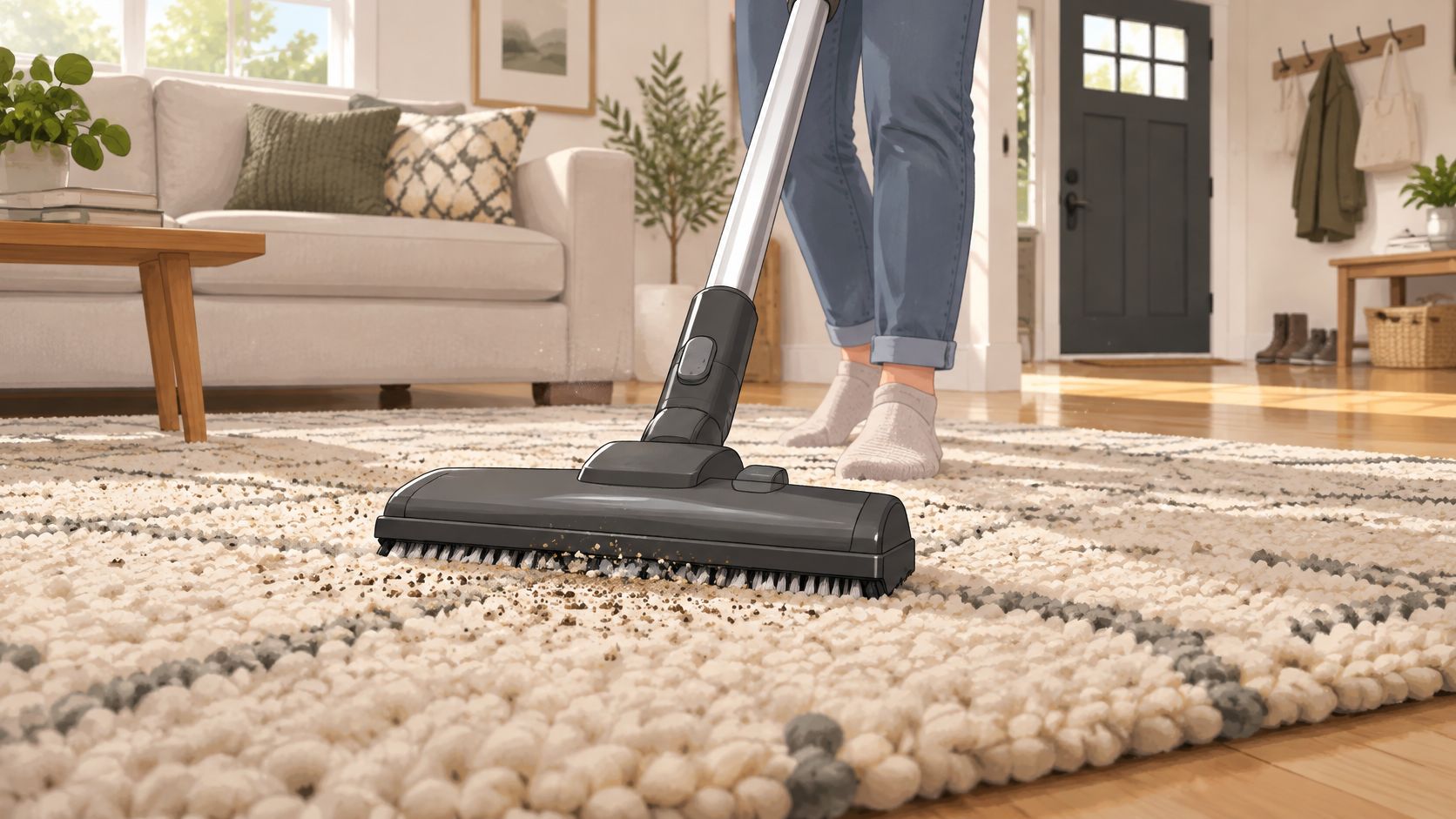
Grit settles between wool fibers, where foot traffic presses it against the pile. Frequent, gentle vacuuming removes that abrasive material before a rug looks visibly dirty.
The WoolSafe Organisation recommends vacuuming high-traffic areas such as entryways and hallways daily in an average household, and the rest of the home two or three times per week. For thorough cleaning, it advises three or four passes north-to-south and three or four east-to-west, approximately six to eight directional passes altogether.
Match the Vacuum to the Pile
Suction-only cleaning protects loop pile from snagging. A brush-assisted upright can suit sturdy cut pile, provided the brush doesn't pull fibers or make the rug lift from the floor. Lower suction when a lightweight rug catches under the head.
Vacuuming frequency and method by zone
| Zone | Frequency | Method |
|---|---|---|
| High-traffic zones such as entryways and hallways | Daily in an average household | Suction only for loop pile; brush-assisted upright for cut pile |
| Rest of the living space | Two or three times per week | Same settings, three to four passes each direction |
| Rug before any damp treatment | A thorough session before cleaning | Suction only, working in both directions |
| Fringe and thin edges | Weekly check | Hand tool or suction nozzle, never a beater bar |
Keep rotating brushes away from fringe and worn edges. A busy hallway may benefit from an extra light pass during pet-shedding season or after muddy weather, once tracked soil has dried.
Practical rule: A vacuum should lift loose soil, not pull the rug apart.
Lift a corner periodically and inspect underneath for grit that has worked through. Vacuum the exposed floor before replacing the rug; otherwise, dirt remains trapped beneath it.
A recurring reminder makes this maintenance easier to sustain. After a month, adjust the routine according to how much grit the initial pass collects, not just whether the surface looks clean. The durability discussed in these wool rug benefits depends on removing abrasive soil without repeatedly roughening the fibers.
Check the Rug Before Any Liquid Touches It
The care label takes priority over a generic cleaning recipe. Where letter codes appear, W permits water-based cleaning, S means solvent-only, W/S permits either specified method, and X means vacuum-only care rather than liquid spot cleaning.
These codes are common on upholstery but aren't a universal rug-labeling system. A missing label doesn't establish permission to use water or solvent. Seller records or the manufacturer's care guidance should settle that question before treatment.
Identify the Whole Rug, Not Just the Surface
A wool face can conceal cotton foundations, jute backing, adhesive, or synthetic components. Those materials react differently to moisture, and a surface that feels nearly dry can hide a wet foundation.
- Fiber content: Check for silk and other blends, not just the word wool.
- Construction: Identify loose loops, glued backing, fragile edges, and existing repairs.
- Condition: Look underneath for discoloration, crumbling adhesive, or a musty smell.
- History: Record dimensions, previous cleaning, and the likely stain source.
This comparison of hand-knotted rugs and hand-tufted rugs helps explain why construction changes the cleaning decision. Antique, hand-knotted, and silk-blend pieces deserve professional assessment rather than an experimental home wash.
Check Product Compatibility
Household surface cleaners aren't substitutes for wool shampoo. Fillaree's discussion of cleaner dwell time and surface safety offers useful context for checking surface compatibility, but it isn't approval to apply an all-purpose cleaner to wool.
Even an appropriate rug cleaner needs a hidden-area test. The product, water, and dye must work together without changing color or texture.
Spot Treatment for Wine, Pet Urine and Mud
The first minute is for removing contamination, not scrubbing it away. Scoop solids with a spoon, then press a clean white towel or absorbent tissue onto liquid.
The WoolSafe carpet-cleaning guide recommends blotting from the outer edge toward the center, avoiding rubbing, and rinsing without saturating the rug. A white towel also makes transferred dye easier to recognize.
Choose the Treatment by the Stain
Stain first aid for wool rugs
| Stain | First action | Cleaner to try | Avoid |
|---|---|---|---|
| Red wine | Blot from the outer edge inward with a clean white towel | Cool water, then a water-based wool spot cleaner | Hot water, rubbing, and bleach |
| Pet urine, fresh | Blot, then rinse lightly with cool water | A pH-neutral enzyme cleaner explicitly suitable for wool, tested first | Ammonia, whose smell can encourage repeat marking |
| Pet urine, dried | Blot any surface moisture; reassess if odor returns after treatment | A wool-approved, pH-neutral enzyme cleaner | Scrubbing with a stiff brush |
| Mud, dried | Let dry, then vacuum out loose soil | Cool water and mild wool shampoo | Scrubbing wet mud, which pushes grit deeper |
| Unknown greasy or oily stain | Use an appropriate solvent before a water-based agent | Wool-safe solvent, tested first | Water alone, which doesn't effectively remove oil |
Apply cleaner to the cloth rather than pouring it onto the spot. Fold the towel frequently so a clean face absorbs the next blot instead of returning contamination to the pile.
For wine, a light cool-water rinse means a damp cloth pressed against the affected fibers, not a stream from a jug. A stubborn mark may fade gradually, but repeated wetting isn't a safe substitute for professional stain removal.
Treat Pet Odor Without Damaging Wool
Enzyme chemistry matters because wool is a protein fiber. pH-neutral doesn't automatically mean wool-safe; some enzyme formulations can attack the fiber, so explicit wool compatibility is essential.
Evo Dyne Products' overview of enzyme cleaners for pet urine odors explains the odor-removal approach, but product suitability still requires checking. Dried urine that has reached the foundation usually needs more than surface treatment.
Stop after two gentle treatment rounds. Dye transfer, a changing color, or moisture reaching the backing ends the home attempt immediately.
For households with recurring accidents, choosing an appropriate construction matters as much as choosing a cleaner. These considerations for area rugs in homes with pets can help reduce future maintenance problems.
How to Deep Clean a Wool Rug Step by Step
Wool needs less water and less agitation than most homeowners expect. This method is a controlled surface clean for a sturdy, colorfast rug with suitable care instructions, not a substitute for professional immersion washing.

Prepare for Controlled Moisture
Gather a vacuum, soft sponge, clean white towels, separate wash and rinse containers, and pH-neutral wool shampoo. Prepare a drying location before starting; a wet rug shouldn't remain on hardwood or over its pad.
Remove loose soil. Vacuum thoroughly using the appropriate pile setting and inspect underneath. Skipping dry preparation turns trapped grit into muddy residue.
Test a hidden corner. Apply the diluted cleaner sparingly, allow the prescribed contact time, and press with a white cloth. Check again after drying for dye transfer, stiffness, or a changed pile texture; a brief wet inspection alone isn't enough.
Mix a mild solution. Use pH-neutral wool shampoo at its stated dilution in lukewarm water, approximately 20 to 30 degrees Celsius. Measure the concentrate rather than adding an extra splash, and exclude bleach and hot water.
Clean small sections. Work across an area about a forearm wide with a sponge wrung until it doesn't drip. Move gently with the pile; a slick, foamy surface indicates too much solution.
Remove cleaner residue. Use a separate sponge dampened with clean water, moving in the same direction. Wring it between passes rather than repeatedly adding rinse water to an already wet section.
Blot out moisture. Press dry white towels onto the pile and lift them straight off. Replace damp towels promptly; rubbing can leave a fuzzy patch even when the stain disappears.
Support the rug for drying. Lay it flat on a clean, moisture-safe surface with airflow underneath, or use a broad breathable rack. Keep the wet rug supported so its weight doesn't stretch an edge or crease the foundation.
Know What This Method Cannot Fix
Flooding the backing can cause wicking, where dissolved contamination travels upward during drying. Browning may appear at the fringe, while wet cotton or jute foundations can swell and remain damp long after the wool surface feels dry.
Eco Clean Solutions' guidance on minimal-moisture wool carpet care reinforces the value of controlling moisture. Carpet shampoos intended only for synthetics aren't interchangeable with wool products, and inadequately removed detergent attracts fresh soil.
Steam machines and domestic hot-water extractors add risks that hand blotting avoids. For example, extracting a wine spot on an unstable hand-knotted rug can spread dissolved dye into the surrounding field and leave a permanent ring.
A successful result has even pile, unchanged color, and a neutral smell when dry. Appropriate care helps preserve the texture that makes wool area rugs appealing in the first place.
Drying a Wool Rug Without Shrinking or Mildew
Wool can feel dry at the tips while remaining damp at the base. Safe drying requires moving air across both faces, not heat concentrated on the surface.
A lightly treated spot dries differently from a thoroughly wet rug, so a clock alone can't establish readiness. Humidity, pile density, foundation material, and the amount of retained water all affect the result.

Use Airflow Rather Than Heat
Flat drying with broad support is the safest default. A small, sturdy rug may dry over a broad rail in shade if its care instructions permit, but a narrow clothesline can crease a heavy wet rug.
Keep it away from direct sun, radiators, heaters, and hot hair dryers. Concentrated heat can distort the rug, while strong sunlight can fade dyes.
Run a fan on low to circulate room air across the drying area. Turn the rug carefully when its structure can support handling, allowing the underside to receive air without stretching wet corners.
In humid Hampton Roads weather, outdoor shade may offer less drying power than an air-conditioned room. A dehumidifier helps remove airborne moisture; a fan alone can't lower the room's humidity.
Check Before Returning It to Service
- Pile base: Separate the fibers and feel near the foundation, not just the tips.
- Backing: Lift the rug and check underneath for dampness.
- Odor: A musty smell calls for assessment rather than fragrance.
- Shape: Confirm that edges lie straight and corners haven't curled.
A dry-looking surface isn't proof that the foundation is ready for a rug pad.
Arrange fringe gently while it's still slightly damp. Once the whole rug feels dry, allow additional airing before replacing furniture and the pad. Any developing musty odor or persistent wet foundation warrants professional help.
Decide Whether to DIY or Call a Professional
Home care makes sense for routine soil and fresh, localized stains on a sturdy, colorfast wool rug. Professional cleaning is the safer option when the problem reaches the foundation or the rug's construction makes experimentation expensive.
Antique, hand-knotted, and silk-blend rugs belong in that second category. So do large unknown stains, suspected mold, persistent mustiness, and marks that remain after restrained spot treatment.
Compare the Scope, Not Just the Price
Professional rug cleaning costs in 2025
| Service | 2025 price | Best fit |
|---|---|---|
| Professional washing, per square foot | Wool-rug washing cost $3 to $8 per square foot, according to HomeAdvisor. | Large or dense wool rugs |
| Standard rug cleaning, per rug | Professional rug cleaning generally cost $80 to $400 per rug, averaging $175 for a standard rug, according to Angi. | Most room-size wool rugs |
| Typical 8-by-10-foot rug | A standard 8-by-10-foot rug averaged $100, according to Thumbtack. | Routine professional cleaning |
| Hand-knotted oriental and silk, per square foot | Premium professional cleaning was reported at $4 to $12 per square foot, according to DataIntelo. | Valuable, antique, or silk-blend rugs |
These historical estimates describe different services and pricing bases, not interchangeable quotes. A surface clean, controlled wash, and urine-decontamination treatment can involve different work.
Ask What the Quote Includes
Before booking, establish whether the service includes pickup, washing, controlled drying, and delivery. Ask whether the cleaner tests colorfastness and construction before selecting the method, and whether stain or odor treatment costs extra.
Prepare the rug's size, fiber content, approximate age, stain history, and previous treatments. Photographs of the face, backing, label, and affected area help the cleaner assess whether transport or specialist handling is needed.
For a household that repeatedly needs wash-through cleaning, a different rug construction may be more practical. This guide to washable area rugs explains an alternative worth considering rather than repeatedly soaking unsuitable wool.
If replacement becomes necessary, the Rug Market in Virginia Beach offers hundreds of hand-knotted, artisan, and one-of-a-kind rugs, with flexible financing plans available for a larger purchase. Preserving a valuable existing piece, however, usually starts with stopping home treatment before the damage becomes permanent.
Willis Furniture & Mattress offers rug selection and Design Center guidance to coordinate a replacement with the room's furniture, lighting, and everyday maintenance needs. Visit Willis Furniture & Mattress to explore the Rug Market, discuss financing options, or consider budget-friendly finds at the Willis Outlet.