
Power Recliner vs Manual Recliner: A 2026 Buyer’s Guide


A couple walks into a furniture showroom looking for one simple answer: power recliner vs manual recliner. One person tests a lever-back chair, enjoys the quick mechanical motion, and assumes the lower price settles the matter. The other presses a button on a powered model, adjusts the back and leg rest separately, and realizes that “comfortable” can mean something very different after a full evening, a difficult recovery, or a long caregiving day.
That showroom decision gets expensive when buyers test only the cushion and fabric. The right chair must fit the user's strength, the room's outlet and wall clearance, the household's daily habits, and the owner's tolerance for maintenance. The question isn't which mechanism feels better for ten seconds. It's which chair will still make sense after years of sitting, repairs, outages, and changing mobility needs.
The Showroom Moment Most Buyers Get Wrong
The couple sits in two chairs side by side. The manual recliner opens with a firm pull, the footrest snaps into place, and the seat feels familiar. The power recliner moves more slowly, but its back and leg rest stop exactly where the user wants them. Within minutes, both shoppers have discovered that their assumptions about price and comfort don't match the experience.
That's where many families choose incorrectly. They compare upholstery, cushion softness, and showroom appearance, but they don't test the actions they'll repeat every day. Can the person using the chair operate the mechanism without shoulder or wrist strain? Will the chair sit near an outlet without creating a cord hazard? Does the user need one relaxed position, or several small adjustments throughout an evening?
A manual recliner uses physical effort, but its simplicity has real value. It doesn't depend on electricity, electronic controls, or a motor. A power recliner reduces effort and allows more precise positioning, but it introduces components that may eventually need service. Neither answer is automatically right for every household.
Showroom rule: The best recliner is the one the primary user can operate comfortably at the end of an ordinary, tiring day.
The couple should also test the chair from upright to standing, not just from sitting to lounging. A senior may struggle with a lever even if the chair feels comfortable. A healthy adult may dislike a cord, heavier frame, or slower movement when a manual model would serve perfectly. A family furnishing a tight room may need a wall-hugging design, while a household planning long movie nights may value independent back and leg-rest adjustment more than easy rearrangement.
For shoppers considering floor samples or immediate availability, the Willis Furniture floor-sample selection can help them evaluate actual chairs rather than relying on photographs. The practical test remains the same: sit upright, recline gradually, return to upright, extend the footrest, and stand without rushing.
The choice also carries a longer ownership question. Power models now lead recent global market estimates, with power recliners representing about 58.3% of unit sales and 63.2% of revenue in 2025, while manual models represented 41.7% of unit sales in the same estimate (market data and mechanism comparison). Those figures show where shoppers are moving, not which chair belongs in every home.
What Sets Power and Manual Recliners Apart
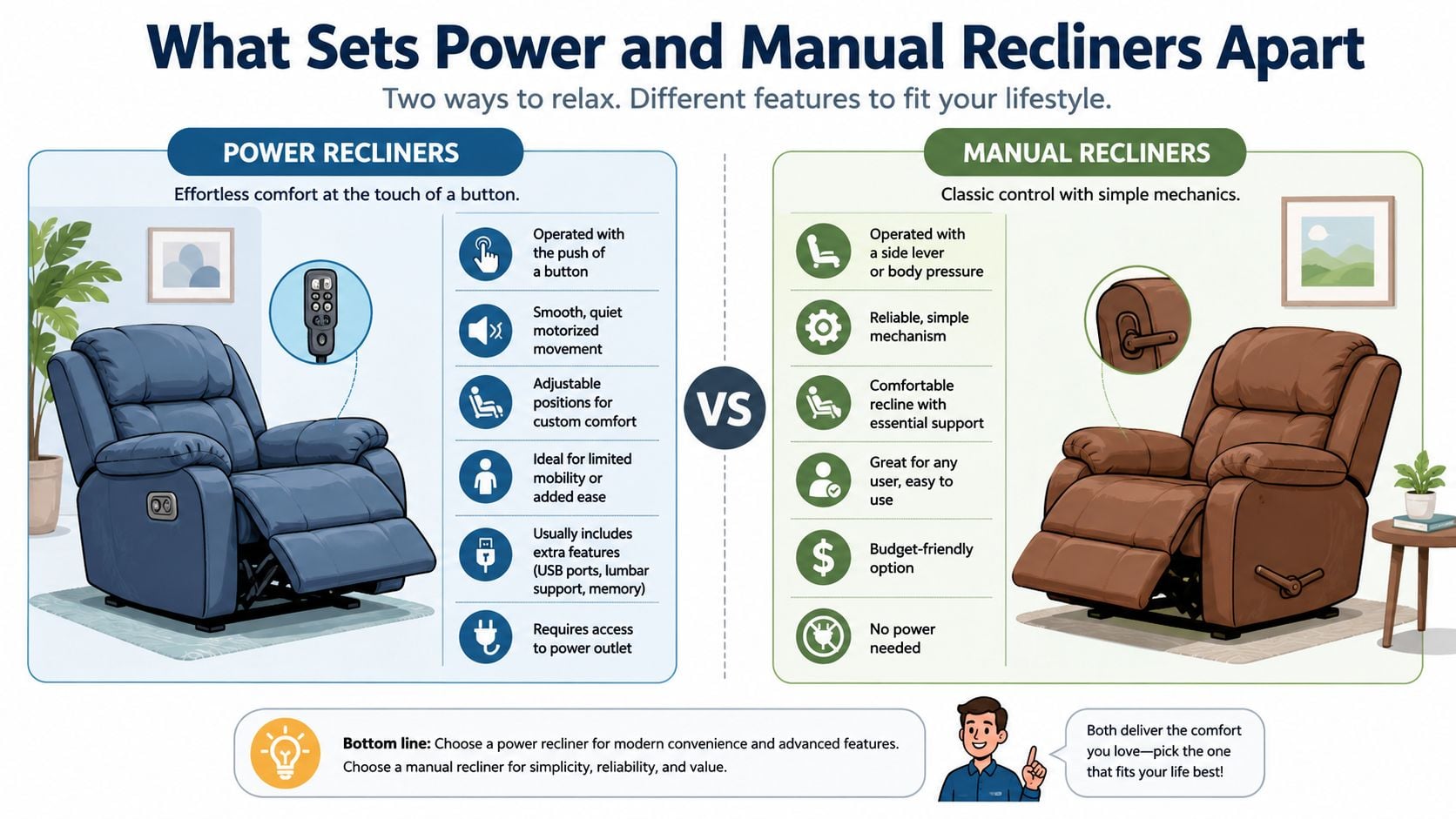
A manual recliner changes position through a lever, pull handle, body pressure, or push-back movement. The user supplies the force that releases or moves the mechanism. A power recliner uses an electric motor, commonly connected to a linear actuator, to move the backrest and leg rest through buttons or a remote.
The mechanical difference is straightforward:
- Manual operation: A lever or body-weight mechanism releases the footrest and back. The chair typically offers a limited set of positions.
- Powered operation: An electric actuator moves the chair while the user holds or taps a control. The backrest and leg rest can often move independently.
- Feature integration: Power models may add adjustable headrests, lumbar controls, USB ports, heat, or massage, depending on the design.
- Placement requirement: Manual chairs need no outlet. Power chairs need a safe electrical connection and thoughtful cord placement.
From mechanical furniture to motorized comfort
Manual recliners appeared first. An independent industry history places the recliner's origin in the late 1920s, when manually operated versions gained popularity in American homes. Power recliners emerged later as electric motors and remote controls turned reclining into a powered adjustment rather than a physical motion (recliner market history and product evolution).
That history still matters because the older mechanical design hasn't become obsolete. A two-position chair, three-position chair, push-back model, or wall-hugger manual recliner can be exactly right for a user who wants predictable operation and no electrical dependence. The newer powered format earns its premium by offering effortless movement and finer control.
The practical distinction is best understood as simplicity versus adjustability. Manual mechanisms keep the system lean. Power mechanisms let users make small changes to posture, leg elevation, and head support without shifting their body to force the chair into place. Buyers who want a more detailed explanation can review what a power recliner is before visiting a showroom.
Comfort, Positioning, and Daily Ergonomics
A ten-second showroom test hides the most important comfort difference. Manual chairs usually move into a few fixed positions, while power chairs generally provide nearly unlimited seat-back and leg-rest positioning, with the two sections moving independently.
That distinction becomes obvious during a full evening. A power user can raise the footrest slightly for television, recline farther for reading, or adjust the headrest to keep the neck aligned. A manual user may need to choose the closest available position and then shift the body to compensate.
Power vs Manual Recliner Comfort and Ergonomics Compared
| Feature | Power Recliner | Manual Recliner |
|---|---|---|
| Position control | Fine, incremental adjustment | Fewer fixed or body-driven positions |
| Back and leg-rest movement | Often independent | Commonly linked through one mechanism |
| Effort | Button-controlled, low physical effort | Requires a lever, push-back motion, or leg strength |
| Long sitting | Easier to tune posture during use | Comfortable when the available positions match the user |
| Best ergonomic advantage | Micro-adjustments for back, neck, and legs | Simple, predictable movement |
| Main compromise | Requires electricity and more components | Less precision and more physical effort |
Lumbar support and headrest alignment matter more than showroom softness. A seat that feels plush at first can still leave the lower back unsupported or the head tilted forward during a long program. Readers comparing support-focused designs can use this Posture Corporate Ergonomics image as a visual reminder that the head, shoulders, spine, hips, and legs need to work together.
Manual movement isn't bad. A healthy adult may enjoy the direct response of leaning back and using the legs to return upright. That physical interaction can feel quick and intuitive. For someone with arthritis, limited upper-body strength, balance concerns, or post-surgical restrictions, the same movement may become tiring or unsafe.
Which design rewards which routine
Power wins for long-duration sitting when the user needs frequent posture changes, raised legs, or effortless adjustment. It's also the stronger choice when two people of different heights share the chair and need different head, back, or footrest positions.
Manual wins when the user wants a chair that moves without a cord, prefers a quick mechanical response, or plans to relocate furniture often. For back-support priorities, shoppers can compare recliners designed for back support and then test whether the chair supports the body in both upright and reclined positions.
Durability, Maintenance, and the 10-Year Question
The simple ownership answer favors manual construction, but the frame matters more than the label. A manual recliner avoids motors, wiring, transformers, handsets, and electronic controls, so its failure profile is simpler. A power recliner adds convenience, but each electrical component creates another maintenance point.
Residential recliner mechanisms are commonly expected to withstand roughly 25,000 to 30,000 cycles under benchmarks associated with standards such as EN 1728 and BIFMA X5.4. That benchmark applies to the mechanism question, not the entire chair. Foam, fabric, springs, frame joints, and user weight still influence the service life.
10-Year Durability and Maintenance Snapshot
| Maintenance Factor | Manual Recliner | Power Recliner |
|---|---|---|
| Main mechanism | Lever, handle, pull strap, springs, and steel parts | Motorized actuator, wiring, transformer, and controls |
| Electrical dependence | None | Required for normal operation |
| Routine care | Clean upholstery, tighten hardware, lubricate moving joints | Clean upholstery, protect the power supply, inspect cords and controls |
| Likely aging points | Foam compression, fabric wear, hardware loosening | Foam and fabric wear, handset, wiring, actuator, or transformer |
| Repair complexity | Usually mechanical and straightforward | May require electrical diagnosis and component replacement |
| Long-term strength | Simpler failure profile | More adjustment capability, more components |
A manual chair can still fail. A stretched pull strap, worn spring, loose bolt, or tired cushion can make the chair unpleasant or difficult to use. Power chairs can also run reliably for years, especially when the frame and mechanism are well made. The point isn't that every power motor fails. The point is that a powered chair gives owners more parts to maintain.
Frame construction deserves closer attention than shoppers usually give it. Kiln-dried hardwood or a structural frame generally deserves more confidence than a lightly built frame, regardless of whether the chair is manual or powered. Upholstery can be cleaned or replaced, and foam can be renewed, but a weak frame limits every other investment.
Ownership test: Ask which component would be hardest to repair locally, then ask whether the chair's warranty and service process cover it.
A protection plan can also change the ownership calculation. Buyers reviewing coverage should read the Guardsman furniture warranty information carefully, especially for exclusions, service responsibilities, and the difference between upholstery coverage and mechanism coverage. A warranty isn't a substitute for construction quality, but it can reduce uncertainty around a more complex powered system.
Upfront Price, Long-Term Cost, and Smart Financing
Price sets the first boundary, but it shouldn't make the final decision. Manual recliners commonly fall between $300 and $900, while power models start near $800 and can exceed $3,000 for full-size lift-and-recline chairs. Those ranges come from the provided buying framework and should be treated as broad retail calibration, not a promise for any individual model.
Power models also use electricity. The added operating cost can be roughly $15 to $30 per year, depending on use and local rates, according to the provided comparison framework. That expense is usually less important than the purchase premium and the possibility of future service, but it belongs in a serious ownership discussion.
Calculate value by use, not sticker price
A manual chair is usually the better financial choice when the user needs basic reclining, has stable mobility, and plans moderate use. The buyer pays less initially and avoids electrical components. A power chair earns its cost when the household uses its positioning every day, needs lift assistance, or would otherwise struggle to remain comfortable in a fixed manual position.
The most useful calculation is cost per comfort hour. A chair used briefly and occasionally should face a stricter price test. A chair used every evening for reading, recovery, television, or sleep support may justify a larger investment because the household receives value repeatedly.
The financial comparison becomes less certain when repairs enter the picture. Manual mechanisms tend to need less technical service, while power buyers should ask about motor, handset, transformer, and warranty coverage before signing an order. Buyers shouldn't accept a vague promise that parts are “available.” They should ask who diagnoses the problem, who supplies the part, and who performs the repair.

Financing should protect the household budget
Financing works best as a planning tool, not as permission to overspend. A buyer can compare the complete chair cost, expected use, warranty, delivery, and possible service before choosing a payment structure.
Willis Furniture & Mattress offers financing options for qualified shoppers, including promotional plans that can spread a larger furniture purchase across a defined period. The buyer still needs to understand the terms, payment deadline, and interest conditions before accepting any offer.
A practical rule separates needs from decoration. Pay for lift assistance, independent positioning, supportive geometry, and durable construction when those features solve a daily problem. Skip massage, lighting, or extra controls if they won't be used.
Accessibility, Seniors, and Aging in Place
For older adults, the central question isn't whether a chair reclines. It's whether the chair reduces the effort required to sit, adjust position, and stand safely. Chair design research involving older or immobile users emphasizes pressure distribution, transfer demands, and manual handling outcomes, concerns that ordinary shopping guides often overlook (research on chair design for older and immobile users).
A manual recliner can serve an independent adult whose strength, balance, and hand function are stable. The lever may feel immediate and predictable, and the absence of a cord removes one placement concern. But a user with arthritis, limited shoulder motion, post-surgical restrictions, or reduced leg strength may struggle with the force needed to activate or close the mechanism.
A power recliner usually deserves the first test for a mobility-limited user. Button control reduces the need to pull, push, or shift body weight. A lift chair can also assist the transition toward standing, but the caregiver and user must test the movement together. The chair should bring the user forward in a controlled way without forcing the person to lean dangerously or twist.
Accessibility Outcomes by User Need
| Accessibility Need | Better Fit | Why It Matters |
|---|---|---|
| Limited hand or shoulder strength | Power recliner | Button control can reduce lever and pull effort |
| Stable mobility and preference for simplicity | Manual recliner | Direct operation requires no electrical system |
| Difficulty rising from a low seat | Power lift recliner | Lift assistance can support a standing-ready transition |
| Frequent posture changes | Power recliner | Independent movement allows finer adjustment |
| Concern about outage operation | Manual recliner or backed-up power model | Manual operation remains available without electricity |
| Tight living room | Wall-hugger power or compact manual model | Placement depends on wall clearance and room flow |
| Caregiver-assisted transfers | Power lift model after an in-home trial | The caregiver can assess clearance, timing, and stability |
Weight capacity must be verified against the specific product, not guessed from the category. The plan for a heavier user should include checking the manufacturer's stated rating, seat width, transfer clearance, and base stability. A high-capacity chair may be the right answer, but the exact rating belongs on the product specification sheet.
Power outages require a plan. Some power recliners include a manual override or release mechanism, while others may accept a battery backup port or similar system. The method depends on the model, and guidance describes options such as disconnecting the actuator or using a release lever to return the chair upright without normal power (power recliner outage and manual-release guidance).
Caregiver standard: If standing, transferring, or returning upright is a safety issue, an in-home trial matters more than a showroom promise.
Which Recliner Fits Your Home and Lifestyle
A clear recommendation framework starts with the person who will use the chair most, then checks the room, budget, and maintenance tolerance. The following household profiles expose the differences better than a generic list of features.
The young renter in a first apartment
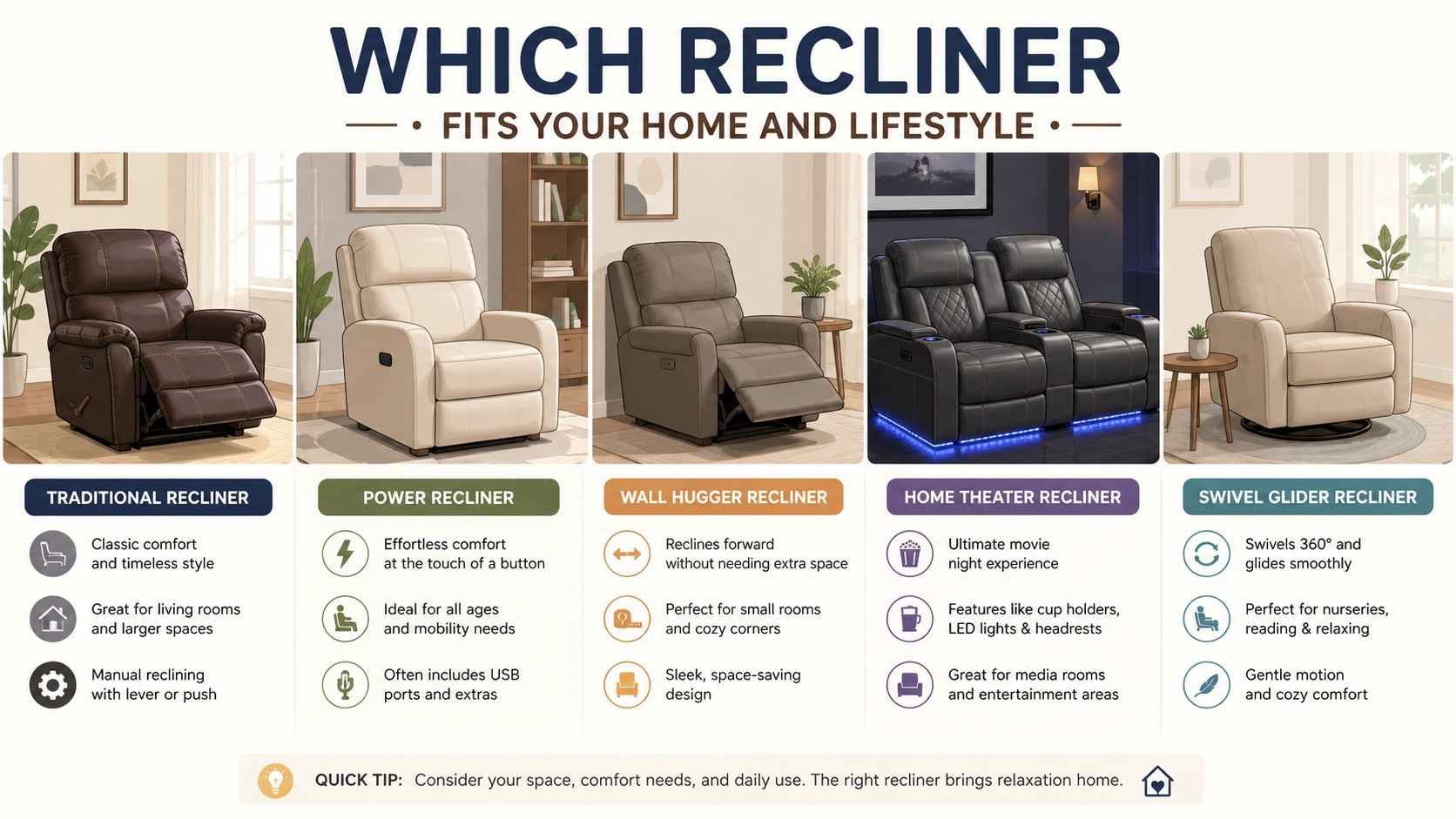
A manual recliner is usually the smarter starting point. It costs less, needs no outlet, and is easier to reposition when the apartment layout changes. A compact design with a clean silhouette can provide reading and television comfort without making the room feel dominated by a large motorized chair.
The exception is a renter with a specific mobility need or a long-term back-positioning requirement. In that case, a compact power model may earn its space, but the renter should confirm delivery access, cord routing, and the lease's furniture restrictions.
The busy parent
A manual chair suits a household that wants quick, durable seating for shared movie nights, reading, and naps. It's simple to operate and doesn't add another powered device to a crowded family room.
A power recliner makes more sense when one parent uses the chair for long periods or needs precise leg and back support. The chair should be tested with children nearby, especially around moving footrests and reachable controls.
The empty nester in a condo
A wall-hugger model can solve the common conflict between comfort and limited floor space. Power is valuable when the user wants small posture changes, but a manual wall-hugger remains the better fit when outlet placement, weight, or furniture rearrangement matters more.
Room planning should happen before purchase. The household needs to measure walking paths, side-table access, door swings, and the space required for the footrest.
The senior aging at home
Power is the default recommendation when the user has arthritis, reduced strength, balance concerns, or caregiver support. Lift assistance and low-effort controls can change the chair from a lounge seat into a daily mobility aid.
An in-home trial should check the seat height, transfer motion, control visibility, cord position, and the user's ability to return upright. If an outage would create a safety problem, the household should ask about a compatible backup or manual-release system before buying.
The home-theater enthusiast
Power seating generally wins for a media room because independent adjustment helps each viewer settle into a preferred viewing position. Manual seating remains attractive for buyers who want a lighter, simpler arrangement or who need to move chairs during room changes.
The showroom couple eventually chooses based on habits, not specifications. One person uses the chair briefly and values simplicity, while the other spends long evenings sitting and needs gradual positioning. Their final answer comes from the primary user's body, the room's constraints, and the household's willingness to plan for power and service.
Willis Furniture & Mattress can help shoppers compare manual and power recliners in person, while its Design Center can customize upholstery, scale, and room coordination around the selected chair. Buyers who want premium comfort should ask about available financing, and shoppers focused on lower-cost floor samples or overstock should also consider the Willis Outlet.
Visit Willis Furniture & Mattress to test power and manual recliners with the actual user who'll rely on the chair most. The showroom team can help match the mechanism to mobility needs, room layout, comfort goals, and budget, then arrange the right next step for delivery and setup.