
Your Guide: How to Pull Out Table from Cabinet

A pull out table from cabinet usually looks like a clever little luxury until the day it sticks, drops on one side, or refuses to glide back in. That's when a hidden feature turns into a repair question, a cabinet question, and sometimes a replacement question all at once.
For many homeowners, the problem starts during a kitchen refresh. The cabinet is being painted, the flooring is changing, or the table itself has gone wobbly after years of use. Others inherit one in an older kitchen and aren't even sure how the hardware works. That uncertainty matters because a pull-out table isn't just a drawer with a bigger face. It's a moving surface that depends on alignment, slide condition, and cabinet strength.
Table of Contents
- From Hidden Gem to Headache Why You Need to Remove Your Cabinet Table
- Tools and Triage Identifying Your Pull-Out Table System
- How to Safely Remove Your Pull-Out Cabinet Table
- What to Do When Your Pull-Out Table Misbehaves
- Reinstalling Your Table for Smooth and Stable Use
- Professional Solutions for Complex Cabinet Systems
From Hidden Gem to Headache Why You Need to Remove Your Cabinet Table
A common call starts with the same description. The table used to slide out easily, then it began rubbing, then someone leaned on it during dinner, and now the whole thing feels off. In some homes, the issue isn't failure at all. The homeowner needs the table out of the way so the cabinet can be repaired or replaced.
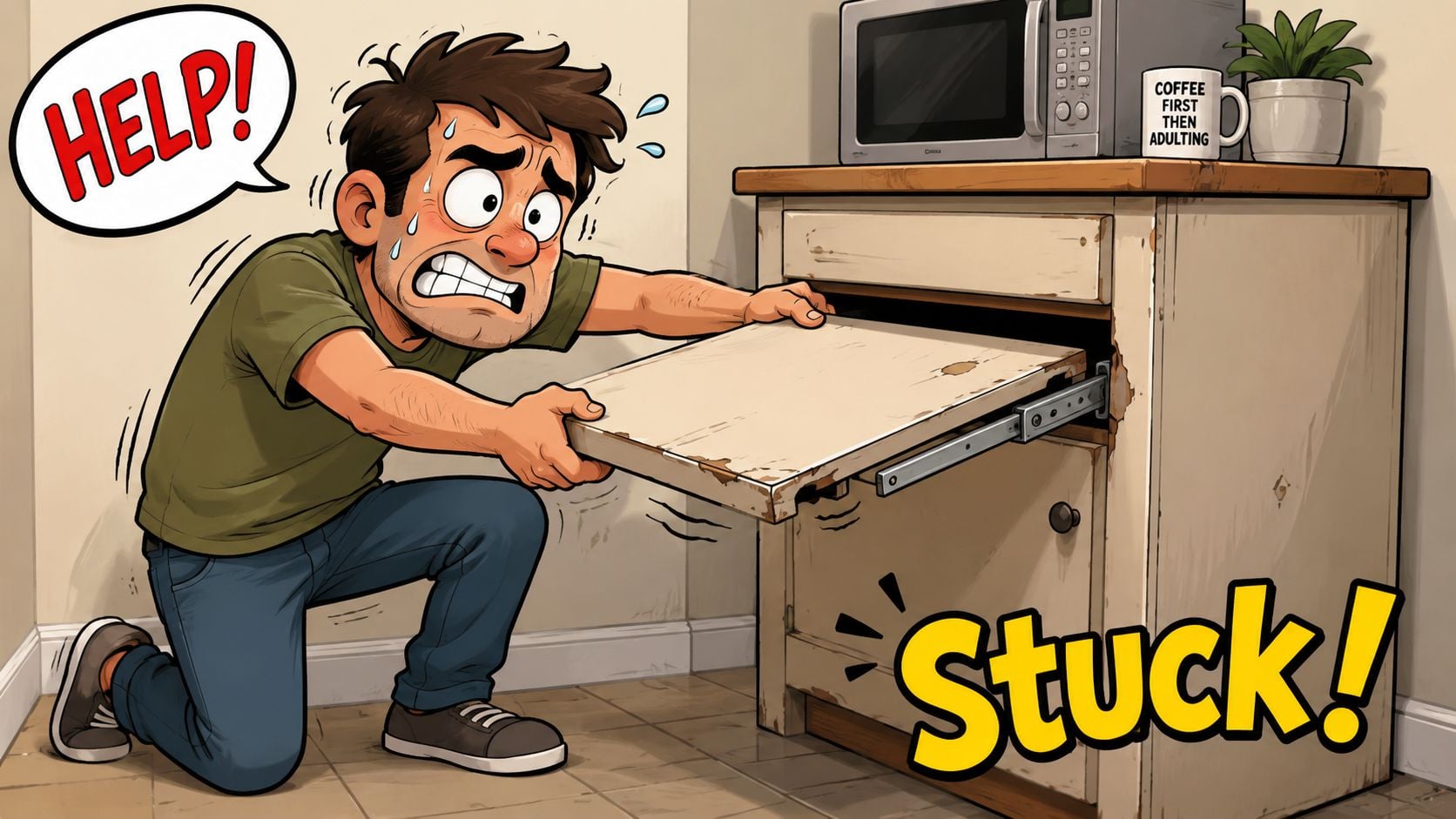
That frustration is understandable because these tables were built to disappear neatly into the kitchen. Some are simple pull-out work surfaces. Others are more ambitious dining extensions. One documented built-in example shows how compact cabinetry can become a dining surface up to 70.9 inches long, in a cabinet 29.5 inches high and 32.3 inches wide, with seating for up to 6 people through a real pullout dining design discussed alongside Häfele's pull-out table system. That tells a homeowner something important. This category belongs to real, engineered kitchen design, not a novelty aisle.
Why removal often becomes necessary
A pull out table from cabinet usually comes out for one of four reasons:
- The cabinet needs service: Water damage, loose face frames, or worn interior panels can make the table unsafe to keep using.
- The hardware has failed: Slides, hinges, and folding supports don't last forever.
- The table no longer suits the room: A household may need a fixed dining solution instead of a hidden one. In that case, something like an expandable dining room table can solve the same space problem with fewer moving parts.
- The mechanism was never installed well: Poor alignment can make a decent table feel cheap.
A stuck pull-out table is usually a symptom, not the real problem. The real problem is wear, misalignment, or weak cabinet structure.
That's why careful removal matters. Done properly, it protects the cabinet, preserves reusable parts, and makes the next decision clearer.
Tools and Triage Identifying Your Pull-Out Table System
Before a single screw comes out, the cabinet needs a calm inspection. Most damage during removal happens because someone starts unscrewing the wrong part first or tries to force a slide that has a release tab.
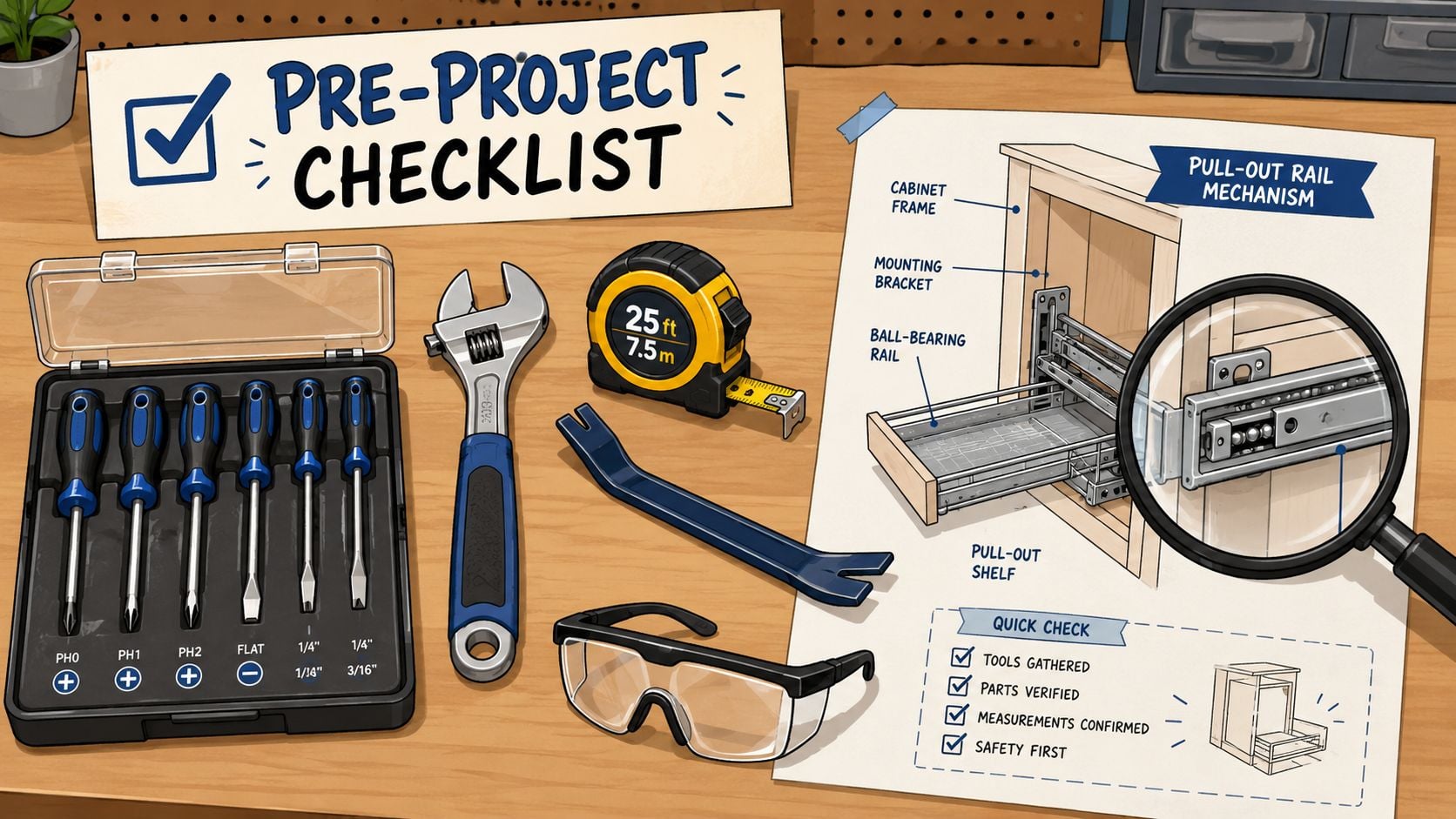
A solid prep list doesn't need to be fancy. It needs to keep the work controlled.
The essential setup
- Screwdriver set: Both manual and driver-bit options help because some cabinet screws strip easily.
- Tape measure: Needed to confirm clear opening, table width, and whether the unit has shifted.
- Level: A quick read on whether sagging is a hardware problem or a cabinet problem.
- Flashlight: Most failures hide at the back of the slide or near the mounting brackets.
- Non-marring pry tool: Useful when trim pieces or stuck covers need gentle persuasion.
For readers building a broader project checklist, this guide on what you need for home renovations is a practical companion because it helps separate must-have tools from optional extras.
Safety first, before diagnosis
Empty the cabinet completely. Clear the floor around it. If the table has leaves, swing-out supports, or a folding leg, make sure another person is available to steady the weight when it comes free.
A dining storage piece often combines moving parts with surrounding millwork, so it helps to think about the cabinet the same way a furniture maker would think about a case piece. This overview of selecting a dining storage piece is useful because it trains the eye to look at structure, clearance, and daily use rather than just surface style.
Identifying the mechanism
Not every pull out table from cabinet removes the same way. These are the three types most homeowners encounter:
| System type | What it looks like | What removal usually involves |
|---|---|---|
| Side-mount slide table | A tray or top riding on visible slides at each side | Release levers or screws on the moving members |
| Heavy full-extension system | Thicker slide assemblies with more travel and more support | More weight, more screws, stricter need for support during removal |
| Folding or cantilevered mechanism | Hidden leaves, pivot arms, or supports that open into a larger table | Sequence matters, and the table may need partial disassembly first |
If the hardware includes hinges, folding arms, or a support leg, the order of removal matters more than the tool choice.
The right diagnosis saves the cabinet face, the finish, and a lot of frustration.
How to Safely Remove Your Pull-Out Cabinet Table
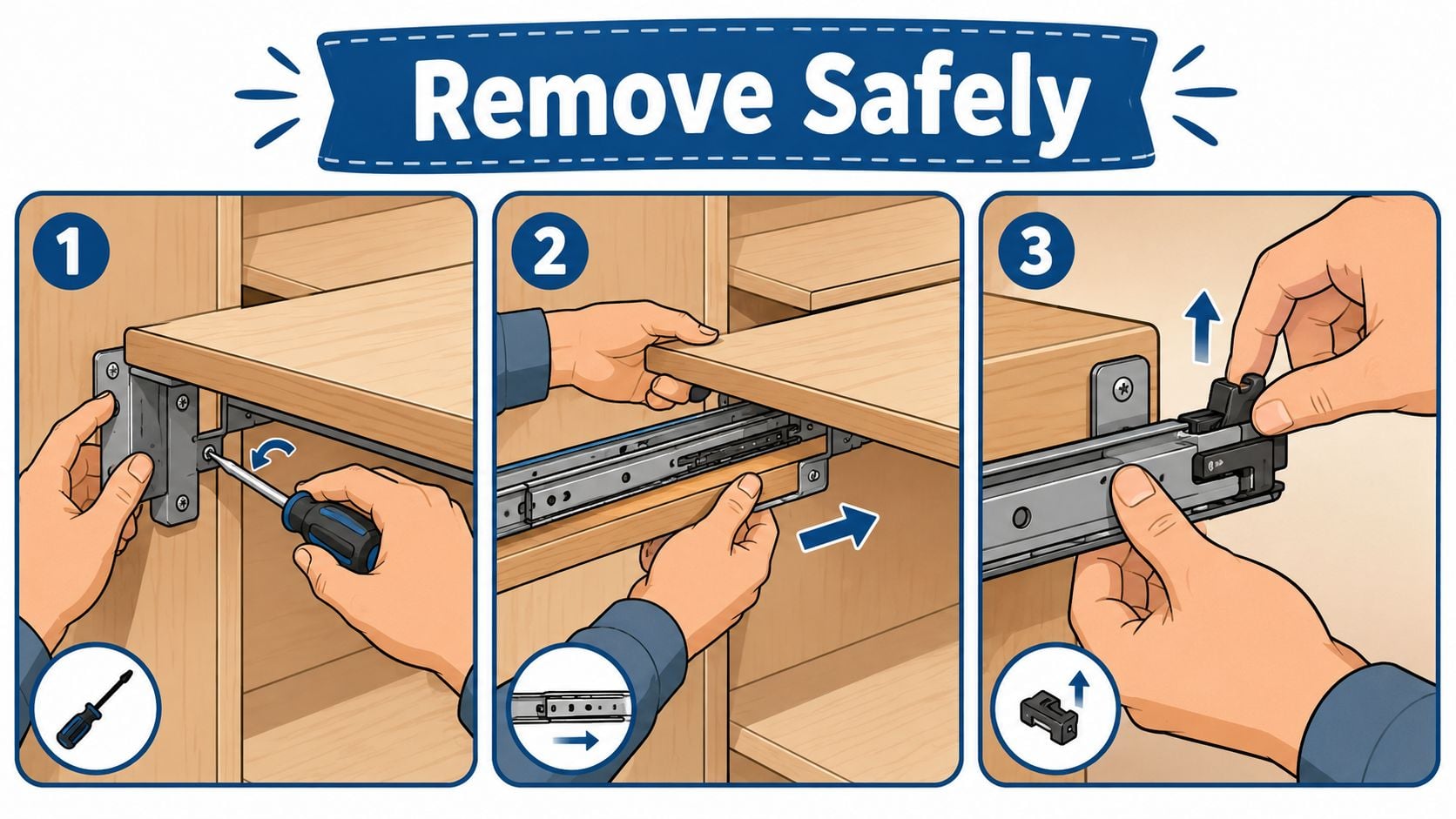
Some tables lift out with release tabs. Others won't budge until the support hardware is separated in the right order. The work goes smoothly when the table is fully extended, well supported, and inspected before any screws are removed.
For standard side-mount slides
Start by extending the table as far as it will go. Look along each slide for a plastic lever, spring clip, or stamped metal tab. On many systems, one side releases upward and the other downward, so both sides need to be checked before pulling.
Use this sequence:
- Support the table surface with one hand or a temporary support underneath.
- Trigger both release tabs if present.
- Pull the moving section straight out without twisting.
- Set the table aside on a padded surface.
- Remove the cabinet-side members only if the cabinet itself needs repair or replacement.
If the table won't release, stop and inspect for hidden screws driven through the underside into the tabletop or frame.
Never force a stuck slide. Find the release mechanism or the retaining screw first.
When screws do need to come out, the cabinet material matters. Most cabinet walls are 3/4 inch thick, and using fasteners longer than about 1 1/4 inches can risk blowing through the finished side panel. Pilot holes help prevent splitting, especially during reinstallation or hardware replacement, as noted in this cabinet slide installation guidance.
For telescoping or folding mechanisms
These systems need slower hands. A folding pull-out table often combines slides with pivoting arms, a drop leaf, or a leg that transfers weight to the floor. In that setup, removing the slide screws first can leave the rest of the mechanism unsupported.
A safer approach looks like this:
- Open the table only to the point where the hardware is visible. Full deployment can make some systems harder to control.
- Identify the load path. Determine whether the weight is carried by slides, a leg, side arms, or a combination.
- Detach the table surface from the moving frame first when possible.
- Remove folding supports next, keeping the hardware grouped and labeled.
- Take out the slide assembly last.
This is the same mindset used in other compact built-in storage projects. A piece designed to save floor space can still create service headaches if access is tight. For readers interested in other pull-out applications, Templeton Built's article on optimizing laundry space with pull-outs is helpful because it shows how hidden hardware changes the way a cabinet has to be planned and serviced.
If the table is stuck halfway
Half-open tables are the most annoying. They usually jam because the slides are racked out of square, debris has entered the tracks, or a support arm has shifted. In that situation:
- don't yank from one side
- don't pry on the cabinet face
- don't remove random screws hoping one of them is the answer
Instead, get eye level with the hardware and compare left and right sides. If one side sits farther forward, the table has likely twisted on the slides. Gentle pressure to square the surface before trying the release often works better than force.
After removal, place hardware in labeled bags and take photos before disassembly. That makes later repair far easier, especially if the system uses mirrored parts or brackets with multiple mounting holes. For care after handling finished wood components, a basic routine for wood furniture care helps prevent fresh scratches and moisture damage while parts are off the cabinet.
What to Do When Your Pull-Out Table Misbehaves
A pull-out table that sticks once can be an annoyance. A pull-out table that keeps sticking, sags under light use, or wobbles at the front edge is usually telling you something more important about the cabinet itself.
These systems fail in predictable ways. The underlying issue is usually wear, misalignment, or a weak cabinet structure. In a busy kitchen, that wear comes from moisture, crumbs in the tracks, side loading, and years of people leaning on the outer edge as if it were a fixed table.
Sticking and grinding
Dragging action usually points to dirt in the slides, bent hardware, or screws that have backed out enough to shift the track position. Start with the simple checks before ordering parts.
- Clean the slide members: Vacuum debris from the cabinet and wipe exposed metal parts.
- Tighten fasteners: Even slight movement at the mounting point can throw the slides out of parallel.
- Inspect both sides for damage: If one slide is bent or twisted, adjustment rarely lasts.
Grinding is a stronger warning sign. It usually means the metal parts are no longer traveling on the same line, and continued use wears the mechanism faster each time the table is opened.
Wobble and sag
A shaky pull out table from cabinet is often blamed on the tabletop, but the problem usually starts lower down. Loose brackets, tired support arms, stripped screw holes, and cabinet side panels that have softened over time all allow movement.
| Symptom | Likely cause | Usual response |
|---|---|---|
| Front edge drops | Wear in slide members or support hardware | Replace worn hardware if matching parts are available |
| Whole table shifts sideways | Loose cabinet-side mounting or enlarged screw holes | Reinforce the mounting area and reinstall the hardware |
| Surface rocks under light pressure | Joint looseness in the frame or support arm | Tighten, reglue, or replace the affected part |
One shop rule applies here. If the wobble returns soon after tightening, the fastener is often holding in weakened material, not sound wood.
For related wear issues around cabinet hardware, some homeowners also find value in SouthRay Kitchen & Bath repair tips because door alignment and pull-out alignment often fail for similar reasons.
When repair stops making sense
Some pull-out tables deserve careful repair. Others do not. If the hardware is obsolete, the cabinet side is compromised by moisture, or the table depends on unusual proprietary parts, repair can turn into repeat labor with a short service life.
That is the point where a good furniture maker looks past the mechanism and considers the whole piece. If the cabinet box is still strong, repair may be worthwhile. If the structure is tired, replacing hardware alone will not give you a stable result.
At Willis, we always weigh the cost of parts, labor time, expected lifespan, and how the table is used in daily life. A prep surface used a few times a month has a different standard than a pull-out table serving regular family meals. If you need help deciding whether to fix the existing unit or start fresh, our furniture repair team at Willis Furniture can assess the condition of the piece and recommend the option that makes sense for long-term ownership.
Reinstalling Your Table for Smooth and Stable Use
Reinstallation decides whether a pull-out table feels dependable or turns into a recurring nuisance. A table can slide back into place and still fail in daily use if the cabinet is out of square, the slides are slightly out of line, or the fasteners are biting into tired material.
Start with a dry fit. Set the table and hardware in place before fully tightening anything, then check the reveal at the front, the gap along each side, and the way the table enters the cabinet opening. Small alignment errors show up quickly once the weight shifts to one corner.
Accuracy matters more than speed here.
Measure from the cabinet face to the first mounting screw on both sides. Then measure again at the rear. Matching numbers tell you more than a quick look from the front. If one slide sits ahead of the other, the table will often travel well for part of its run and bind near the end, which is a common sign that the installation is fighting itself.
A reliable reinstall usually comes down to four checks:
- Slides stay parallel from front to back: Even a slight taper can cause racking.
- Fasteners suit the cabinet material: Particleboard, plywood, and solid wood each hold screws differently.
- The table sits centered in the opening: An uneven gap often points to hidden misalignment.
- Nothing rubs during travel: Check the face frame, interior sides, and any support members.
Test the action several times before calling it done. Pull the table out fully, push it back in, then apply light hand pressure across different areas of the top. If it glides empty but twists or dips with modest use, stop and inspect the cabinet box, not just the slides. In my shop, that is often the moment when a simple reinstall turns into a structural decision.
Smooth travel comes from square installation and solid support.
Do not rely on lubricant to cover up poor alignment. Lubrication may quiet the motion for a while, but it will not correct a cabinet side that has shifted or a mounting point that has loosened in weakened wood. Long-term ownership is the true standard. A pull-out table should return to service without asking for constant readjustment a few months later.
If the table still feels unstable after careful alignment, the better answer may be repair to the cabinet structure, upgraded hardware, or full replacement of the pull-out assembly. Homeowners who want a second opinion on whether the piece is worth saving can submit a furniture service request for cabinet table repair and have the condition reviewed with long-term use in mind.
Professional Solutions for Complex Cabinet Systems
Some pull-out projects stop being sensible DIY work once safety enters the picture. That line is crossed when the cabinet walls are weak, the table is unusually heavy, or the mechanism is meant to support more than light occasional use.
A key concern that many online tutorials skip is structural safety. A pull-out surface used for light prep has different support requirements than one expected to serve daily meals. Load-bearing demands and tipping risks become much more important in those family-use situations, as noted in this overview of pull-out table safety considerations.

That's where professional planning earns its keep. A custom hidden table may need reinforcement in the cabinet box, a different support strategy, or a better answer entirely. For homeowners who want the clean look of integrated furniture without guessing at structure, the Design Center can plan a solution around the room, the household's habits, and the right scale for the space. If the project moves beyond a repair and into a full replacement or service request, the next practical step is a furniture service request.
Financing also matters in real projects. Premium mechanisms and custom cabinetry can raise the cost quickly, and flexible payment options can make a better-built solution more attainable than a stopgap repair.
For homeowners weighing repair, replacement, or a more custom built-in solution, Willis Furniture & Mattress offers help that connects inspiration to action. The Design Center can customize a space-conscious dining or storage plan, the Outlet gives shoppers access to value-minded options, and flexible financing can make a longer-lasting investment easier to manage.

