
Finding the Best Mattress for Back Pain Relief


If you're looking for the best mattress to soothe a sore back, the sweet spot is often a medium-firm mattress. Materials like latex or hybrid constructions usually hit the mark, offering that perfect blend of sturdy spinal support and gentle, pressure-relieving comfort. They keep your hips from sinking too low while still cushioning your joints.
Your Path to a Pain-Free Morning Begins Here
Waking up with a stiff, aching back shouldn’t be a normal part of your routine. If you're one of the millions of Americans starting your day with discomfort, this guide is your first step toward changing that. The right mattress is a powerful tool for your well-being—it can either be the source of chronic pain or the key to deep, lasting relief.
At Willis Furniture & Mattress, we’ve been helping our Virginia Beach neighbors sleep better for generations. We know just how deeply connected rest and health are, and this guide is designed to demystify the process of finding the perfect mattress for your body.

Why Your Mattress Matters More Than You Think
It's easy to underestimate the impact of an old, unsupportive mattress, but the numbers don't lie. Back pain affects over 65 million Americans every year, making it one of the most common health complaints in the country. To make matters worse, trying to sleep on the wrong surface can aggravate chronic back pain by as much as 40%, trapping you in a frustrating cycle of discomfort and exhaustion.
Your mattress is the foundation for a restorative night's sleep. When it starts to fail, your body loses its ability to fully rest and repair itself. Watch out for these tell-tale signs:
- Morning Aches and Pains: Waking up feeling stiff is a major red flag that your mattress is no longer keeping your spine properly aligned.
- Visible Sagging or Dips: That noticeable crater in the middle of your bed means the core support system has given up.
- Tossing and Turning: If you can't get comfortable, it's often your body instinctively searching for a supportive position your worn-out mattress just can't provide.
A truly great mattress does more than just feel soft. It actively works all night long to maintain your spine’s natural curve, taking the pressure off your lower back, hips, and shoulders.
While choosing the right mattress is a huge step, incorporating comprehensive back pain relief strategies can provide even more support for a pain-free life. The first step is recognizing the top signs that indicate it’s time to replace your current mattress.
Coming up, we'll dive into the different mattress types and introduce you to our BedMatch technology—a data-driven system that takes the guesswork out of finding the perfect fit for your unique body and sleep style.
How Your Mattress Impacts Spinal Health
Think of your spine as a perfectly engineered bridge, with a natural ‘S’ curve that needs solid, even support all night long. If that support gives way, the whole structure gets compromised. The result? That all-too-familiar ache so many of us wake up with. Getting this simple idea is the first real step toward finding a mattress that actually relieves back pain.
During the day, your muscles are working overtime to hold your spine in alignment. But when you lie down, it's their turn to relax and recover. That’s when your mattress clocks in, becoming your body's main support system for the next eight hours. A great mattress holds your spine’s natural shape, letting your muscles and ligaments completely release their tension.
But when a mattress fails at this one crucial job, it forces your spine into unnatural angles. Instead of providing relief, it creates strain. This nightly misalignment is one of the biggest—and most overlooked—causes of chronic back pain.
The Hammock Effect: Too Soft
One of the biggest culprits behind morning back pain is a mattress that’s way too soft. A super-plush surface might feel incredible for the first few minutes, but it usually doesn't have the deep-down support your body needs to stay in a neutral position. Without that firm foundation, your heaviest parts—usually your hips and pelvis—sink way too far into the bed.
This creates what’s known as the “hammock effect.” Your spine bows into a U-shape, stretching the muscles and ligaments in your lower back completely out of whack. If you consistently wake up with a dull ache in your lumbar area, it’s a classic sign your mattress is letting you down—literally. Over time, that constant strain can lead to nagging stiffness and discomfort that lasts all day.
Your mattress should conform to your body's curves, not force your body to conform to its weaknesses. Proper support means your spine stays straight, from your neck down to your tailbone.
The Pressure Point Problem: Too Firm
Going to the other extreme, a mattress that’s as hard as a rock creates a whole different set of issues. Instead of letting your body settle in, a rigid surface just pushes back against your natural curves, creating intense pressure points. For side sleepers, this usually shows up as pain, tingling, or numbness in the shoulders and hips.
Even worse, a mattress that’s too firm leaves gaps between your body and the bed. For back sleepers, the most vulnerable spot is the lumbar region—that gentle curve in your lower back. When this area isn't properly cushioned, your lower back muscles stay tensed up all night trying to support themselves, which means you never truly rest and recover. This lack of conforming support is just as bad for your spine as the sagging of a soft mattress.
Finding the Perfect Balance
The secret to a healthy spine in bed is the perfect marriage of support and pressure relief. Support is all about the mattress’s ability to keep your spine in a neutral line. Pressure relief is about cushioning your body’s curves to get rid of discomfort. It’s never just about "firm" or "soft"; it’s about finding the exact blend that fits your body.
This is where you have to move beyond guesswork. Our BedMatch system at Willis Furniture & Mattress uses over 1,000 scientific calculations to map your body’s unique pressure points and support needs. It takes the trial-and-error out of the process, pinpointing the ideal mattress to keep your spine perfectly aligned. And for those who need even more personalized relief, understanding how adjustable bases can help alleviate health concerns can take your sleep setup to a whole new level.
Decoding Firmness and Support for Your Sleep Position
When you’re mattress shopping, it's easy to get tangled up in the terms “firmness” and “support.” People often use them interchangeably, but they do two completely different jobs for your back.
Think of it like this: support is the mattress's core—the strong, internal system that keeps your spine in a straight, neutral line all night long. Firmness, on the other hand, is just the surface feel. It’s what you notice the moment you lie down—that initial "ahh, soft" or "hmm, solid" sensation.
Getting this balance right is everything. A mattress can feel like a cloud on the surface but still pack a serious punch with its deep-down support. And on the flip side, a rock-hard mattress might not give your lower back the contouring it needs, leaving you just as achy as before.
The Myth of "One-Size-Fits-All" Firmness
For decades, the go-to advice for anyone with back pain was simple: get a firm mattress. Lately, "medium-firm" has become the new magic word. While it's a decent starting point for many, the reality is that your perfect firmness level is incredibly personal. It all comes down to your primary sleeping position and your body weight.
It's a staggering fact that 80% of adults will deal with back pain at some point, but the right mattress can be a game-changer. A 2023 Mayo Clinic study really drove this home, finding that medium-firm mattresses helped 73% of participants by keeping their spines properly aligned. The result? They saw their pain drop by an incredible 57% in just three months.
Aligning Firmness with Your Sleep Style
The way you sleep completely changes where your body needs cushioning and where it needs push-back. Your posture through the night has a huge effect on your spine, and understanding the impact of sleeping positions on back pain is the first step toward finding relief.
Side Sleepers: Most of us are side sleepers. If that’s you, you need a mattress that’s soft enough to cushion your shoulders and hips, letting them sink in just the right amount. A surface that’s too firm will create painful pressure points and knock your spine out of line. Look for something in the medium-soft to medium range.
Back Sleepers: Sleeping on your back is fantastic for keeping your spine straight, but only if your mattress is doing its job. Back sleepers need a surface that supports the natural curve of their lower back without letting their hips sag. A medium to medium-firm mattress usually hits that sweet spot between contouring and support.
Stomach Sleepers: This position can put a lot of strain on your neck and spine. To avoid waking up sore, stomach sleepers need a firmer mattress that prevents their hips and belly from sinking too low, which would force the spine into an unnatural arch. A medium-firm to firm mattress is almost always the right call here.
If you want to dig deeper into what works for you, check out our guide on how to choose the right mattress for your sleeping style.
Introducing Zoned Support and Advanced Solutions
Some of the most innovative mattresses today feature something called zoned support systems. The idea is brilliant: they engineer the mattress with firmer support in the center third—right under your heavier torso and hips—while using softer foams or coils at the head and feet for pressure relief.
This graphic shows exactly what we're talking about when it comes to keeping your spine aligned.
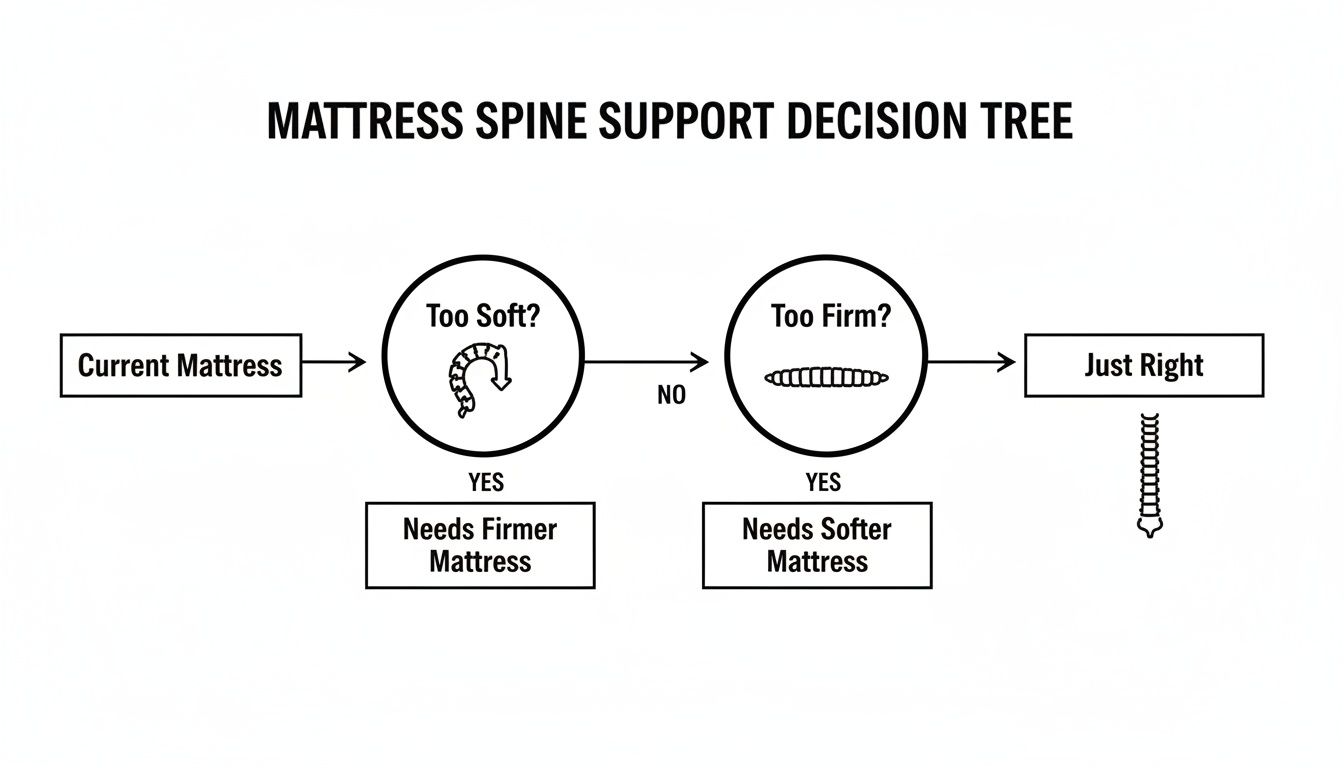
The goal is always the same: a straight, neutral spine is your ticket to waking up refreshed and pain-free.
Of course, these guidelines are a great start, but they’re still just generalizations. That’s precisely why we brought the BedMatch system into our showroom at Willis Furniture & Mattress. It goes way beyond guesswork, using 18 statistical measurements and over 1,000 scientific calculations to pinpoint the exact level of postural support your unique body needs. It maps your shape and pressure points, taking the mystery out of finding a mattress that’s a perfect fit for you.
Choosing the Right Mattress Material
Once you've settled on the right firmness, the next big decision is what your mattress is actually made of. The core components—whether coils, foam, or a mix of both—are the engine driving your mattress's performance. They dictate how it supports your spine, cradles your joints, and even keeps you cool at night.
Each material has a distinct feel and is engineered to solve different sleep problems. For anyone dealing with back pain, choosing the right material is often the final, critical step toward finding real relief.
Innerspring: The Traditional Choice
Most of us grew up sleeping on innerspring mattresses. Built around a core of steel coils, they have that classic, bouncy feel many people are used to. They're fantastic for airflow, which is great if you sleep hot, and they offer a good deal of sturdy support.
But for back pain, traditional innersprings can be a mixed bag. Because the coils are often interconnected, they can’t always contour precisely to the natural curve of your spine. This can create pressure points at the hips and shoulders while leaving the lower back unsupported. Still, they remain a durable and cost-effective choice.
For shoppers looking for dependable, American-made quality on a budget, the Willis Outlet features a curated selection of innerspring models that offer excellent value without compromising on foundational support.
Memory Foam: The Contouring Champion
Think of memory foam as a custom orthotic for your whole body. Originally developed by NASA, this high-tech material reacts to your body heat and weight, softening just enough to mold perfectly to your shape. This incredible ability to adapt provides unmatched pressure relief, a lifesaver for side sleepers who need extra cushioning for their shoulders and hips.
By distributing your weight so evenly, memory foam keeps your spine in a neutral, relaxed position and takes the strain off your lower back. And don't worry about sleeping hot—today's advanced memory foams are made with open-cell designs or infused with cooling gel to solve that old problem.
Hybrid: The Best of Both Worlds
Can't decide between the bounce of coils and the hug of foam? You don't have to. A hybrid mattress gives you a "best of both worlds" experience by combining a supportive innerspring base with thick comfort layers of memory foam or latex on top. If you're curious, you can learn more about what makes a hybrid mattress special in our detailed guide.
This innovative combination is a game-changer for people with back pain. The coil system, typically using individually wrapped "pocketed" coils, provides targeted, responsive support that moves with you. Meanwhile, the foam layers above cushion your joints and fill in the gap at your lower back, ensuring your spine stays perfectly aligned all night long.
To help you see how these materials stack up, here's a quick comparison.
Material Breakdown for Back Pain Relief
| Feature | Innerspring | Memory Foam | Hybrid |
|---|---|---|---|
| Support | Firm, bouncy support from a coil core. | Deep, contouring support that adapts to your body. | Zoned, responsive support from coils plus foam. |
| Pressure Relief | Can create pressure points if not topped with padding. | Excellent pressure relief; cradles hips and shoulders. | Excellent pressure relief from foam layers. |
| Spinal Alignment | Good, but can leave gaps in the lower back. | Excellent; maintains neutral spine by filling gaps. | Superior; coils and foam work together for alignment. |
| Best For… | Back and stomach sleepers who prefer a firm, traditional feel. | Side sleepers and anyone needing maximum pressure relief. | All sleep positions, especially those with chronic back pain. |
It's easy to see why memory foam and hybrids are becoming so popular for pain relief.
The numbers don't lie. The U.S. mattress market is a massive USD 12,926.5 million industry, and it's no surprise that 40% of consumers are buying a new bed specifically to address back pain. In fact, hybrid models are reported to offer 20-25% better lumbar support, which is why a staggering 62% of back pain sufferers rated them as the most effective for relief. You can discover more insights about mattress market trends on grandviewresearch.com.
Because these premium hybrid models feature the latest in sleep technology, they can be more of an investment. At Willis Furniture & Mattress, we believe a pain-free night's sleep shouldn't be out of reach. That’s why we offer flexible financing options through Synchrony, so you can bring home the perfect hybrid mattress and start waking up refreshed, without the financial worry.
The Willis Advantage: How to Find Your Perfect Match
All the research in the world can only get you so far. Reading online reviews is a great start, but to truly find the best mattress for back pain relief, there’s no substitute for trying one out in person. After all, a product description can't tell you how a mattress will contour to your body or relieve pressure on your hips and shoulders.
That’s why we believe a visit to our showroom is a crucial step for anyone serious about waking up without aches and pains. It’s your opportunity to feel the real difference between a mattress that’s just soft and one that’s genuinely supportive. Think of it as an investment in countless pain-free mornings.
A Step-by-Step Guide to In-Store Testing
When you stop by our showroom, don't be shy—the goal is to mimic how you actually sleep at home.
- Dress Comfortably: Wear something loose and easy to move in.
- Assume Your Position: Lie down just like you would at home, whether you’re a side, back, or stomach sleeper.
- Stay a While: This is key. Spend at least 10 to 15 minutes on any mattress you’re seriously considering. This gives your body time to relax and settle, which is the only way to tell how the mattress will truly support you through the night.
- Check for Gaps: While on your back, try sliding a hand under the small of your back. If it slides through too easily, the mattress is probably too firm. If you can’t get your hand in at all, it’s likely too soft.
This hands-on process lets you cut through the marketing noise and listen to what your body really needs for proper spinal alignment.
BedMatch: The Science of Perfect Support
Even with careful testing, what feels comfortable for a few minutes might not be what your spine needs for a full eight hours. That's where we bring in a game-changer: our BedMatch diagnostic system. This is where the art of comfort meets the science of support.
BedMatch takes the guesswork completely out of the equation. It uses real data—not just a gut feeling—to pinpoint the exact support your body needs for optimal spinal alignment and pressure relief.
The process is surprisingly simple but incredibly precise. You’ll lie on a special diagnostic mattress for just a few minutes while the system runs over 1,000 scientific calculations. It maps 18 different statistical measurements of your body to find the perfect support level needed to keep your spine in a neutral, relaxed position. If you want to see the technology in action, you can learn more about how BedMatch works and discover why it’s so effective.
Seamless Service from Showroom to Bedroom
Finding the right mattress is just the first step in the Willis experience. We know that getting a new bed home should be a relief, not another headache. That’s why we offer a full white-glove delivery service to make the entire process completely effortless.
Our professional team does more than just drop a box on your curb. We’ll bring your new mattress inside, set it up in your bedroom right where you want it, and even haul away your old mattress for you. From the moment BedMatch helps you find your fit to your first night of deep, restorative sleep, we’re here to make sure your journey to a pain-free life is a smooth one.
Beyond the Mattress: Building Your Sleep Sanctuary
Finding the right mattress is a massive leap forward in the fight against back pain. But think of it as the foundation of a house, not the whole home. To truly wake up feeling restored and pain-free, you have to look beyond the mattress and build a complete sleep sanctuary—an environment where every single piece works in harmony to support your spine and encourage deep relaxation.
Your pillow, for instance, plays a starring role. Its job is just as important as your mattress: keeping your neck and upper spine perfectly aligned all night. A pillow that’s too high or too flat forces your neck into an awkward angle, sending strain right down your back. It's a small detail with a huge impact.
And then there's the modern game-changer: an adjustable base. Simply elevating your legs can take an enormous amount of pressure off your lower back, offering almost instant relief. It’s a position often called "zero gravity," and it allows those tight lumbar muscles to finally let go and recover while you sleep.
Designing Your Ultimate Relaxation Space
A genuinely restorative bedroom is more than just a place to sleep. The real goal is to create a holistic environment that sends a clear signal to your brain and body: it’s time to unwind. This is where thoughtful interior design can have a profound effect on your well-being.
"A bedroom should be a sanctuary—a space that feels calm, uncluttered, and deeply personal. It's not just about aesthetics; it’s about crafting an atmosphere that actively reduces stress and prepares you for restorative sleep."
Following "The Willis Standard," we believe high-end living should be within reach, and there’s no better place to start than your bedroom. Our in-house Design Center isn’t just for living rooms; our expert consultants can help you pull together a cohesive bedroom oasis built for total tranquility. Imagine pairing your new mattress with the perfect plush rug from our Rug Market to soften your first steps each morning.
Or maybe you could add a comfortable Stressless recliner to a quiet corner, creating a dedicated spot for reading and winding down before you even climb into bed. It’s these touches that transform a bedroom from a functional space into a personal retreat. Our designers can help you select pieces that not only match your style but also enhance your journey to better sleep.
Your Journey to Better Sleep Starts Here
From finding the perfect mattress with our BedMatch system to designing a complete sleep sanctuary, our team is here to guide you every step of the way. We invite you to visit our Virginia Beach showroom to experience the Willis difference firsthand. Let’s work together to build the restful, pain-free life you deserve, one peaceful night at a time.
A Few More Questions We Hear in the Showroom
Shopping for a mattress when you're in pain can feel overwhelming. We get it. To help clear things up, here are some straight answers to the questions we hear most often from customers dealing with back pain.
How Long Should a Mattress for Back Pain Last?
A high-quality mattress built for support should serve you well for 7-10 years. After that, even the best materials start to lose their integrity. If your bed has developed a permanent body impression, feels lumpy, or leaves you feeling stiffer than when you went to sleep, its support core is officially past its prime.
Think of replacing your old mattress as a crucial investment in your long-term health. At Willis, we're proud to carry durable, American-made brands that are built to provide consistent comfort and support for years to come. We also offer flexible financing options to make this important investment more accessible.
Can a Mattress Topper Really Help My Back Pain?
A mattress topper can add a bit of cushion to a mattress that’s too hard, but it’s a band-aid, not a cure. It's like putting a nice-looking rug over a hole in the floor—it might look better, but it doesn't fix the structural problem.
A topper can't add support where it doesn't exist. If your mattress is already sagging, the topper is just going to sag right along with it. It won't give you the spinal alignment you need to truly relieve back pain.
The only way to get lasting relief is to address the root of the problem: a mattress with the right foundational support for your body. If budget is a concern, we invite you to explore the Willis Outlet, where you can find high-quality, supportive mattresses at an exceptional value.
Does the BedMatch System Actually Work?
It absolutely does. Our BedMatch system goes way beyond the generic "firm" or "soft" labels. It uses real science to find the best mattress for your back pain relief by analyzing your specific body, not just what works for the average person.
The system takes 18 different statistical measurements, looking at everything from your weight distribution to your unique posture. It then crunches the numbers to pinpoint the exact level of support your spine needs to stay perfectly aligned all night. It’s one of the most accurate ways to take the guesswork out of mattress shopping and ensure you're making a choice that will truly help you feel better.
Ready to finally wake up without that familiar ache in your back? The team at Willis Furniture & Mattress is here to guide you. Stop by our Virginia Beach showroom to try out our BedMatch technology and see our collection of American-made mattresses for yourself. A better night's sleep is waiting for you.


