SPECIAL HOURS: We will be closed on Saturday, July 4th | We will be OPEN on Sunday, July 5th from 1pm to 5:30pm

Finding the Best Mattress Support for Back Pain


Waking up sore isn't just a lousy start to your day—it's a flashing neon sign from your body that you're not getting truly restorative rest. At the heart of a pain-free morning is proper mattress support for back pain, which is all about maintaining your spinal alignment while you sleep. Without it, even a full eight hours can feel more like a wrestling match.
Why Your Mattress Is the Key to a Pain-Free Morning
If you’re waking up with a stiff, aching back, your mattress is almost always the prime suspect. Over the years, even the highest-quality beds lose their ability to support you correctly. That’s when the trouble starts, leading to a cascade of issues that kill your sleep quality and leave you with chronic discomfort.
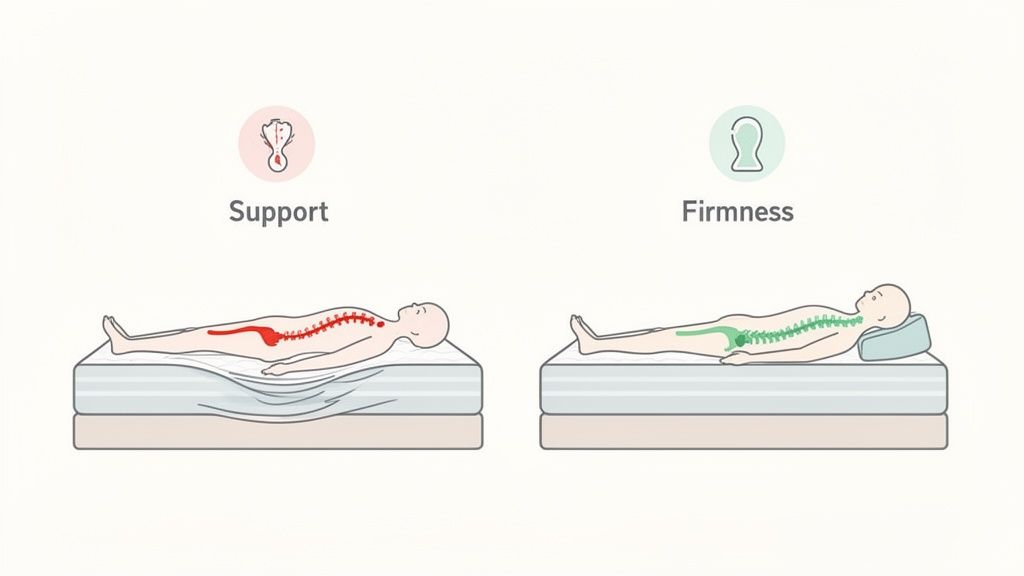
A truly supportive mattress holds your spine in a neutral position—basically, mimicking your best standing posture. It needs to be firm enough to keep your hips and shoulders from sinking too far, but also adaptive enough to contour to your body's natural curves. When that balance is off, your muscles have to work all night to compensate, and that leads directly to inflammation and pain.
Understanding Support vs. Firmness
People mix up support and firmness all the time, but they are two very different things. Getting this right is probably the most crucial part of finding relief.
Here’s a quick breakdown to help you tell them apart:
| Concept | What It Means for Your Back | What to Look For |
|---|---|---|
| Support | This is the mattress's ability to hold your spine in proper alignment. It pushes back against your weight to prevent sagging. | The mattress "core"—innerspring coils, high-density foam, or latex layers. This is the engine of the mattress. |
| Firmness | This describes the immediate feel of the mattress surface—how soft or hard it feels when you first lie down. It's all about comfort preference. | The top comfort layers—pillow tops, memory foam, or plush quilting. This is about your personal "cuddle factor." |
Think of it this way: a mattress can feel incredibly soft on top (low firmness) but still have a rock-solid supportive core underneath. On the flip side, a mattress that feels as hard as a board might not actually support your spine's natural curve, creating painful pressure points.
Spotting the Signs of Failing Support
So, how can you tell if your mattress is the problem? Your body and bed will give you some pretty clear clues.
Keep an eye out for these tell-tale signs:
- The Obvious Dip: If you can see a noticeable sag or body impression in the middle of your bed, it’s game over. That’s a clear red flag.
- Morning Aches: Do you feel stiff and sore when you first wake up, but the pain eases after you’ve been up and moving for about 30 minutes? That's a classic sign of poor overnight support.
- Restless Nights: If you're constantly tossing and turning, it’s often your body desperately trying (and failing) to find a comfortable, supported position.
Back pain is a massive issue, and the market for mattresses designed for pain relief is growing just as fast, with over 200 million units sold each year. Spring mattresses, which are projected to hold a 65.39% market share by 2026, are a popular choice because their wrapped-coil designs are fantastic at providing targeted, robust support for the lower back.
Getting the foundation right is the first and most important step in improving your overall sleep quality.
Matching Your Sleep Position to the Right Support
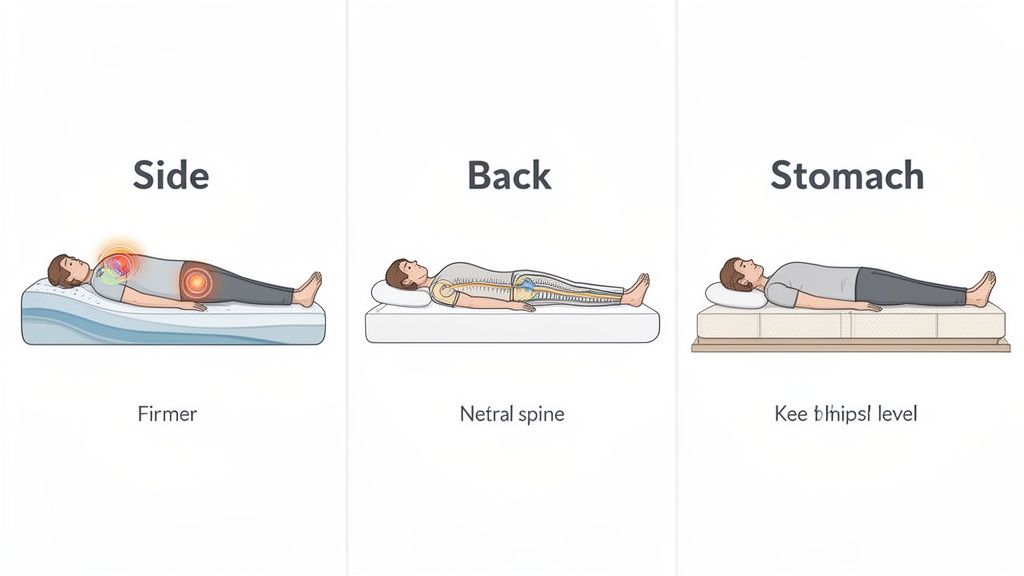
How you sleep isn't just a quirk; it's the single most important clue to finding the right mattress support for back pain. A mattress that feels like a dream to a back sleeper might be a total nightmare for someone who sleeps on their side.
It all comes down to where your body puts the most pressure. The right mattress has to work with those pressure points to keep your spine in a healthy, neutral line. This simple match-up is often the difference between waking up refreshed and waking up sore. Let’s look at what each sleep style really needs.
Support for Side Sleepers
If you’re a side sleeper, your mattress needs to have enough give to let your shoulders and hips sink in just the right amount. This contouring isn't a luxury—it's essential. Without it, your spine gets pushed into an awkward curve, creating intense pressure and that all-too-familiar morning stiffness.
Picture a straight line running down your spine. On a mattress that’s too firm, that line will bend way out of whack. The ideal surface is often a medium-soft to medium-firm hybrid or memory foam mattress. It cradles those high-pressure zones while still supporting your waist.
The Needs of Back Sleepers
For back sleepers, the name of the game is maintaining the natural "S" curve of your spine. The biggest challenge? That gap in your lower back, the lumbar region.
If a mattress is too soft, your hips will sink lower than your shoulders, creating a hammock effect that puts a ton of strain on your back muscles all night long. But a rock-hard mattress isn't the answer either—it won't let your hips settle in at all, leaving your lower back completely unsupported.
This is why back sleepers usually do best on medium-firm to firm mattresses, like many innerspring or hybrid models. They provide that robust support needed to keep your hips lifted and your spine perfectly aligned. You can explore some of our top picks here: https://www.willisfurniture.com/mattressguide/just-right-back-sleeper-results/
Key Takeaway: The best mattress for back pain doesn’t fight your body’s natural curves. It fills in the gaps and supports the heavier areas to keep your spine in a neutral, relaxed position all night.
A Firm Foundation for Stomach Sleepers
Of all the positions, stomach sleeping puts your spine in the most vulnerable position. It can easily cause your lower back to arch unnaturally, leading to chronic pain. If this is you, you absolutely need a firm surface that prevents your midsection from sinking and pulling your spine out of alignment.
A plush, soft mattress is the enemy here. Stomach sleepers should be looking for a firm hybrid or a responsive foam mattress that offers a solid, level surface. The goal is to keep your hips and abdomen on top of the mattress, not sinking into it. This takes the strain off your neck and back, helping you avoid long-term discomfort.
No matter how you sleep, finding that perfect balance is a personal journey. At the Willis Furniture Design Center, our experts can help you see and feel how different mattress types can be tailored to your specific needs. We believe high-end living should be accessible, which is why our financing options make it easy to invest in your health and comfort.
Comparing Mattress Types for Spinal Alignment
Walking into a mattress showroom can feel a bit like alphabet soup—memory foam, innerspring, hybrid, latex. It’s easy to get lost in the terminology. But getting to the bottom of what makes each type different is the first real step toward finding the right mattress support for back pain. Each material feels and performs differently, especially when it comes to keeping your spine happy.
Memory foam is famous for that slow-sinking, body-hugging sensation. It’s brilliant at relieving pressure because it molds so precisely to your curves, which is a huge plus if you’re trying to ease stress on your joints. It's no surprise that the global mattress market, valued at a staggering $46.48 billion in 2024, is growing as more people look for these kinds of ergonomic benefits. Foam mattresses alone make up about 45% of that market, loved for their contouring comfort and knack for isolating motion.
Then you have the classic innerspring mattress. Built around a core of steel coils, these beds have a much bouncier, more responsive feel. They offer firm, reliable support and fantastic airflow, making them a solid choice if you tend to sleep hot or just prefer the feeling of sleeping on top of your mattress instead of sinking into it.
The Rise of the Hybrid Mattress
For a lot of people dealing with back pain, the perfect mattress isn't one extreme or the other. It’s somewhere right in the middle. That’s exactly where hybrid mattresses come in, designed to give you the best of both worlds.
A hybrid takes a supportive innerspring coil system and tops it with generous layers of memory foam, latex, or other comfort materials. This layered construction strikes a unique and powerful balance:
- Support from Below: The pocketed coils provide that essential push-back against your body weight, which is key to holding your spine in proper alignment.
- Comfort from Above: Meanwhile, the foam layers give you that pressure-relieving contour you need to cushion sensitive areas like your hips and shoulders, a must-have for side sleepers.
This combination creates that just-right feeling of supportive comfort, and it’s why hybrids have quickly become a top recommendation for anyone struggling with back pain. You can learn more about what makes these beds work so well in our detailed guide to hybrid mattresses.
Making a Premium Investment in Your Health
Think of a new mattress not just as a purchase, but as a real investment in your long-term health and well-being. A high-quality bed from a premier brand like Stressless or Barclay Butera is built differently, using superior materials and advanced construction meant to deliver consistent, reliable support for years to come.
At Willis Furniture, we believe that a pain-free night's sleep shouldn't be out of reach due to budget constraints. Our flexible financing options make it possible to bring home the perfect premium mattress today, so you can stop compromising on your comfort and start investing in your health.
How to Properly Test a Mattress in the Store
Choosing a mattress after lying on it for five seconds is a mistake I see people make all the time. It’s like buying a car without a test drive—you're almost guaranteed to regret it later. To find the right mattress support for back pain, you have to do more than a quick "feel test"; you need to understand how the bed will actually support your body all night long.
Just sitting on the edge or flopping down for a moment won't tell you anything meaningful. You'll never know how your spine will feel after eight hours. The goal here is to get as close as you can to your real sleep experience, and that takes a bit of time and a more thoughtful approach.
The 15-Minute Test Drive Routine
For any mattress you’re seriously considering, plan to spend at least 15 minutes on it. No exceptions. Start by getting into your go-to sleeping position, whether that’s on your back, side, or stomach. Now, just stay there. Give it a solid five to seven minutes for your muscles to relax and your body to really sink in.
Once you've settled, it's time to move around. Roll into your other common sleeping positions and pay close attention to what you feel.
- Pressure Points: Do you notice any uncomfortable pressure building up in your shoulders, hips, or knees? That’s a huge red flag, especially for side sleepers.
- Spinal Alignment: This is crucial. If you're with someone, ask them to check your spine. On your side, it should look perfectly straight from your neck to your tailbone. On your back, you shouldn't have a big, unsupported gap under your lower back.
- Ease of Movement: How easy is it to change positions? A good mattress should feel responsive, letting you move freely without that "stuck in quicksand" feeling.
It also helps to have a little inside knowledge about what's going on inside the mattress.
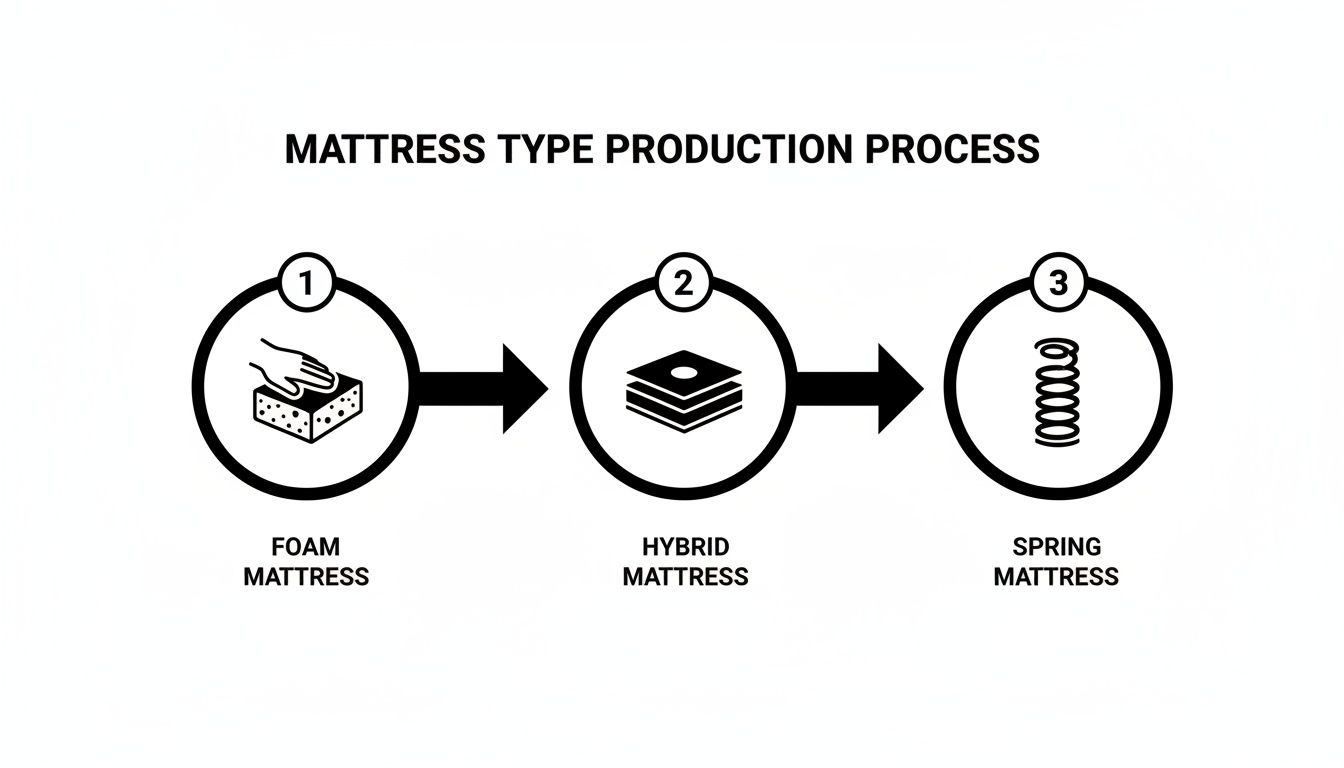
This gives you a peek behind the curtain, showing how different materials like foam, hybrids, and springs are put together. When you understand the construction, you can better connect what you're feeling to the materials doing the work.
Let Science Guide Your Search
Even with a careful test, it's easy to get swayed by what you think you should like. This is where we can take the guesswork out of the equation and let objective data point you in the right direction.
At Willis Furniture, we use the advanced BedMatch® diagnostic system. This isn't just a simple quiz—it's a scientific analysis that takes 18 statistical measurements and runs over 1,000 calculations to map out your unique sleep profile. In just a few minutes, it identifies the precise level of postural support your body needs to stay properly aligned.
This data-driven approach cuts through the confusion. It ensures the mattress you choose is based on your body's specific needs, not just a gut feeling. It gives you a personalized blueprint, so you can test the recommended options knowing they’re already a scientific match for you.
If you want more advice on making the right choice, take a look at our tips for buying a new mattress.
Creating a Complete Sleep System for Back Health
A great mattress is the foundation, but the right supporting cast turns your bed into a true system for back pain relief. Think of it this way: every piece, from the pillow to the frame, has to work in harmony. The right accessories do more than just add a little extra comfort; they actively enhance the supportive qualities of your mattress, creating a sanctuary where your body can truly rest and heal.
Of course, a supportive mattress is only half the battle. A truly comprehensive approach also means paying attention to what you do during the day. Learning how to prevent lower back pain with better habits and movements is just as important as the support you get at night. It’s about tackling the problem from every angle.
The Critical Role of Your Pillow
Your pillow supports the top third of your spine, and if it's wrong, it can undo all the good work your mattress is doing. A bad pillow forces your neck and upper back into an unnatural position, creating tension that can easily travel down your spine and leave you feeling stiff and sore.
Finding the right pillow is all about your sleep position and mattress type:
- Side Sleepers: You'll need a thicker, firmer pillow. The goal is to fill that gap between your ear and the mattress, keeping your neck perfectly aligned with the rest of your spine.
- Back Sleepers: A thinner pillow is best here. Look for one with a little extra lift right under the neck to support the natural curve of your spine.
- Stomach Sleepers: Go for a very thin pillow—or even no pillow at all. This prevents your head from being propped up at a harsh, painful angle.
Upgrading Your Foundation
The platform your mattress sits on is just as important as the mattress itself. An old, sagging box spring or a weak frame will cause even the best new mattress to dip. When that happens, you lose the mattress support for back pain you invested in. A solid foundation provides a flat, stable surface, letting your mattress perform exactly as it was designed to.
Want an even bigger upgrade? Consider an adjustable base. These powered foundations let you lift your head and feet with the push of a button, and the benefits for back pain are immediate.
Raising your legs even slightly can take a massive amount of pressure off your lower back. This "zero-gravity" position offers almost instant relief for lumbar strain, helping your muscles relax in a way a flat mattress simply can't match.
Here at the Willis Furniture Design Center, our experts specialize in building these complete sleep systems. We can show you how to integrate an adjustable base into a beautiful custom upholstered bed frame that fits your style, or find the perfect pillow to pair with your new mattress. We believe in making high-end living accessible, and our financing options ensure you can invest in a total solution for your back health without having to compromise.
Protecting Your Mattress and Your Back
Finding the perfect mattress is a huge win for your back, but the job isn't quite finished. To keep that ideal mattress support for back pain, you’ve got to put in a little bit of care. Think of it as protecting your investment—a few simple habits will ensure your mattress delivers that same restorative, pain-free sleep for years to come.
Without proper care, even the best mattress can start to form dips and soft spots, which is bad news for your spinal alignment. The single most important thing you can do is rotate it regularly. Just turn it head-to-foot every three to six months to prevent uneven wear and keep body impressions from forming. It's a simple step that makes a world of difference in keeping the support consistent.
Safeguarding Your Investment for the Long Haul
Beyond a quick rotation, a high-quality mattress protector is your bed’s best friend. It acts as a shield, guarding the internal foams and fibers against spills, sweat, and allergens that can break them down over time. A good protector doesn't just keep your mattress clean; it actively extends its lifespan, making sure the support you love on day one is there for you on day one thousand. You can dive deeper into their importance by reading our guide on the hidden benefits of a mattress protector.
A Pro Tip on Budgeting: Premier support doesn't always have to come with a premium price tag. Smart shopping can make a world of difference for your back and your wallet.
If you're looking for exceptional value without cutting corners on quality, the Willis Outlet is a fantastic place to start. We often have high-quality floor models, overstock items, and discontinued lines from top-tier brands. This is a great way to get the top-notch support your back desperately needs at a price that won’t keep you up at night. A pain-free morning is more accessible than you think.
Your Questions About Mattresses and Back Pain, Answered
When you're dealing with back pain, mattress shopping can feel overwhelming. We get it. Our team hears these questions all the time, so let's clear up a few common misconceptions.
Is a Firmer Mattress Always Better for Back Pain?
Not at all. This is probably one of the biggest myths out there. The old-school advice to just "get the firmest mattress you can find" is seriously outdated.
What you really need is a mattress that keeps your spine in a neutral, natural alignment. For most people, that sweet spot is actually a medium-firm feel. It's got enough give to contour to your body's curves (especially around the shoulders and hips) but enough support to keep your spine from sagging. An extra-firm mattress can sometimes do more harm than good, creating painful pressure points instead of relieving them.
Can an Adjustable Base Really Help?
Absolutely. An adjustable base can be a game-changer for anyone with persistent back pain.
Think about it: elevating your legs, even slightly, takes a significant amount of strain off your lower back. Raising your head can do the same for your upper spine and neck. It’s all about finding that "zero-gravity" position where you feel almost weightless, minimizing stress across your entire body.
Our experts at the Willis Furniture Design Center can show you how to pair an adjustable base with the right mattress, creating a complete ergonomic sleep system tailored to your unique needs. We can even help you customize an upholstered frame to seamlessly incorporate the base into your bedroom design.
While the right mattress is a huge step, some people find they need a multi-faceted approach to feel their best. For some, exploring options like MLS laser therapy for chronic back pain relief can be another part of their wellness journey.
Your journey to a pain-free morning starts with the right support. Visit Willis Furniture & Mattress to experience our BedMatch technology and find the perfect sleep system for your needs. Explore our mattress collection today.


