
Guide to Dining Benches Upholstered: 2026 Edition


Some dining rooms look polished and still don't get used. The table is beautiful, the chairs are upright, and the whole room feels like it's waiting for a holiday instead of a Tuesday night dinner. In a lot of homes, that space becomes decorative first and practical second.
A padded bench changes that rhythm. It softens the room, invites people to stay longer, and makes the dining area useful for more than meals. Homework spreads out there. Coffee lingers there. Guests slide in without the room feeling stiff. For homeowners trying to cozy up your living space, this kind of seating often does more than another centerpiece or wall color ever could.
That shift matters in coastal Virginia, where homes often need to feel welcoming, flexible, and easy to live in. A bench with upholstery can bring warmth to a formal dining room, create comfort in a breakfast nook, or help a mixed-use room feel finished instead of improvised. It's one of those choices that affects both how a room looks and how often people use it.
Thoughtful furniture decisions also tend to support the bigger goal of loving where you live. That mindset comes through clearly in this reflection on home and self-care. A dining room that invites people in instead of keeping them at attention does exactly that.
Table of Contents
- Welcome Home to a More Comfortable Dining Room
- Should You Choose a Bench Instead of Chairs
- How to Measure for a Perfect Upholstered Bench
- Selecting the Right Fabric and Cushion Fill
- Styling and Placement Tips for Your Dining Bench
- Customization Delivery and Making It Yours
Welcome Home to a More Comfortable Dining Room
A dining room earns its keep when people want to sit there after the plates are cleared. That's where dining benches upholstered tend to outperform more formal seating. They visually relax the room before anyone even sits down.
In homes with children, visiting relatives, or open layouts, a bench often becomes the seat everyone chooses first. It feels more forgiving than a row of rigid chairs. It also helps a dining area do double duty as a workspace, a gathering spot, or a catch-up zone.
Why the room starts working harder
An upholstered bench changes the emotional temperature of the room. Hard edges soften. The table feels less ceremonial. The room starts to support everyday life instead of occasional use.
A well-chosen bench doesn't just add seating. It changes how long people stay at the table.
There's also a design reason this form still resonates. Upholstery has a long history, but upholstered seating stayed uncommon until about the 17th century, and the first fully upholstered armchair appeared in 1705, helping establish the comfort-first language later used in pieces like dining benches, as noted in this history of upholstery.
What makes it feel current
Today's appeal isn't only about softness. It's about versatility.
- For busy households the bench can turn an underused dining room into a daily landing place.
- For smaller homes it can make a room feel less crowded than a set of bulky matching chairs.
- For style-minded homeowners it adds texture, shape, and a custom look without requiring a full remodel.
That combination of comfort and usefulness is why upholstered bench seating keeps showing up in real homes, not just styled photos.
Should You Choose a Bench Instead of Chairs
The first question isn't which fabric to pick. It's whether a bench fits the way the room functions.

Benches solve some problems very well. They also create a few. The right choice depends less on trends and more on traffic, cleanup habits, and how people use the table from morning to night.
When a bench works better
A bench often makes sense in a tight nook, along a wall, or on the long side of a rectangular table. It can reduce visual clutter and create a cleaner path around the room. It also gives the table a more communal feel. Guests tend to settle in differently on a bench than they do in separate chairs.
For households that host casually, that matters. A bench says, “slide in,” not “find your assigned seat.”
A bench can also be easier to integrate into a room with mixed functions. In a breakfast area that opens to the kitchen, or a dining space that shares square footage with a family room, bench seating usually feels more relaxed and less formal. Homeowners sorting through room flow often benefit from guidance like this article on maximizing dining space with table shapes and seating arrangements.
When chairs still win
Benches aren't automatically the practical choice. Upholstered ones especially need honest consideration.
A useful contrarian point is that upholstered benches can be less forgiving than wood or performance-seat alternatives for households with children, pets, or frequent spill risk. That trade-off is often missing from product pages, even though the category spans a wide range from entry-level models in the low-$100s to higher-end designs in the $300+ range, based on this overview of upholstered dining bench pricing and category gaps.
Practical rule: If the dining table regularly becomes a craft table, homework station, or spill zone, maintenance should outrank looks.
Chairs also have advantages for some households:
- Easier individual access. One person can get up without everyone else shifting.
- More personal space. Formal diners and taller adults sometimes prefer a defined seat.
- Simpler spot replacement. If one chair wears out, replacing one piece is easier than replacing a full bench.
A balanced setup often works best
For many dining rooms, the strongest answer isn't all bench or all chair. It's one upholstered bench on one side, chairs opposite, and possibly host chairs at the ends. That layout gives the room softness and flexibility without asking the bench to solve every seating need.
Homeowners shopping value-conscious options should also keep budget in view. If the goal is to try the look without committing to a higher custom spend, the Willis Outlet is the practical place to start. Outlet pieces, floor samples, and overstock can make bench seating easier to test in real life.
How to Measure for a Perfect Upholstered Bench
An upholstered bench should fit the table the way a perfectly fitted jacket fits the person wearing it. Close isn't good enough. If the height is off, knees hit the apron. If the depth is too generous, the walkway tightens. If the length is wrong, the whole setup looks accidental.
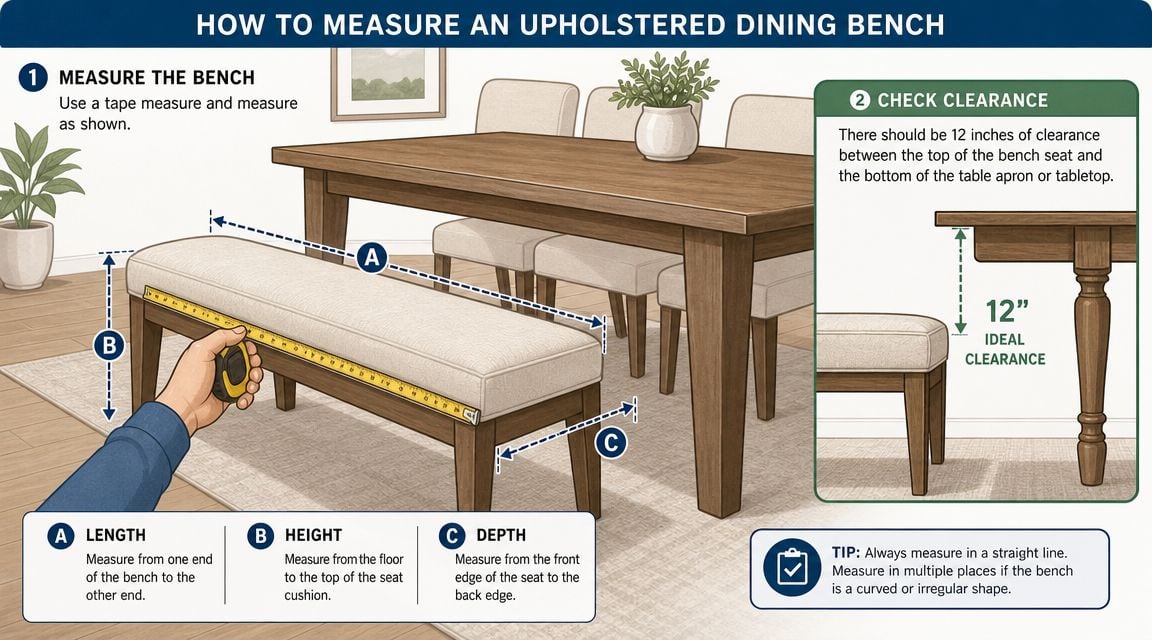
The baseline numbers are straightforward. A practical benchmark for upholstered dining benches is a seat height of 18 to 20 inches from the floor, about 12 inches of clearance below the tabletop, and a seat depth of around 18 inches, according to this guide to upholstered dining bench dimensions.
Start with height
Seat height determines whether dining feels natural or awkward. Upholstery adds thickness, so this isn't the place to guess. A bench that looks right can still sit too high once the cushion is compressed under weight.
Use these checks:
- Measure from the floor to the top of the finished seat, not the frame.
- Measure from the floor to the underside of the table, not the top surface.
- Confirm usable clearance, especially if the table has a thick apron or decorative trim.
For anyone comparing tables and seating, this guide to dining table heights helps translate measurements into comfort.
Then move to depth and length
Depth affects both comfort and circulation. A deeper bench can feel more lounge-like, but it also asks for more room behind it. In a narrow breakfast area, that extra projection can become a daily irritation.
Length should support the table without overwhelming it. A bench that runs nearly edge to edge feels built-in and tidy. One that's too short can look disconnected. One that extends too far can make getting in and out harder than it needs to be.
| Dimension | What to check | Why it matters |
|---|---|---|
| Height | Finished seat to floor | Protects knee room and dining posture |
| Depth | Front edge to back | Balances comfort with aisle space |
| Length | End to end relative to table | Shapes both access and visual proportion |
Measure the room with the bench occupied in mind, not just pushed in for the photo.
A good measuring plan also accounts for who uses the room most. A compact nook, a formal dining room, and a family drop zone don't need the same bench footprint.
Selecting the Right Fabric and Cushion Fill
The frame gets the bench in the room. The upholstery determines whether people keep liking it six months later.

When choosing upholstery, many shoppers focus on color first and regret it later. Dining seating needs to handle friction, crumbs, shifting posture, and frequent contact at the front edge of the seat. The smartest fabric choice depends on who's using the bench and how much maintenance the household is willing to accept.
How the main upholstery options compare
Some fabrics look beautiful in a showroom and become stressful at home. Others feel understated at first and prove their value every week.
A simple comparison helps:
| Material type | What it tends to do well | What to think about before choosing |
|---|---|---|
| Performance-style fabric | Handles daily use with less worry | May have a more practical hand depending on weave |
| Linen-look upholstery | Feels airy and relaxed | Usually asks for quicker spill response |
| Velvet-style upholstery | Adds depth and dressier texture | Can show pressure marks and directional shading |
| Leather | Ages with character and wipes more easily | Surface wear and temperature feel vary by home |
Homeowners comparing natural-looking textiles often appreciate an outside reference like this expert fabric guide for your projects, especially when trying to understand how casual texture differs from more structured fabric choices.
Cushion feel matters as much as the fabric
The seat can be upholstered in the right textile and still feel wrong if the fill doesn't suit the purpose. Dining benches need support more than sink. People should be able to sit down, eat comfortably, and get up without feeling like they're climbing out of a lounge cushion.
That usually means choosing between two broad comfort profiles:
- Firmer, supportive foam works better for upright dining and everyday use.
- Plusher fills can feel inviting at first but may make table seating feel too relaxed.
Soft doesn't always equal comfortable. For dining, support usually wins over plushness.
The back cushion, if there is one, should follow the same logic. If a bench is meant for meals, the upholstery should help hold the body in a comfortable dining posture rather than encourage slouching.
Match the material to the household
A household with school-age children, pets, or frequent entertaining should choose maintenance first and style second. A lower-traffic formal room can take more risk with texture and color. Neither approach is better. The point is alignment.
That's where the Design Center becomes useful. Willis Furniture & Mattress offers custom upholstery guidance with fabric and leather selections, which lets homeowners compare swatches under real lighting and pair the cover with the right cushion feel instead of making a blind online decision. Helpful background reading on upholstery fabric types can also narrow the field before stepping into custom options.
Styling and Placement Tips for Your Dining Bench
A good upholstered bench shouldn't look like an afterthought pushed under a table because there wasn't room for chairs. It should look intentional from every angle.

Placement does most of that work. The same bench can read casual, tailored, coastal, or traditional depending on what surrounds it and where it sits in the room.
Best placements for different room types
Against a wall, an upholstered bench starts to feel like a banquette. That setup works especially well in breakfast nooks and corner dining areas where the goal is comfort with a compact footprint.
On one side of a rectangular table, a bench softens the room without taking over. Pairing it with chairs opposite creates rhythm and keeps entry and exit simpler. In an open floor plan, that mix often feels more balanced than matching seating all around. Homeowners working through layout decisions can borrow useful ideas from these strategies for arranging furniture in an open concept living space.
A bench can also live beyond the dining room. The same silhouette may work in an entry, under a window, or at the foot of a bed if the upholstery and scale are chosen carefully. That flexibility makes upholstered benches appealing in homes where every piece needs to earn its space.
Style it for coastal Virginia living
In coastal interiors, the bench should feel collected, not themed. Lighter wood tones, textured neutrals, and soft blue or sand-inspired upholstery tend to sit comfortably in the region without looking overly beachy.
For a more traditional home, the bench can carry a refined profile with a defined back, turned legs, or a richer fabric. In transitional rooms, a clean-lined bench with subtle texture often bridges formal and casual better than a carved wood chair ever could.
A few styling moves consistently help:
- Ground it with a rug that's large enough to support both the table and the bench visually.
- Repeat the upholstery tone somewhere else in the room, such as drapery, art, or accent seating.
- Use pillows carefully if the bench isn't used for every meal. Too many can interfere with function.
- Mix chair shapes thoughtfully so the room feels layered rather than mismatched.
Finish the room, not just the seat
The bench should connect to the full room story. Lighting, rug texture, chair scale, and wall color all influence whether the bench feels integrated or isolated.
The most inviting dining spaces usually mix structure and softness. The bench handles the softness. The table, chairs, and rug provide the structure.
That's why total-room planning matters. A dining bench can be the starting point, but it rarely works at its highest level without support from the surrounding pieces.
Customization Delivery and Making It Yours
The difference between “close enough” and “exactly right” usually comes down to customization. That's especially true with upholstered dining seating, where comfort depends on details people don't always see first.
For banquette-style dining seating, commercial upholstery guidance recommends a seat height of 18 to 19 inches and a back angle of 98° for table dining, according to this reference on specifying banquette and booth seating. Those are the kinds of specifications that can change a bench from attractive to properly comfortable at the table.
What custom solves
Customization helps when the room has quirks. Coastal homes, older floor plans, and dining nooks rarely line up with one-size-fits-all furniture. A standard bench may be too deep, too casual, too low, or upholstered in a fabric that doesn't match the home's actual use.
A more customized process lets homeowners make decisions such as:
- Frame style that suits the room's architecture
- Fabric or leather that fits the household's cleanup reality
- Finish selection that coordinates with existing woods
- Seat and back comfort that support dining instead of lounging too much
For homeowners gathering visual direction before choosing details, resources like Fiore's luxury home decor guide can help clarify the difference between decorative inspiration and livable design.
Make the purchase easier to live with
A premium or custom bench is still a practical purchase decision. It has to fit the budget as comfortably as it fits the room. That's where financing matters.
Qualified buyers can use the Synchrony HOME financing option with 6 months of deferred interest on purchases of $299 or more, which makes a custom or higher-end selection more manageable without forcing a compromise at the point of design. For shoppers who want quality but need to watch spend closely, the outlet route remains the better first stop.
Delivery matters too. Upholstered pieces are vulnerable to damage if they're dragged, squeezed through a tight turn, or left for the homeowner to wrestle into place. White-glove delivery removes that friction by handling placement, setup, and inspection in the room where the bench will live.
The right bench should arrive ready to belong there, not ready to become another project.
A comfortable dining room usually starts with one smart seating decision. If a homeowner is weighing upholstery, custom sizing, room flow, budget, or delivery logistics, Willis Furniture & Mattress offers a practical place to compare options, work through design details, and turn a good idea into a finished room.


