
What Is a Wall Hugger Recliner? a Guide for Home Comfort


A Virginia Beach living room can feel full before the furniture is even arranged. A sofa, a television, a coffee table, and a walkway already claim most of the floor, yet a comfortable recliner still seems essential. A traditional model pushed against the wall may look tidy when upright, then collide with the drywall when the backrest moves.
That's where a wall hugger recliner earns its place. It delivers a reclining position while shifting its movement forward, making it a practical choice for compact rooms, bedrooms, media spaces, and homes where every inch matters. The important detail is easy to miss, though. Saving space behind the chair doesn't eliminate the need for usable space in front.
The Solution to Your Tight Living Room
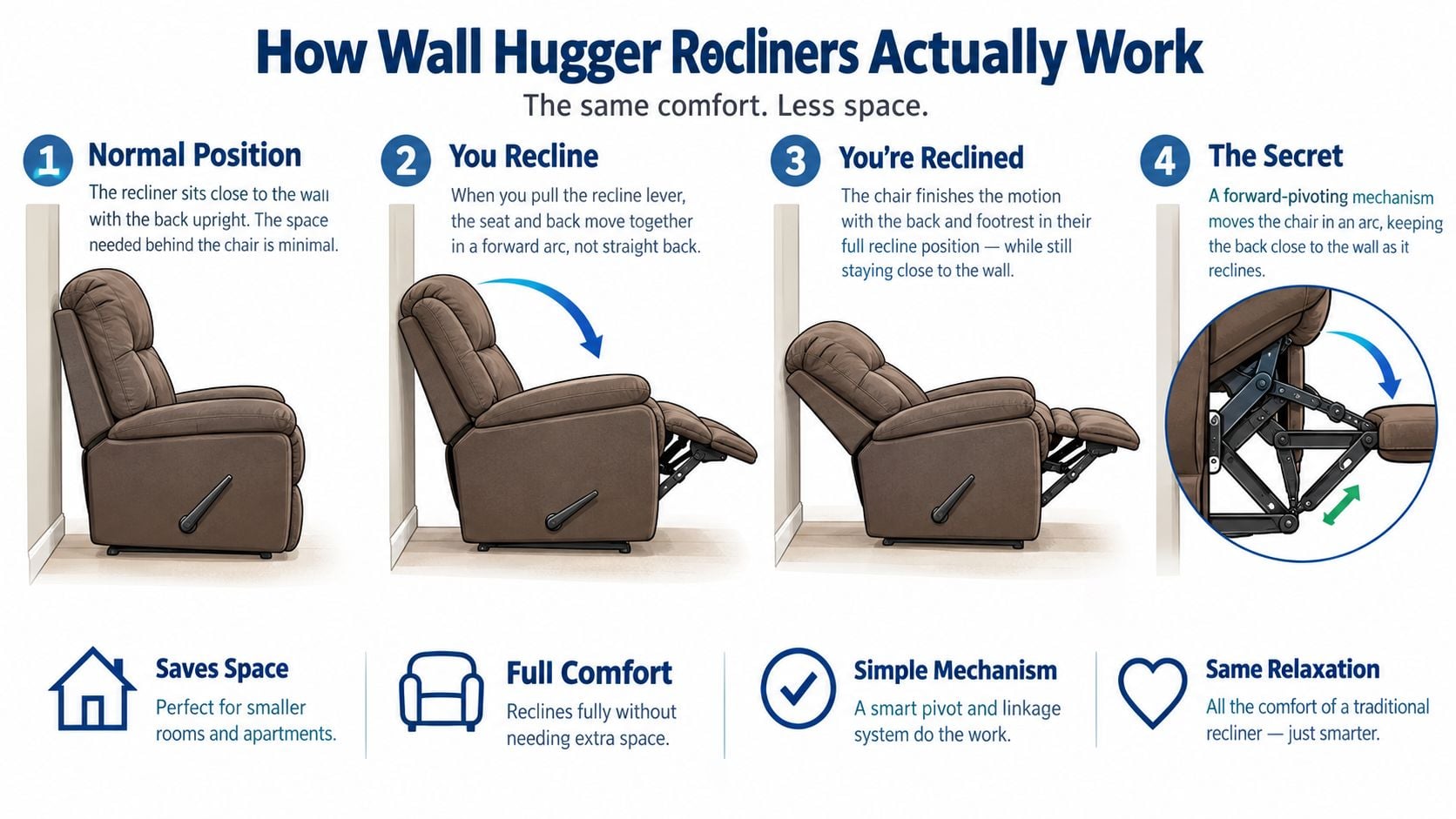
A wall hugger recliner is a space-saving chair engineered to recline close to a wall. Instead of sending the backrest through a wide backward arc, the mechanism moves the seat forward as the back tilts. The chair can still provide a full reclining function, but its motion fits a tighter floor plan.
That distinction matters in Hampton Roads homes, where a living room may need to serve as a family room, reading area, and entertainment space at the same time. A conventional recliner can force the entire seating arrangement away from the wall. A wall hugger preserves more of the open floor behind the chair, which can help protect walking paths and keep the room from feeling crowded.
Practical rule: A wall hugger solves a wall-clearance problem, not every space problem. The chair still needs room to move forward and extend its footrest.
Homeowners planning a smaller room can also benefit from broader layout guidance in the RBA Home Plans design guide. The same principle applies to recliners: furniture should support the room's circulation instead of forcing people to work around it.
A wall hugger is also called a wall-away recliner, wall recliner, or zero-wall recliner. Those names describe the same basic idea, a reclining chair that relocates its movement away from the wall. The engineering shift from backward-swinging mechanisms to forward-gliding mechanisms made reclining seating more workable in apartments, smaller living rooms, and senior-friendly spaces.
Before purchasing, the room should be measured while considering the complete layout, not just the chair's upright footprint. The small living room setup guide can help homeowners think through sofa placement, pathways, tables, and seating relationships before a recliner arrives.
For a Virginia Beach homeowner, the recommendation is straightforward. If the chair must sit near a wall, a wall hugger deserves serious consideration. If the room has generous open space behind the seating, the specialized mechanism may be less important than comfort, upholstery, and overall style.
How Wall Hugger Recliners Actually Work
The mechanism is simpler to understand than the name suggests. A wall hugger uses a forward-gliding track system beneath the seat. When the chair reclines, the seat base travels forward while the backrest tilts backward, shifting the motion away from the wall.
A standard recliner typically relies on a fixed pivot that sends the backrest into the room. Many standard models need roughly 10 to 18 inches of rear clearance, while a wall hugger often needs only about 3 to 6 inches. Those figures vary by model, so the manufacturer's specification remains the final authority. The basic comparison is documented in this wall hugger recliner product guide.
Measure the rear clearance
Start by measuring from the wall to the chair's structural back, not just to the loose cushion. Many models need only a few inches behind them, but the exact requirement depends on the track and pivot design. A chair that appears suitable can still contact trim, molding, or a nearby obstruction if the measurement is taken casually.
The mechanism may require internal forward travel within the base. That travel lets the seat reposition itself while preserving the reclining geometry. In practical terms, the back stays comparatively close to the wall, but the chair's moving parts still need space to operate.
Measure the front clearance
This is the hidden requirement that causes the most installation mistakes. As the seat glides forward and the footrest opens, the chair occupies more usable space toward the room. One product listing specifies 4 inches of wall clearance and 25.5 inches of front clearance for full reclining, as shown in this wall hugger recliner specification.
Another listing shows a different model requiring 4 inches behind the chair and 26 inches in front, with a fully reclined depth of 65.5 inches. Its upright dimensions are 39.5 inches high, 34.75 inches wide, and 37.75 inches deep, demonstrating why measurements must be checked for the exact chair rather than copied from a general category guide. The details appear in this model measurement listing.
Check the operating style
Manual chairs use a lever or handle, while power models use an electric control. Both can use the forward-gliding principle. Buyers comparing motorized operation, adjustment, and placement should review this guide to power recliners.
The correct sequence is simple: measure the wall gap, measure the front path, mark nearby furniture, and test the chair fully open. A wall hugger saves rear space, but it can't make a coffee table, ottoman, or walkway disappear.
Comparing Wall Huggers to Other Recliner Types
A wall hugger is defined by how it moves, not by whether it has fabric upholstery, leather, power controls, or a particular silhouette. That makes it different from categories such as rocker recliners and lift chairs, which address other priorities.
| Seating type | Primary strength | Main placement consideration |
|---|---|---|
| Wall hugger recliner | Preserves rear wall space during reclining | Needs forward clearance for the sliding seat and footrest |
| Traditional or rocker recliner | Offers familiar reclining, with rocking available on rocker models | Usually needs substantially more room behind the chair |
| Lift chair | Assists the user when standing or sitting | Requires attention to operating space and mobility needs |
A traditional rocker recliner makes sense when gentle rocking is a central requirement and the room has enough open floor behind the chair. It isn't automatically the right choice for a tight layout. A wall hugger generally prioritizes compact placement over rocking movement.
A lift chair serves a different purpose altogether. Its powered lifting action helps a user transition between sitting and standing, which can be valuable for seniors or anyone with mobility concerns. A wall hugger may be comfortable for a senior, but its defining feature is wall-saving movement, not assisted standing.
Manual and power wall huggers
The manual-versus-power decision deserves more attention than it usually receives. Manual operation can suit buyers who prefer a straightforward chair without an electrical connection. Power operation offers button-controlled positioning and may be easier for someone who finds a lever difficult to use.
Recent buying coverage indicates that higher-priced recliners increasingly pair wall-hugger mechanisms with power functions and premium upholstery, creating a broader choice between compact placement and upgraded comfort features. That makes the power versus manual recliner comparison useful before choosing a mechanism.
The recommendation is practical. Choose a wall hugger when rear clearance controls the layout. Choose a lift chair when standing assistance is the priority. Choose a rocker when rocking matters and the room can accommodate its movement. A power wall hugger is the strongest fit when precise adjustment and easy operation matter more than mechanical simplicity.
Ideal Settings for Wall Hugger Recliners
Coastal Virginia homes often need furniture that works hard without making the room feel overfilled. A wall hugger fits that assignment because it can sit near a wall while preserving the chair's reclining function. The result is more flexibility in rooms where a conventional recliner would push the seating arrangement too far into the walkway.
A compact home theater is a natural setting. The chair can sit near the rear wall while the front remains planned around footrest extension and movement. In a bedroom, it can create a reading or recovery corner without consuming the open area needed for dressers and circulation. In a small den, it can provide dedicated relaxation seating without overwhelming a desk, bookcase, or media console.
Three useful placements
- Home theater: Keep the rear wall visually clean while planning the front clearance around the reclined position.
- Compact bedroom: Use the chair as a reading seat or quiet retreat where a larger seating arrangement would dominate the room.
- Small den: Pair one wall hugger with a restrained table or lamp instead of forcing a full sofa-and-chair grouping into limited space.
A wall hugger doesn't have to look utilitarian. Upholstery, arm shape, stitching, scale, and color determine whether the chair blends into a coastal interior, a traditional room, or a sleeker modern setting. In a well-planned room, the recliner can become a deliberate focal point rather than a bulky afterthought.
A compact chair still needs visual breathing room. Leave enough open floor around the moving parts, then use fabric and proportion to make the piece feel intentional.
Homeowners should assess the chair in both positions, upright and fully reclined. The space-planning techniques guide offers a useful framework for considering scale, flow, and furniture relationships. That approach prevents the common mistake of choosing a chair that fits against the wall but blocks the room once opened.
Evaluating the Benefits and Trade-offs
The strongest benefit is clear: a wall hugger lets a room keep more usable space behind the chair. That can preserve a walkway, maintain a cleaner furniture line, and make a compact living room feel less congested. The design also gives buyers more freedom to place reclining seating in bedrooms, dens, and media areas where a traditional model might not work.
The trade-off is equally clear. The chair moves forward, so the front clearance becomes part of the furniture footprint. A coffee table placed too close can interfere with the footrest, the sliding seat, or the person using the chair.
Where the design earns its keep
- Tight wall placement: The chair can sit much closer to the wall than a conventional recliner, subject to the model's specification.
- Layout flexibility: Homeowners can protect rear walkways and make better use of narrow room dimensions.
- Comfort-focused seating: The mechanism changes the path of movement, not the basic purpose of the chair. Buyers can still prioritize cushioning, head support, lumbar support, and upholstery.
- Room zoning: One chair can define a reading corner or media seat without requiring a large open zone behind it.
The mechanism can also add complexity. A forward-gliding design uses track and pivot components to coordinate movement, so buyers should inspect the construction, listen for rough operation, and ask how service is handled. A manual model may appeal to someone who values mechanical simplicity, while a power model may provide easier control and more precise positioning.
The value decision
High-quality American-made mechanisms and premium upholstery naturally command more than entry-level imported construction. That higher cost can be justified when the chair will receive frequent use, must fit a difficult layout, or needs to coordinate with a carefully designed room. It shouldn't be justified by the phrase “wall hugger” alone.
A sensible buyer evaluates the complete package: frame quality, track movement, seat support, fabric or leather, warranty coverage, repair access, and room fit. The best choice isn't the chair with the smallest rear gap. It's the chair that reclines smoothly without obstructing the room or compromising daily comfort.
Choosing Your Perfect Recliner at Willis
Selection should begin with the room, then move to the body, then finish with appearance. A chair that looks excellent in a showroom can still feel wrong if its seat depth, arm height, or front clearance doesn't suit the home.
Start with the fit
Measure the wall clearance and the complete forward path before focusing on color. Then assess seat depth and support while sitting upright and reclined. The chair should support the intended posture without forcing the user to stretch for the footrest or crowding the knees against the arms.
Fabric deserves equal attention. A busy household may benefit from a durable, forgiving upholstery choice, while a formal room may call for precise fabric or leather. The right material should match cleaning expectations, traffic, pets, sunlight, and the room's existing palette.
Choose the mechanism
A manual wall hugger is a sensible option for buyers who prefer direct operation and fewer electrical requirements. A power model makes more sense when button control, precise positioning, or easier adjustment is important. Buyers should operate each chair through its full range rather than judging it while upright.

Willis Furniture & Mattress offers wall hugger models alongside broader recliner choices, allowing shoppers to compare manual and power operation in person. Its Design Center can customize the look through upholstery selections, including fabrics and leathers, and can help coordinate a recliner with the room's scale and style. Custom options from brands such as Stressless and Barclay Butera support a more individualized result for homeowners who want premium comfort without treating the chair as an afterthought.
Financing can also make a carefully selected piece easier to plan for. Willis offers financing options through Synchrony HOME for qualified buyers, including promotional financing on eligible purchases, subject to the account terms and current offer details.
The showroom is useful for testing the details that specifications can't settle. A Virginia Beach shopper can sit in the chair, operate the mechanism, check the front movement, compare upholstery, and discuss delivery placement before making a decision. For budget-conscious buyers, the Willis Outlet provides access to discounted quality pieces, floor samples, and overstock items, while still keeping the focus on creating a functional room.
The living room recliner collection is a practical starting point, but the final decision should come from a full-room evaluation. The right wall hugger isn't just the one that fits near the wall. It's the one that supports the household, suits the room, and remains comfortable every day.
Willis Furniture & Mattress offers wall hugger recliners, custom upholstery guidance, room-planning support, and accessible options through its Design Center and Willis Outlet. Visit Willis Furniture & Mattress in Virginia Beach to test the reclining motion, confirm the hidden front clearance, and choose seating that fits the home properly.


