
How Does Deferred Interest Work on Furniture


Deferred interest accrues during the promotional period and is waived only if that promotional balance is paid in full by the deadline; if any of it remains, the accrued interest can be charged retroactively from the original purchase date. On a $1,200 sofa bought on a six-month promotion at a hypothetical 29.99% annual rate, the accrual waiting in the background is about $180 before compounding.
A showroom on a Saturday afternoon makes the next part concrete. A sofa fits the room, the offer reads six months with no interest if paid in full, and the approval slip lists a minimum payment small enough to feel harmless. The purchase feels finished well before the delivery truck is scheduled.
It isn't finished. The minimum payment and the payment that earns the waiver are different numbers, and the distance between them is where most of the confusion about how deferred interest works sits. What follows turns the deadline into a monthly dollar target, prices what a miss costs, and separates this product from a true zero-percent offer.
Deferred Interest Is a Waiver With a Deadline
A $40 minimum payment keeps the account current; it leaves most of a $1,200 balance unpaid when the six-month deadline arrives. That distance between "current" and "cleared" is the part to price before signing.
Deferred interest is interest the lender calculates during the promotional window and holds off the statement. No finance charge appears while the offer runs. The waiver generally applies only when the promotional balance attached to that purchase reaches zero by its own end date.
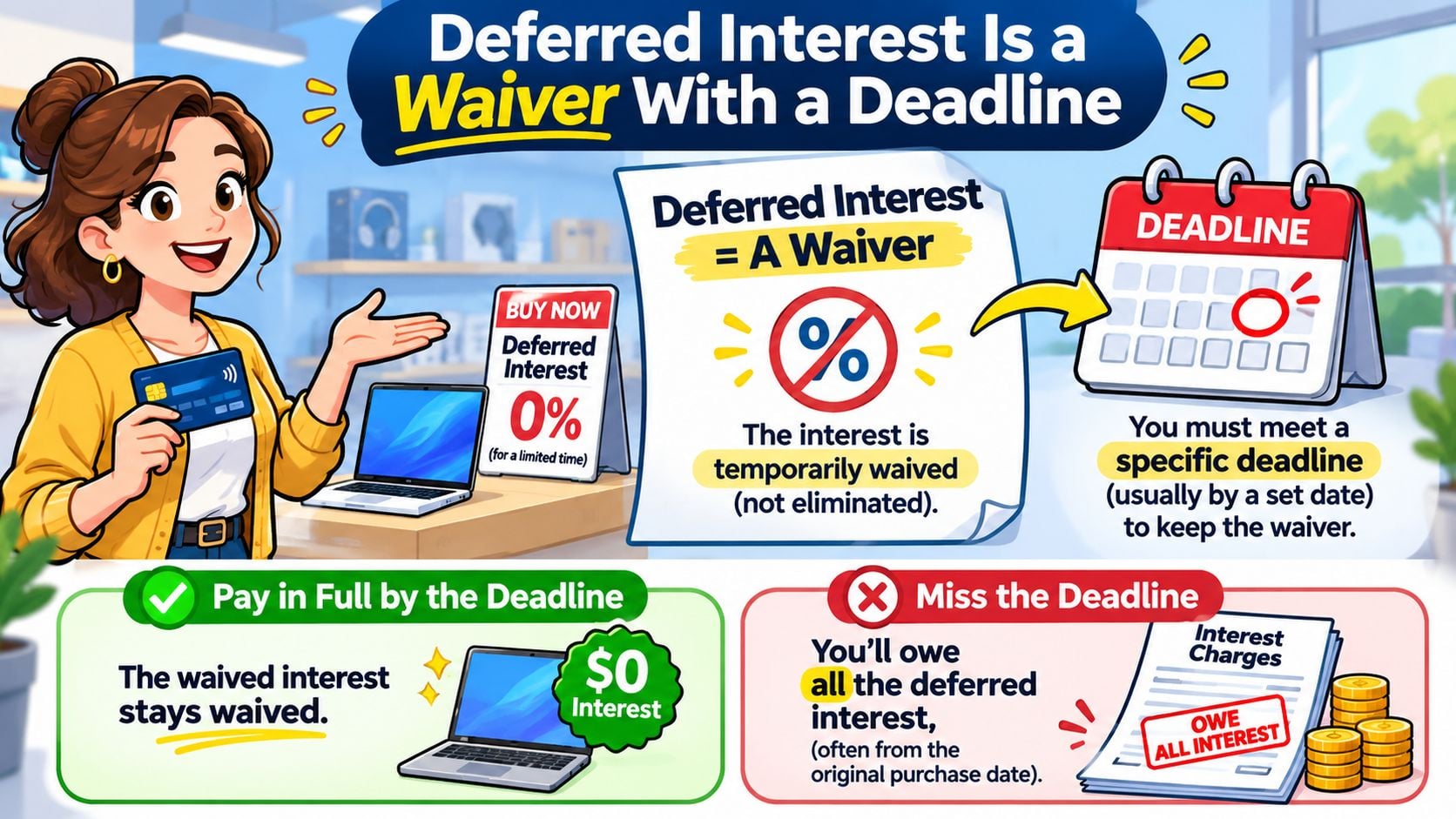
The mechanic works like a glass jar on the counter. Each day the promotional balance remains, a little interest drops in where the shopper cannot see it. Reach zero by the deadline and the jar is emptied with the waiver. Leave even a small amount and the lender can bill the jar's contents back to the original purchase date.
That is the surprise in the paperwork. A leftover balance can make months of stored interest payable at once, on top of the amount still owed.
Three items are worth circling in pen before the signature.
- The end date of the promotion, which attaches to the purchase rather than to a convenient statement cycle.
- The promotional balance itself, meaning which receipt qualifies and how later payments are allocated if the same account holds other balances.
- The regular APR behind the offer, the rate that governs the account once the window closes or the balance fails the paid-in-full test.
For the arithmetic that converts an APR into a daily charge, understand daily rate math and grace periods shows how issuers build that number, the same math behind any retroactive bill. The financing options at Willis Furniture & Mattress put the available plans in writing, easier to compare before the delivery date than after.
The rule in one line: the interest-free period is conditional, and the condition is a zero promotional balance on a specific date.
The Monthly Payment That Clears the Promotion
The working formula is one division. Take the promotional balance, divide it by the number of months in the promotion, and treat the result as the floor for every payment. A $1,200 sofa on a six-month offer gives $200 a month. Six payments at that size clear the balance before the deadline, and the accrued interest is generally waived.
Shave the payment to $190 and the arithmetic turns. Six payments of $190 total $1,140, about $60 short of the balance, and a promotional balance that never reached zero can release the interest that has been collecting since the purchase date. The shopper who sent $1,140 gets no partial credit, because the test is paid in full, not nearly paid off.
Why the minimum payment is the wrong target
The minimum on the statement exists to keep the account current, not to finish a promotion. On a longer window it can be a small fraction of balance divided by months, which is exactly the trap. The CFPB's explanation of no-interest-if-paid-in-full offers notes that minimum payments are often insufficient to retire a promotional balance, and warns that payments can exceed the promotional balance while other purchases on the account absorb the money, leaving the designated purchase short at the deadline.
The buffer that covers the messy weeks
Round the calculated payment up rather than down. Take $200 to $215 or $220 and the plan survives the four things that usually go wrong.
- Tax folded into the balance. A financed tax line lifts the promotional balance above the sticker price, so divide the financed number.
- Delivery that posts later. A purchase that hits the account days after the showroom visit loses those days off the runway.
- A pending return. A credit for a returned cushion reduces what's owed only once it posts, not the day the truck takes it back.
- A payment that posts late. A scheduled date landing on a weekend or after the issuer's cutoff pushes the money into the next cycle.
Payment allocation deserves its own line. On a revolving account, money paid above the minimum can be applied to newer charges rather than to the promotional purchase, so confirm how the issuer applies payments and keep new charges off that card until the promotional balance reads zero. A fixed-rate installment product, the kind described in this guide to closed-end loans for thin credit files, trades the waiver for a set schedule and removes the allocation question entirely.
Then build one habit. On every statement, find the promotional expiration date, read the remaining promotional balance, and check that the automatic payment still matches the new balance divided by the months left. The store's easy financial options for furniture page keeps those terms in one place for the comparison.
| Purchase setup | Promo length | Payment to plan | Result |
|---|---|---|---|
| $1,200 sofa paid at $200 a month | 6 months | $200 | Reaches $0 before the deadline and accrued interest is generally waived |
| $1,200 sofa paid at $190 a month | 6 months | $190 | About $60 remains and retroactive interest can be charged from the purchase date |
| $299 qualifying purchase on one receipt | 6 months | About $50 plus a buffer | Can clear a six-month offer; below $299 or a split receipt may miss the promotion |
| $1,999 purchase on one receipt | 12 months | About $167 plus a buffer | Matches a 12-month no-interest-if-paid-in-full window when the threshold is met on one receipt |
| Lender minimum payment only | Set by the offer | Often well below balance divided by months | Keeps the account current but does not guarantee a zero promo balance |
What Retroactive Interest Adds After a Miss
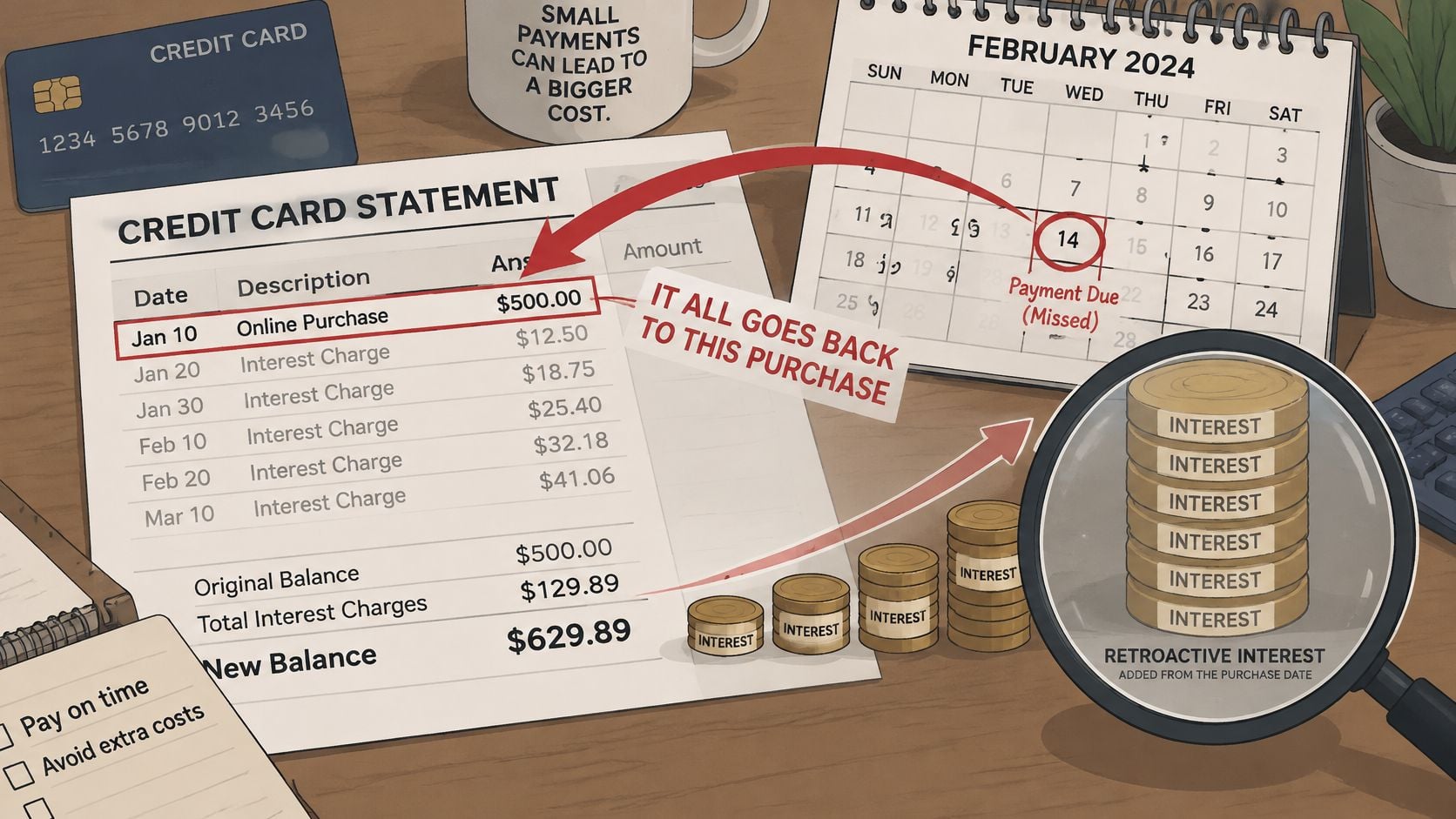
A few dollars left at the deadline can pull in interest on every balance that existed from the purchase date forward. The promotion works like a stack of daily charges held in a drawer: paid in full by the posted date, the stack is waived. Short by a cushion, a tax remainder, or one late posting, the whole stack comes due.
The CFPB's issue spotlight on the high cost of retail credit cards found that roughly one-fifth of deferred-interest promotional balances historically received retroactive interest charges. Interest accrues during the promotion and is not billed immediately. If any qualifying balance remains, the lender can apply the accumulated interest retroactively, often from the original purchase date rather than only on what is left.
Follow that accrual across a six-month sofa promotion. In month one the daily rate runs against nearly the full purchase, while the statement still shows no interest due. Each payment above the lender's minimum shrinks the balance that accrues the next month, so month four costs less per day than month one. Those early, larger days stay in the stack. A minimum-only payment keeps the account current and barely reduces it, which is how a balance can look almost gone in month six and still carry a large hidden total. Agreements that compound on daily balances add a bit more each day on top of the prior day's interest, and that total runs higher than a charge figured only on the unpaid remainder.
The scale is large. CFPB credit card market data shows total deferred-interest charges climbing from just under $2 billion in 2021 to more than $3.8 billion in 2024.
Why the final week decides the outcome
Two households buy the same sofa. One sets an automatic payment equal to the promotional balance divided by the months left, finishes with room to spare, and owes the purchase price only. The other sends an amount that feels close, stops short, and receives the accumulated charge from the purchase date. Most of the sofa was paid. The waiver still failed.
The final week is where careful plans break. A returned cushion still in dispute, a payment that lands the day after expiration, or a few dollars of tax left on the promotional balance can each fail the paid-in-full test. Schedule the last payment for a week before the deadline and confirm the posted balance rather than assuming the transfer arrived.
What to look for in the agreement
Read three things: the APR that applies after a miss, the exact expiration date, and whether the waiver covers only that promotional purchase. The waiver disappears for the entire accrued amount once the condition is missed, which is why a small buffer matters more than rounding the payment down to a tidy number.
A mattress runs on the same mechanics, and the financing for a mattress terms at Willis Furniture & Mattress are worth comparing with the sofa terms before both land on one account.
A Sofa Purchase From Receipt to Payoff Date
The promotion lives on the receipt before it lives on any calendar. Under Synchrony's HOME Credit Card terms, the deferred-interest offer runs six months on qualifying purchases of $299 or more, with the qualifying amount on a single receipt and framed as "no interest if paid in full" rather than as an unconditional zero-interest loan.
Take a $2,400 sectional with two $110 throw pillows. Rung up together, the pillows join the promotional balance. On a second receipt they fall below the $299 floor and ride the regular APR instead. One transaction, one promotion, one deadline.
Divide $2,400 by six and the payment is $400. Tax folded into the balance plus a delivery charge that posts a few days later push the working number to $440, and that is the figure entered into the automatic payment setup before the sofa leaves the truck. Change the order to a $1,900 loveseat and the same window calls for roughly $317 a month before the buffer. The price sets the payment; the receipt sets the clock.
Month one through month five
The first statement is the important one. It should show the payoff deadline, and the buyer checks that the promotional balance matches the full $2,400 rather than a piece of it. The card then stays in a drawer, because a floor lamp charged in month two joins the same revolving account and competes with the sectional for every dollar sent in.
Payment allocation is the quiet risk in this story. Issuers apply payments by their own rules, so every extra charge on the account gives the next payment somewhere else to go. Keeping the card parked means each $440 lands entirely on the promotional balance.
An ottoman return in month three changes the balance only after the credit posts. The automatic payment stays at $440 until a statement shows the lower promotional figure, then it is recalculated from the new balance divided by the months left. The last payment is whatever the final statement still shows, sent as a payoff rather than an installment.
The near-miss version runs the same math with one sloppy habit. The buyer rounds the automatic payment down to a friendlier figure, adds a rug to the same account two months later, and discovers in the final month that the payments retired the rug while part of the sectional balance stood open. Interest calculated from the original purchase date then arrives alongside the remaining furniture balance.
The receipt decides the promotion before the payment schedule does. Get the whole qualifying purchase onto one transaction, then let the deadline set the monthly amount.
The showroom work comes first, and this guide to how to buy a couch covers fit, fabric, and delivery timing. Once the order is written, the financing plan is a division problem that runs for six statements.
Deferred Interest Compared With True 0 Percent APR
A "no interest for 12 months" tag can sit on either of two different contracts. Under a waiver, interest is tracked from the first day and cancelled only when the promotional balance reaches zero on time. Under a true 0% APR period, nothing accrues during the window, so a balance left over starts collecting the regular rate from that day forward.
That single difference changes what a missed deadline costs.
| Question | Deferred interest | True 0% APR |
|---|---|---|
| Does interest build during the window? | Yes, tracked but not billed | No |
| Balance paid in full on time | Tracked interest is waived | Nothing was owed beyond principal |
| Balance still open after the deadline | The waived amount posts at once | The regular rate applies to the remainder going forward |
| Is the minimum payment enough? | Rarely; the safe figure is balance divided by months | Also leaves a balance, but the cost runs forward only |
| Other purchases on the same card | Each payment can retire new charges while the promo balance stands open | Allocation still decides which balance shrinks first |
Which offer fits a finished payoff
Deferred interest costs nothing when the payoff is already funded: the balance divided by the promotional months becomes the automatic payment, set with a small buffer, and no new charges join the card. The waiver then behaves exactly like an interest-free loan, because the deadline was never in doubt.
A true zero period is the calmer fit when income is uneven or the room is being furnished piece by piece. A balance that outlives the window owes only the regular rate from that day on, so the deadline marks a change in billing instead of a trapdoor.
"No interest if paid in full" is always the deferred kind. An unconditional zero rate needs no "if," so the conditional phrase is the deadline announcing itself.
The monthly statement prints the promotion's expiration date, and on a deferred-interest account it also shows the accrued amount waiting on the other side of that date. The account agreement sets the regular APR and the exact cutoff, so reading the statement each month keeps the payoff figure current as the months remaining shrink.
Two signs in the same showroom can both promise six months free of interest and mean two different products. What separates them is one fact about timing: whether interest accrues during the window or only after it ends.
Decide Before You Apply
A $2,400 sectional on a six-month deferred-interest offer comes to about $400 a month before tax and delivery. That amount has to land on the promotional balance itself. If the next paycheck cannot cover it on the day you apply, waiting costs less than signing.
Run the decision against money you already have.
- Yes: the monthly figure fits inside regular income, the automatic payment is set above it, and the cash buffer for tax, delivery timing, or a return is in the account today.
- Wait: the plan depends on a tax refund, a refinance, or a raise that has not arrived.
- Shrink: the balance would fall into a shorter window than expected, or two receipts would split the purchase below the qualifying minimum.
- Choose a different structure: a fixed-rate installment plan turns the deadline into a schedule, and a leftover balance does not pull interest back to the purchase date.
The same promotion does not treat every applicant alike. CFPB remarks on the deferred-interest market report that consumers with low credit scores avoided retroactive interest only about half the time, compared with nearly 90% for consumers with high credit scores. Among consumers charged deferred interest who also had other purchases on the account, more than half had paid more than the full promotional balance during the promotion, and over one-third had paid more than 150% of it.
A higher score lines up more often with a payoff that finishes. A lower score leaves more room for a small leftover to become a charge dated back to the purchase. The second finding is the allocation trap. Extra dollars can pay down other charges on the same card and still miss the furniture balance the waiver requires. The issuer applies each payment according to the account rules, so the amount that zeros the promotion is the amount posted to that purchase, not the total that left your bank.
A late paycheck, a return dispute, an emergency repair, or a few dollars left unpaid can each start that backdated charge. Those events are ordinary, which is why the payment has to survive them. Pulling an instant cash advance to cover a furnace repair in the same month a furniture payment is due is the scramble that leaves the promo balance short.
For a full room at a premium price, Willis Furniture & Mattress offers financing built around promotional terms like the ones described here. Credit approval and the account agreement set when the waiver applies. A full-room project is easier to keep on one qualifying receipt when the Design Center handles custom upholstery, space planning, and coordinating rugs and lighting as one plan. A smaller balance that can be cleared inside a short window fits the Willis Outlet, where floor samples and overstock lower the total before the math starts.
A shopper comparing a smaller purchase with a stretch can use how to decorate a living room on a budget to see how far a partial room can go while the financing question settles. If the calculated payment does not fit the household budget, wait or buy less. A $900 sofa paid outright costs less than a $2,400 sectional that ends up carrying interest calculated back to the day it was ordered.
Willis Furniture & Mattress can put this math in front of you before anything is signed, from the qualifying purchase thresholds to the delivery schedule that determines when the clock starts. The Design Center and the Outlet are both on the Virginia Beach campus, and financing questions can be discussed during your visit. Visit Willis Furniture & Mattress to see the collections and the promotional terms side by side before you choose.


