
How to Buy a Couch That Fits Your Life


The most popular couch-buying advice starts in the wrong place. Shoppers are told to choose a style, match a color, and measure the living-room wall. That approach ignores the expensive failures: a sofa that can't get through the front door, cushions that collapse under daily use, upholstery that doesn't suit the household, or financing that becomes costly when the balance remains unpaid.
A better approach treats a couch as a long-term household system. The right decision combines delivery logistics, construction, fabric performance, safety, maintenance, and total cost of ownership. Style still matters, but it comes after the piece can enter the home, support the people using it, and remain serviceable.
Comfort deserves attention, too. Consumer data reports that 99% of surveyed sofa buyers require comfort, while 98% prioritize the desired size, 96% want easy cleaning, 84% expect a warranty, and 78% want the sofa to last about 15 years (Home News Now consumer insights). Those priorities point to a clear standard: shoppers should buy for the way a household lives, not for the photograph that first caught the eye.
Mapping the Delivery Route Before Choosing a Style
Room measurements aren't enough. A couch can fit perfectly against the intended wall and still fail at the front door, hallway, staircase, elevator, or final turn into the room. Delivery clearance is a hard constraint, so it belongs at the beginning of the purchase, before anyone falls for a particular silhouette or fabric.
Measure the sofa itself, including overall width, height, depth, and diagonal depth. Then measure every narrow point along the route from the street or loading area to the room. Delivery guidance recommends checking exterior doors, interior doorways, hallways, staircases, elevators, and tight turns, while accounting for trim, hinges, doorknobs, handrails, baseboards, and other fixed obstructions.
The narrowest point controls the decision
The usable opening is not just the door slab's advertised width. Entry clearance, meaning the space between an open door and the opposite wall, can determine whether the delivery team can rotate the couch into the home. A practical rule is straightforward: the furniture's relevant width or height must be smaller than every passage dimension, and diagonal depth matters when the sofa must be tilted.
A reliable route worksheet should include:
- The sofa dimensions: Record width, height, depth, diagonal depth, and packaged dimensions in the same units.
- The route: Sketch exterior doors, thresholds, hallways, stair turns, elevator openings, and the intended wall.
- Fixed obstructions: Include trim, hinges, knobs, railings, baseboards, ceiling restrictions, and tight corners.
- The configuration: Ask whether legs, backs, doors, or modular sections can be removed, and obtain the answer in writing.
Practical rule: Measure the route as carefully as the room. The smallest clear opening, not the most generous one, determines whether the purchase works.
A modular sofa may solve a difficult stair or hallway, while removable legs may create just enough clearance for a standard frame. Those options need confirmation before ordering, not a hopeful conversation on delivery day. Willis Furniture's furniture delivery and assembly information can help shoppers understand what delivery planning should address.
The route exercise also improves scale. Once the buyer knows how much furniture can enter the home, the room plan can reserve circulation space instead of filling every available inch with seating. A couch should support conversation, movement, and access to doors, tables, and windows. Style selection becomes easier when the practical boundaries are known.
Inspecting Frame and Suspension for Long-Term Durability
Style gets attention. Construction determines whether the sofa still earns its place after years of daily use, cleaning, and people dropping into the same seat night after night. If you want better long-term value, inspect the parts you cannot see first, then judge comfort.
Start with the frame
Ask the salesperson to identify the frame material and the joinery, not just the collection name. Kiln-dried hardwood is still one of the clearest signs of a better-built sofa because controlled drying helps reduce warping and shifting over time. Then ask the practical follow-up questions. Are the joints reinforced? Can structural parts be serviced? Is there a written construction specification?
Suspension matters just as much. Eight-way hand-tied springs remain a strong benchmark for support and longevity. Webbing can feel fine in a quick sit, but it may lose tension with use. If you want to understand what is under the deck and what repair looks like, read this guide to sofa suspension repairs. It gives useful context before you buy.
Open the cushion conversation
Cushions are where many shoppers get distracted. A plush top layer can hide a weak core, and that mistake shows up fast in a family room. Unzip a cushion if the floor sample allows it, or ask for the exact cushion build in writing: core, wrap, fill, cover, and whether replacements can be ordered later.
Replaceable cushions usually beat impressive showroom softness. A sofa you can refresh often costs less to own than one that looks good for a short stretch and then forces a full replacement.
Test it like you live in it. Sit upright. Recline. Stretch out. Stand up without pushing off awkwardly. In the Willis Design Center, a serious sit test means staying put long enough to notice lumbar support, seat depth, cushion recovery, and whether the frame feels steady instead of flexing under you.
- Frame: Confirm material, joinery, reinforcement, and service support.
- Suspension: Identify springs or webbing and ask how repairs are handled.
- Cushions: Check the core, recovery, removable covers, and replacement options.
- Real-use test: Try upright sitting, lounging, stretching out, and getting up.
Cheap sofas often cost more because weak frames and tired suspension are expensive to live with and hard to fix. Better construction, serviceable parts, and replaceable cushions usually win the total cost argument. When you compare models, ask each retailer for written specs. Willis documents those details in its durable upholstered furniture collection.
Selecting Upholstery for Real-World Living
A good-looking sofa can still be the wrong buy if the fabric cannot handle the way your house runs. Start with wear, cleaning, sunlight, pets, and how often the sofa gets used. In a coastal home, moisture and bright light punish the wrong textile fast, and a fabric that looked perfect under showroom lighting can turn into a maintenance job you resent.
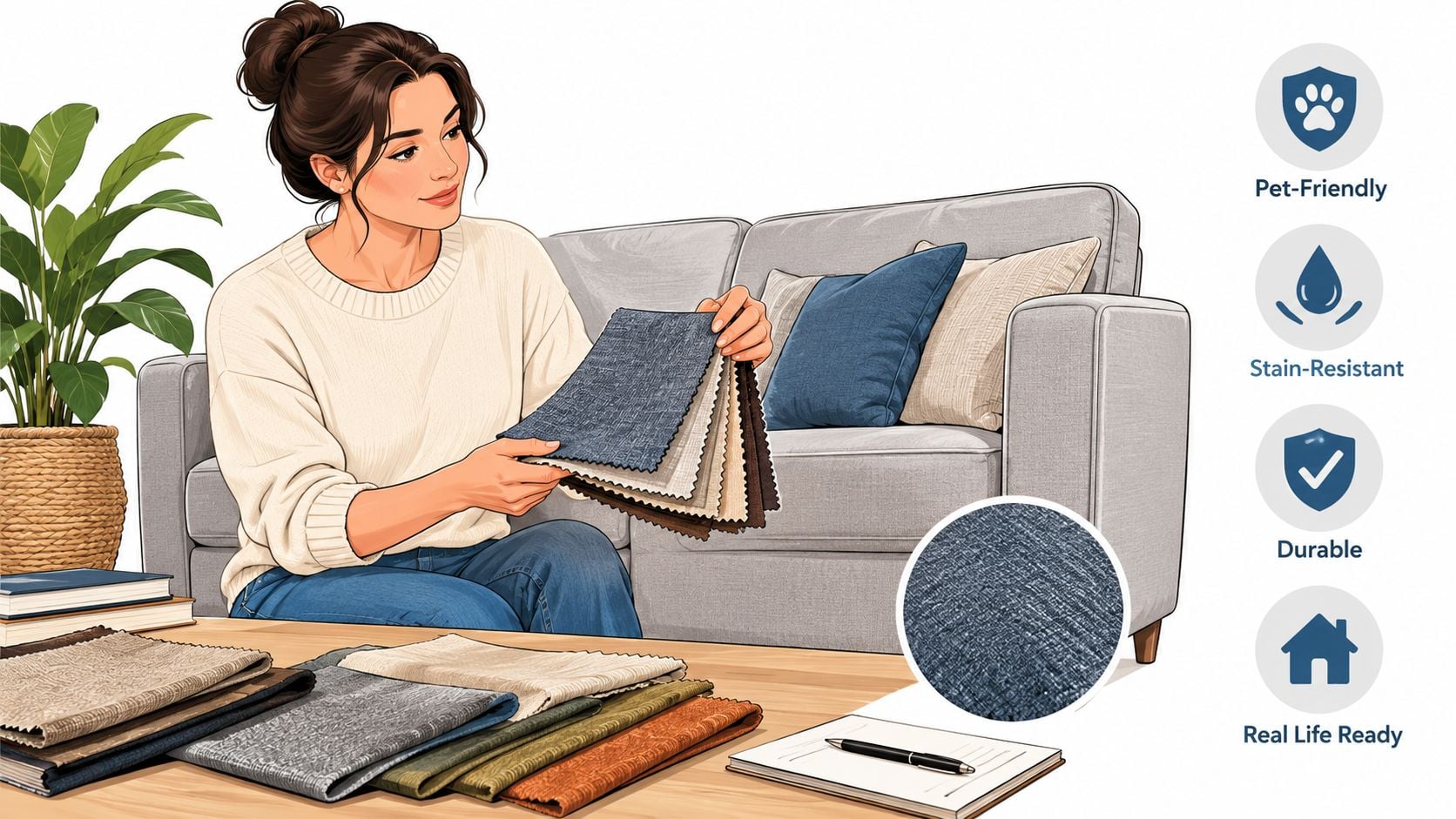
Match the textile to the household
Natural fabrics still have a place. Cotton and linen bring softness, texture, and a relaxed look that many buyers want. They also ask for more discipline. In low-traffic rooms, that trade-off can be perfectly reasonable. In a family room with snacks, naps, guests, and daily use, it usually is not.
Use a working rule that holds up in real homes. Tightly woven polyester blends usually outlast loose all-cotton or all-linen weaves in active rooms, and they are often easier to live with day to day. Commercial-grade, performance, and indoor-outdoor options also deserve a hard look when durability and cleanability matter most.
Do not accept vague labels like “family friendly” without specifics. Ask how the fabric handles abrasion, spills, pet claws, sun exposure, and repeated cleaning. Those answers affect total cost of ownership more than the color name on the tag.
Ask for measurable fabric information
A fabric card should give you something concrete to judge. Ask for abrasion information, stain resistance, cleaning code, lightfastness, and whether the upholstery is replaceable later. A pale, open weave may be fine in a decorative room. A tightly woven performance fabric usually makes more sense where people live on the sofa.
Dog owners need to pay attention to texture and weave, not just fiber content. Claws catch on some fabrics long before stains become the problem. This guide to the best furniture material for dogs is a practical starting point, especially if your dog sheds, scratches, or jumps on the same cushion every day.
Custom upholstery earns its keep when you want a certain silhouette or color scheme without making a bad durability decision. At the Willis Design Center, a trend can be adapted with fabric or leather choices that fit the room and the household. That is the right use of customization. You are not buying style alone. You are choosing a cover you can maintain, clean, and live with for years.
Fabric test: A swatch is only a starting point. The right upholstery should match the household's mess, maintenance tolerance, light exposure, and daily seating pattern.
Always take home a physical sample. Check it in morning light, afternoon light, and lamplight. Read the care instructions before you order, not after a spill. Day-one appearance matters. Long-term resilience matters more.
Navigating Financing and Outlet Savings
Premium furniture becomes more accessible through two very different paths. Promotional financing supports a custom or made-to-order purchase when the household can follow a disciplined payoff plan. Outlet shopping lowers the entry price by accepting availability-driven inventory and less customization.
| Buying Pathway | Best For | Key Trade-Off |
|---|---|---|
| Promotional financing | Buyers who want custom upholstery or a premium construction package | Deferred interest can be charged from the purchase date if the promotional balance isn't paid by the deadline |
| Outlet floor model | Buyers prioritizing immediate availability and a lower price | Selection, finishes, sizes, and reorder options may be limited |
| New full-price purchase | Buyers who need a specific configuration and broad customization | Higher upfront cost without outlet markdowns |
Treat deferred interest as a deadline
Qualifying purchases from $299 to $1,998.99 may receive six months of promotional financing, but the full promotional balance must be paid by the deadline or accrued interest from the purchase date can be charged (Synchrony HOME financing terms). Purchases of $1,999 or more may qualify for 12 months, subject to current eligibility and account terms (consumer finance guidance).
The correct calculation is simple. Divide the total promotional balance by the number of promotional months, then plan to finish repayment before the deadline. Minimum payments may not retire the balance in time, so shoppers should review the account terms and use a pre-application checklist before committing.
Understand what the outlet changes
Outlet savings generally come from overstock, discontinued collections, canceled orders, floor samples, and pieces with minor cosmetic wear. That inventory isn't automatically lower quality, but each exact piece requires inspection because a particular configuration may not be replaceable.
Floor samples are commonly discounted 30% to 50% from original retail pricing, although the actual markdown varies with condition, age, and discontinuation status (Willis Furniture floor-sample guidance). A shopper should inspect the frame, legs, mechanisms, seams, cushions, fabric, hardware, and warranty before treating a discount as a bargain.
The Willis Outlet is the practical destination for budget-conscious buyers who can accept limited customization and availability-driven selection. For a custom premium piece, shoppers can review Willis Furniture financing options and confirm the payoff requirements before signing.
Leveraging Professional Space Planning and Delivery
A couch can be well built, comfortable, and correctly measured yet still make a room feel cramped. Scale, circulation, rug placement, lighting, and the relationship between seating and tables determine whether the furniture works as a room rather than as an isolated purchase.
Professional space planning adds decisions that a basic floor plan often misses. A design consultant can evaluate the sofa's depth against the room's walking paths, balance a large frame with surrounding case goods, and coordinate rugs, lighting, and accessories. That broader approach prevents the common mistake of buying a couch first and trying to force the rest of the room around it.
Plan the entire room
The sofa's proportions should respond to the household's habits and the room's architecture. A deep lounge sofa may be ideal for movie nights but awkward in a narrow conversation area. A structured sofa may suit guests and upright sitting, while a sectional can organize a large open room if the chaise doesn't block circulation.
The Willis Design Center offers in-home design consultation for shoppers who need help with scale, flow, custom upholstery, and coordinated room planning. If a current design trend enters the conversation, the sensible question isn't whether to copy it exactly. The question is whether the Design Center can adapt the trend to the room's dimensions, fabric demands, and long-term use.
Expect delivery to protect the purchase
White-glove service should involve more than carrying a box over the threshold. A careful team confirms the route, protects the home, assembles the piece when required, places it according to the agreed plan, and documents condition before departure. Buyers should also photograph the room and existing surfaces before delivery, then record the sofa's fabric, configuration, visible condition, warranty terms, and return restrictions.
A furniture-cover resource such as How to cover furniture while moving offers practical guidance for protecting upholstery during relocation or handling. The same principle applies during delivery: clean protection and controlled movement reduce avoidable damage.
Delivery standard: The job isn't finished when the sofa enters the house. It finishes when the piece is assembled, positioned, inspected, and ready for the household to use.
Professional planning and careful delivery solve different parts of the same problem. Planning reduces spatial mistakes before purchase, while coordinated delivery protects the investment after the order arrives. Together, they turn couch buying from a single-item transaction into a controlled room project.
Verifying Safety Standards and Planning Maintenance
A good sofa can still become an expensive mistake if you ignore safety labels and basic upkeep. Final value is set after delivery, when you confirm compliance, document condition, and put a care routine in place before daily wear starts costing you money.
Read the compliance label
Start with the law tag and the permanent compliance label. For U.S. purchases, upholstered furniture manufactured, imported, or reupholstered after June 25, 2021 must comply with 16 C.F.R. Part 1640 and TB 117-2013, which address smoldering ignition across cover fabric, filling, barrier, and decking materials (CPSC upholstered-furniture FAQ). The permanent label should state: “Complies with U.S. CPSC requirements for upholstered furniture.”
Check that label before you sign off on the piece and keep a photo of it with your receipt. If the sofa includes a detachable sleeper mattress, do not assume the whole unit falls under one rule. The upholstered furniture is generally covered by Part 1640, while the mattress is usually handled under separate mattress flammability requirements. If the piece is headed outside the U.S., confirm the destination rules directly instead of assuming U.S. labeling carries over.
The fire history is not abstract. In 1979, the U.S. Consumer Product Safety Commission linked upholstered-furniture fires to about 3,200 injuries and 800 deaths each year (CPSC fire-safety history). In that same release, the agency attributed at least 1,700 injuries and 500 deaths directly to cigarette ignition, and estimated annual economic losses at $540 million. As noted earlier, the CPSC has also described upholstered furniture as a frequent first item to ignite in house fires and associated it with about 390 deaths annually, or 17% of home-fire deaths.
That is why the label matters. Style gets attention in the showroom. Compliance matters when a small ignition source reaches fabric and filling at home.
Create a maintenance routine
Maintenance should match the upholstery specification and the way your household lives. Follow the manufacturer's cleaning code. Vacuum seams, under cushions, and deck edges on a regular schedule. Blot spills quickly, rotate or reposition loose cushions when allowed, and never drag the frame across the floor.
Keep a simple ownership file. Save the invoice, warranty, fabric code, cleaning instructions, and delivery photos. Those records make warranty claims easier and help you reorder fabric or replacement cushions before a small issue turns into sagging, abrasion, or color mismatch.
Inspect the sofa every few months. Look for loose legs, shifting arms, broken zippers, uneven seat crowns, or fabric stress at the front rail. Report problems early.
Willis Furniture & Mattress helps Virginia Beach and Hampton Roads shoppers evaluate durable sofas, custom upholstery, space planning, outlet opportunities, financing options, and white-glove delivery. Visit Willis Furniture & Mattress with the route measurements and household requirements in hand, then work with the team to choose a couch built for the room and the life inside it.


