
How to Keep Mattress Cool at Night in 2026


Fewer layers and a moderate room do most of the work. Aim for near 20°C in cooler months or about 26°C in summer, hold humidity around 50% to 56%, and strip the bed back to one breathable layer before spending a dollar on cooling gear.
That sounds too plain for a problem that wakes people at 2 a.m. Along the coast, summer air arrives wet and stays wet, and a bedroom can feel like a warm towel even with the fan running. The instinct is to blame the mattress and start shopping. Usually the mattress is one of three things going wrong at once, and it's the most expensive one to replace.
So work in order. Fix the room and the moisture in the air, then lighten the bedding stack, then look at the fiber against your skin, then consider an active pad, and only then shop a new bed. Each step down that list costs more than the one before it, and each one can be tested in your own bedroom rather than a showroom.
Why Your Mattress Feels Hot After Midnight
At 2 a.m., the patch beneath your hips and shoulders feels warm while the mattress a few inches away feels cooler. That contrast points to heat collecting along the body-mattress contact line. The cause may be foam, humid coastal air, or bedding that holds too much warmth, and each calls for a different fix.
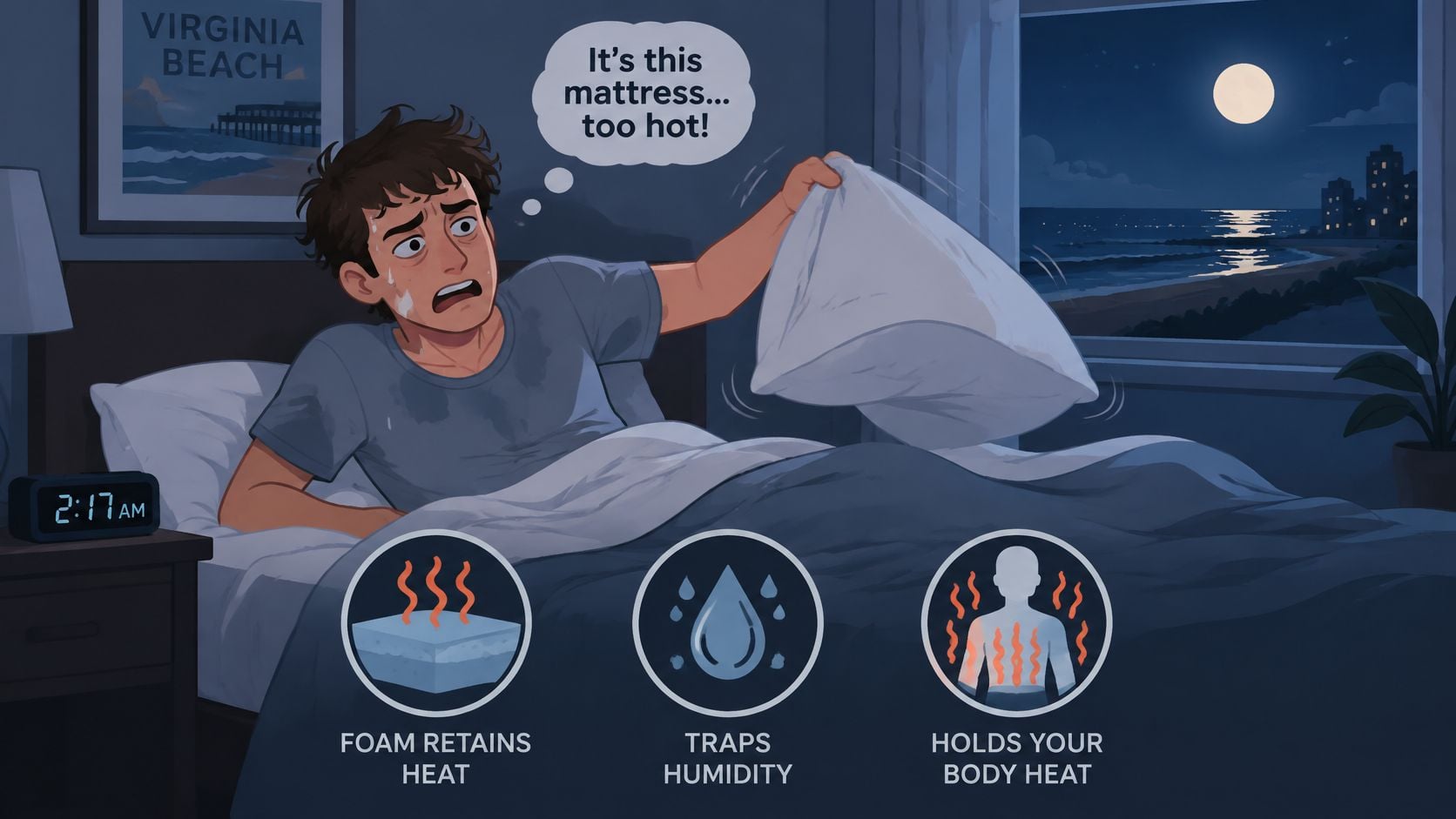
Three things can make that contact zone uncomfortable:
- Foam holding heat where you press down. Memory foam and soft comfort layers mold around the body. That close fit can limit heat movement around the hips and shoulders, especially where the foam compresses.
- Coastal air slowing evaporation. Your body releases heat through the skin, and sweat helps carry it away. Humid air makes evaporation less effective, so a sheet that feels comfortable at bedtime may feel damp later.
- Bedding trapping warm, damp air. A waterproof-backed protector, plush topper, heavy duvet, and tightly tucked top sheet can combine like extra insulation around your body.
The room temperature is only part of the picture. Heat also has to move away from your skin through the mattress surface; when that contact area holds warmth, the bed can feel hot even if the air does not. A 2024 Scientific Reports heat-transfer study tested a high-heat-capacity mattress designed to increase conductive heat loss. The researchers reported more N3 slow-wave sleep and a lower nocturnal heart rate. Total REM sleep did not change, though the timing of REM cycles shifted by 46.1 ± 3.5 minutes, a result reported with p < 0.0001.
Those findings describe sleep measures, not a promise that every cooling mattress will feel cold. A surface can feel cool when you first touch it and still become clammy as moisture builds. The practical goal is to reduce heat at the body-mattress interface while keeping the room comfortable.
Before you spend anything: Notice where the heat collects. A warm patch under your hips and shoulders points toward the contact surface; a sticky feeling across the bed suggests humid air, while a bulky bedding stack may be holding warmth close to you.
For a plain explanation of how ventilated foam, open coil cores, and cooling covers move heat, read about mattress cooling technology. Focus first on where heat and moisture are building up. A cooling surface alone may not help much if the bedding is insulating you or humid air is slowing evaporation.
Set Room Targets and Bed Routine Tonight
At 1 a.m., the room may feel comfortable while the mattress and duvet hold heat around your hips. In Hampton Roads, humidity can make that trapped warmth harder to shed. Set the room first, then simplify the bed before you consider buying anything.
A controlled study of 18 young adults tested winter rooms at 17°C, 20°C and 23°C, and summer rooms at 23°C, 26°C and 29°C, across humidity levels from 40% to 80%. The researchers found thermal-neutral conditions near 20°C in winter and 26°C in summer. Their recommendations were 20.3°C with 56% relative humidity in winter and 26.1°C with 52% relative humidity in summer (a controlled sleep-environment study of 18 young adults). On a Fahrenheit display, those room temperatures are roughly 68°F and 79°F.
What room and bedding changes can do
| Change | Measured result | Use it when |
|---|---|---|
| Winter room near 20°C and 56% RH | Thermal neutral near 20°C; recommended at 20.3°C and 56% RH in a controlled sleep-environment study | Cooler months, before changing the bed |
| Summer room near 26°C and 52% RH | Thermal neutral near 26°C; recommended at 26.1°C and 52% RH in a controlled sleep-environment study | Warm nights |
| Room at 20°C and 55% RH | Strongest overall sleep quality among the tested conditions in chamber testing | When you can maintain a moderate set point |
| Higher temperature or relative humidity | Each 1°C increase was associated with about 0.16% lower sleep efficiency; each 1% RH increase with about 0.1% lower sleep quality in a bedroom-conditions study | The room feels warm or sticky |
| Add bedding | Sleep microclimate warmed by roughly 4°C in a bedding and low-energy cooling study | The bed feels too insulated |
| Remove extra bedding | Sleep microclimate cooled by roughly 1°C in a bedding and low-energy cooling study | A no-cost first adjustment |
| Remove the mattress from the bedding stack | Sleep microclimate cooled by roughly another 1°C in a bedding and low-energy cooling study | Blankets are already reduced |
Six moves for the bed itself
Set a moderate room temperature. Try near 20°C in cooler months and about 26°C in summer. Lower the humidity first, then adjust the temperature. Use air conditioning, a cross-breeze from two open windows, or a dehumidifier if the room feels damp. If the thermostat needs attention, thermostat installation covers wiring and setup.
Start with fewer layers. Adding bedding warmed the sleep microclimate by roughly 4°C in a study of bedding and low-energy cooling strategies. Removing extra bedding cooled it by roughly 1°C, and taking the mattress out of the bedding stack cooled it by roughly another 1°C. The duvet can trap heat even when the room temperature is reasonable.
Loosen a tightly tucked top sheet. A sheet sealed around the bed can limit airflow at the edges. Leave it loose enough for warm, moist air to escape.
Let air reach the mattress base. Clearance beneath and beside the bed, slats rather than a solid deck, and space between the frame and an exterior wall can help air circulate.
Keep sleepwear and posture consistent while adjusting the setup. The bedding and low-energy cooling study found negligible thermal effects from changing sleeping posture or removing clothing. Changing one part of the setup at a time makes it easier to tell what is helping.
A room at 24°C and 70% humidity can feel more uncomfortable than a warmer, drier room because humid air slows sweat evaporation. Temperature is only one part of the heat problem. A cooling mattress surface cannot make damp air evaporate faster.
For more on coordinating the room, bed and lighting, see how lighting, temperature, mattress and bedding work together in a sleep sanctuary.
Sheets, Protectors, and Fibers That Breathe
On a humid Hampton Roads night, the right sheet helps moisture escape instead of holding it against your skin. Fiber and weave matter, but a thick protector or heavy cover can still trap heat above the mattress.
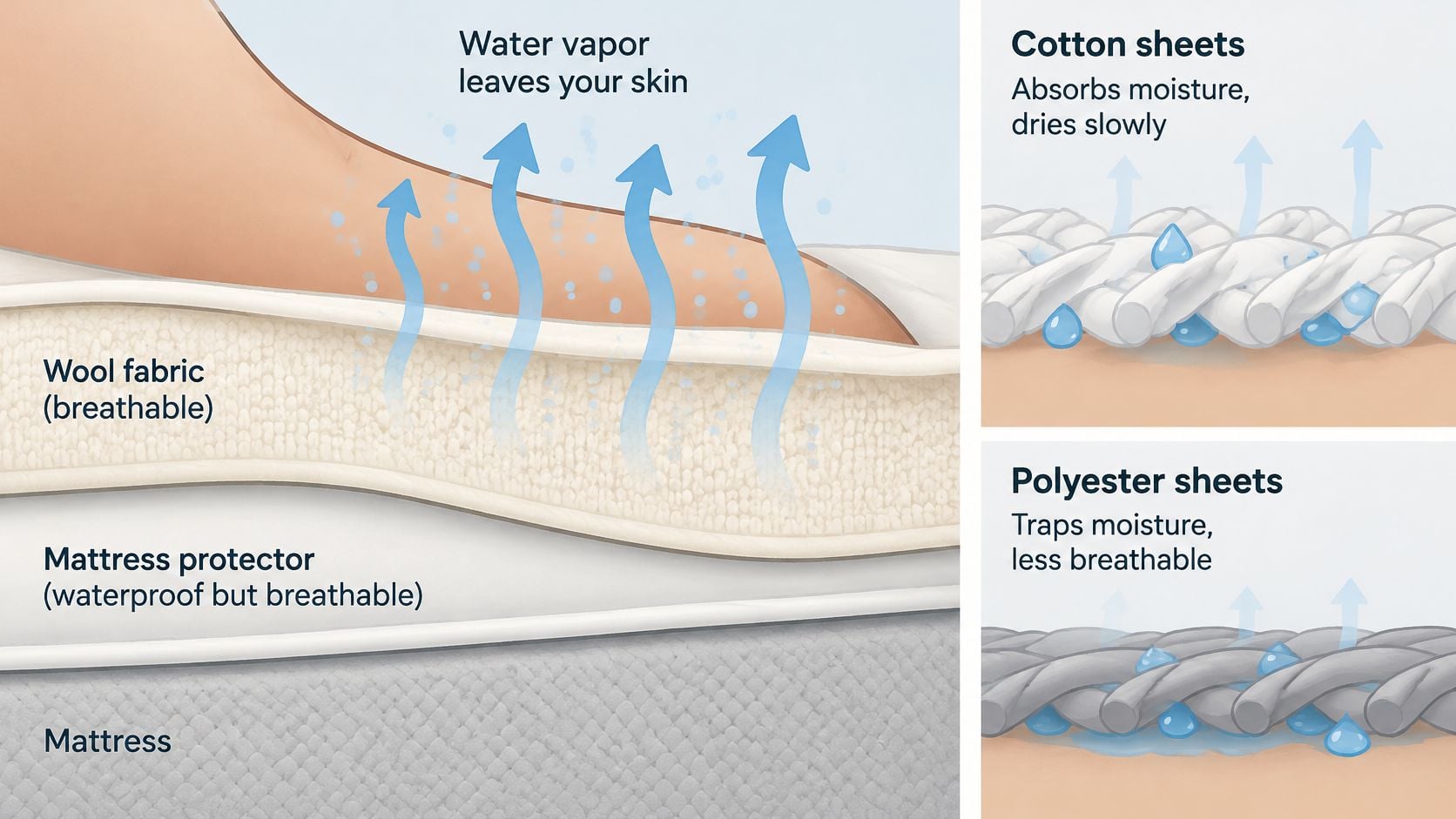
Match the fiber to the night
Cotton is not automatically the coolest choice. A 2024 review found that wool can allow more water vapor to pass through than cotton and polyester, helping sweat evaporate and skin stay drier (the 2024 review of sleepwear and bedding fibers). In a controlled comparison at 17°C or 22°C and 60% relative humidity, the study found that wool sleepwear shortened sleep-onset time compared with cotton, though bedding-fiber effects were less consistent.
- Warm night with some airflow: Try percale cotton or linen. Their crisp, open weaves allow more air movement than sateen or brushed finishes. The guide to choosing bed sheets by fiber and weave explains how those choices affect feel.
- Humid night and damp sheets: Consider wool or a wool blend with a lighter cover. Wool can move vapor without feeling wet as quickly as some fabrics.
- Spills are the main concern: Choose a thin, low-moisture protector. Vinyl-backed and thick quilted pads can restrict vapor movement, working against breathable sheets.
Where the evidence thins out
Reviews of sleepwear and bedding studies suggest materials can affect sleep, but the findings do not establish one best fabric for everyone. Across the studies reviewed, bedroom temperatures ranged from below 20°C to 29°C or 30°C. Only one tested duvet showed a statistically significant effect: goose-down produced a longer N3 percentage than cotton fill under a cool 11°C condition (the review of sleepwear and bedding-fiber studies). That result may not apply to a warm Hampton Roads summer night.
Older adults who chill easily may find a damp, cool sheet uncomfortable in the small hours. For them, managing humidity and using a light wool layer may be more comfortable than changing fibers alone.
Test one change at a time. Keep the thermostat setting and blanket weight steady for two nights, swap only the sheet, then check how the fabric feels at 3 a.m. and whether it is damp at your hips in the morning.
When a Cooling Pad Is Worth Trying
If you still wake hot after adjusting the room and bedding, a cooling pad may help manage heat at the body-mattress contact line. Research is promising, though the evidence is not conclusive. In a non-randomized pilot of 64 participants covering 2,627 days of data, 69% reported improved sleep quality, heat-related sleep trouble fell from 82.5% to 39.7%, and reported sleep duration rose by about 26 minutes on average (the 2025 cooling-bed pilot). The study was not randomized and included mostly female participants, so treat the results as an encouraging signal, not a guarantee.
Timing beats a permanently cold bed
A week-long 2024 study found that cooling during the first half of the night increased deep sleep in men and REM sleep in women. Warming during the second half produced more light sleep in men and more wake time in women (the 2024 study of dynamic temperature control across sleep stages). A separate 2025 test reported that dynamic adjustment lowered mattress temperature by 3°C during REM sleep, from 33°C to 30°C. Male sleep efficiency was 85.1% with dynamic adjustment, compared with 79.3% in the control condition and 77.2% with constant-temperature control (the 2025 cooling-bed pilot).
Practical rule: start with a gentle setting, then ease it back if you wake cold. The goal is fewer heat-related awakenings, not a bed that feels cold all night.
The two-week comparison
Keep your room, sleepwear, and blanket weight steady for a baseline week, then use the pad for a second week. Compare heat-related awakenings and morning comfort across both weeks. Start at a mild setting and adjust gradually; a first-night impression can be misleading.
Check the pad's setup before relying on it. A thick protector placed above the pad can limit its effect, while fan noise, incompatible washable layers, electrical limits, or moisture buildup may create new disruptions. Follow the pad's care and safety instructions.
If you share a bed, you can set the pad to one side only, if the model allows it. A pad can change the surface temperature, but it cannot correct poor support. If you still wake sore, temperature may not be the only issue.
| What you notice | Likely driver | Next fix |
|---|---|---|
| Sheet damp, room not that hot | Humidity blocking evaporation | Use a dehumidifier toward 50% to 56% RH, then try a vapor-open sheet |
| Hot only under hips and shoulders | Contact heat in foam | Improve airflow under the bed or try a thinner topper |
| Cold and awake after 3 a.m. | Pad left on high all night | Lower the setting or turn it down later |
| One partner freezes, one overheats | Different temperature preferences | Keep the room moderate and, if the pad allows, use one side only |
| Pad works poorly despite a low setting | Thick protector or bedding between pad and sleeper | Check the pad's instructions and use a compatible, thinner layer |
| Still sore after the surface is cooler | Support, not temperature | Reassess the mattress support |
A layer placed over the pad can interfere with its effect. Check that the protector is compatible and not too thick. A Dri-Tec performance mattress protector is one option to consider.
Match the Mattress Before You Replace It
The week of notes is already done. If hip heat is still there after humidity is under control and the extra layers are off the bed, a replacement is justified. If those nights showed fewer heat awakenings and drier mornings, keep the routine and stop shopping.
What to judge on the floor
Ask how the build moves heat off the contact line, and whether air can pass through the layers. A cover can feel cold for the first minute and still hold warmth where hips and shoulders press in. That pocket of foam works like a closed cooler: body heat goes in, and with little airflow it stays. Coastal humidity blocks evaporation at the same spot, and a heavy duvet over the top seals the last path out. Foam that stores heat under pressure, or a base with no route for air, stays hot. Ventilated foam, open coil cores, and hybrid designs address that contact problem, and hybrid mattress pros and cons compares those builds with all-foam beds in plain terms.
Support still comes first. A cool top on the wrong firmness will not hold you asleep. If you are still sore after the surface cools, check firmness before another gadget.
Where to take your sleep notes
Use the log to decide the next purchase. Bring it to the Willis Furniture & Mattress showroom in Virginia Beach, or browse the mattress collections online and ask which construction breathes for a hot sleeper. BedMatch uses 18 statistical measurements and over 1,000 scientific calculations to identify the support level your body needs. That settles the firmness question cooling claims tend to skip.
A free consultation can be booked for that conversation. In the Design Center, a consultant can rework placement so the new piece is not sealed against a wall or sitting on a solid, airless box.
Financing options spread a better-ventilated premium mattress over time. Everyday savings at the Willis Outlet can fit a tighter budget. Expert delivery and setup are part of the purchase, so the mattress lands on a foundation that lets it breathe instead of one that blocks airflow. Design services, custom order, and furniture repair are available if the rest of the room needs attention.
Book the fitting with the log in hand. Visit Willis Furniture & Mattress to browse mattress collections, bedding, and bedroom furniture before the next warm spell.