
What Is an Adjustable Base for a Mattress? a Plain Guide


An adjustable base is a motorized, hinged platform under a compatible mattress that changes the sleep surface's angle instead of staying flat. If the mattress itself still feels right, why do so many shoppers keep stacking pillows to read, watch television, or settle their legs?
Pillows bend the neck while the chest and hips stay level, then shift during the night. A base takes a different approach. It moves the whole section under the shoulders or knees and holds that angle, so support comes from the mattress rather than from a pile that collapses. That simple mechanic explains most of the appeal, and it also explains the limits. Changing an angle isn't the same as treating a medical condition, and a base can't help if the mattress on top won't bend with it.
What an Adjustable Base Is and How It Moves
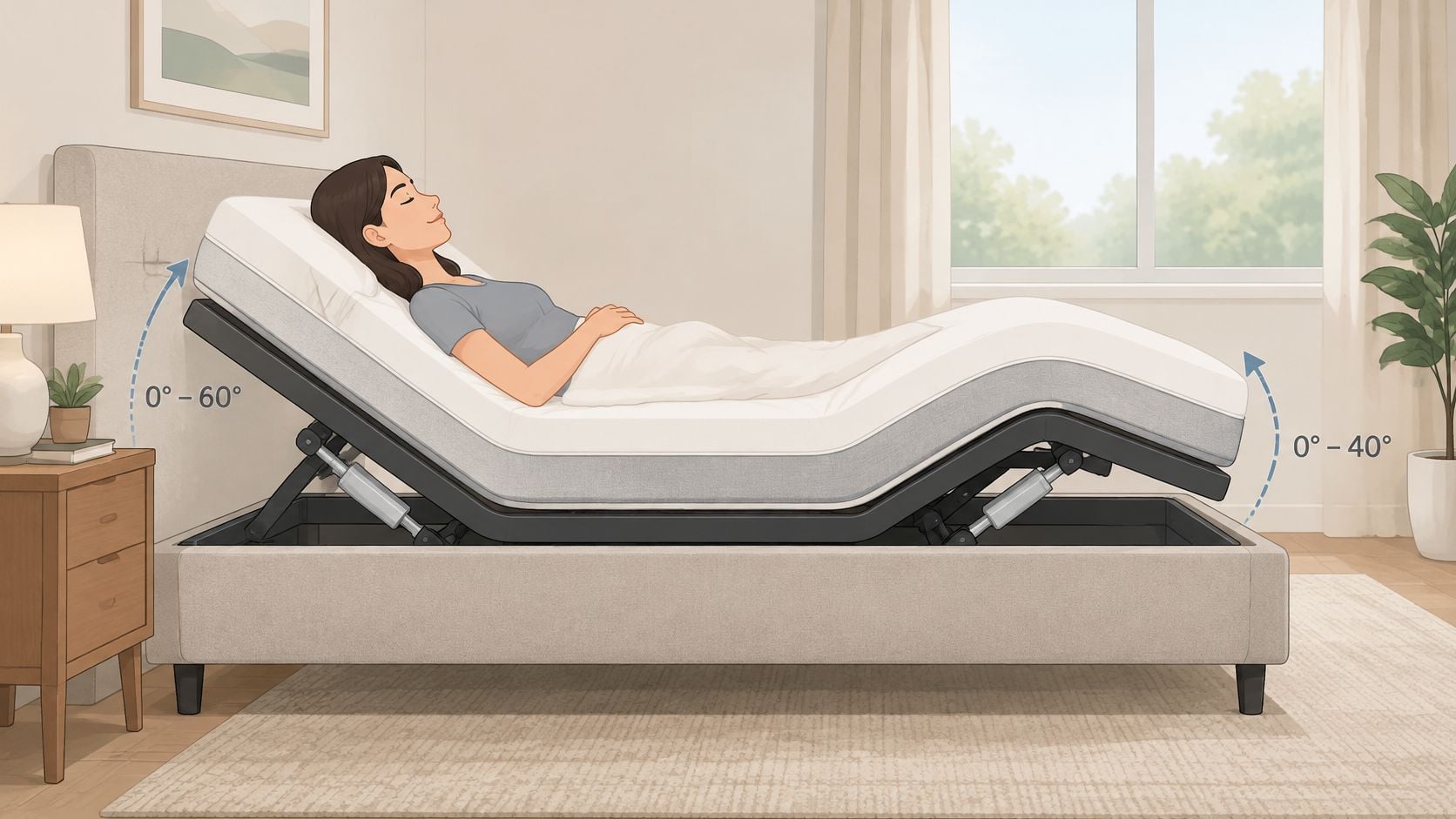
An adjustable base is a motorized, hinged platform placed under a compatible mattress that changes the sleep surface's angle, raising the head, elevating the legs, or moving into a zero-gravity-style position instead of staying permanently flat, as described in the 2022 study published through PubMed Central. It's a foundation, not a replacement bed frame, and the mattress rides on top of it.
Think of a recliner. The seat stays supported while the backrest leans back or the footrest lifts, and each part moves without changing the cushion's firmness. An adjustable base works the same way through articulated sections that move independently. Say someone wants to read before sleep. The head section rises, the mattress bends at the hinge, and the sleeper's back rests against the mattress instead of a hard headboard.
What Changes and What Doesn't
Raising the head reduces the angle between the mattress and the floor. It doesn't soften the foam, stiffen the coils, or change pressure relief built into the mattress. The base changes position, not internal firmness.
That movement comes from powered actuators, moving joints, wiring, and a handheld remote. A flat bed becomes a reading or lounging position at the press of a button, which makes the base a functional appliance worth checking for compatibility, controls, evidence, and safety before purchase.
Positions, Controls and Features Compared
Most remotes look busy, but the useful test is simpler. Shoppers should understand what each button moves, then decide whether that movement matches a real nightly need. A feature that doesn't serve reading, sleeping, resting, or getting in and out of bed is easy to skip.
How Each Position Works
| Feature | How it moves | Typical use |
|---|---|---|
| Flat | Lies level as a standard bed | Sleeping, guest bed, easy bed entry |
| Head elevation | Raises the upper body | Reading, daytime rest, comfort during snoring |
| Leg elevation | Raises the feet and knees | Circulation comfort, swelling after long days |
| Zero-gravity | Raises head and legs together | Lounging, spreading body weight |
| Anti-snore preset | Fixed head lift set from the remote | Quick return to a snore-reducing angle |
| Massage | Vibration motors in the mattress or base | Relaxation; a convenience feature, not therapy |
| Memory presets | Stores favorite positions | Repeatable comfort settings |
| Split base | Two sides move separately | Couples with different sleep needs |
Readers curious about that combined head and leg position can review what zero gravity positioning involves before deciding whether it's a daily position or an occasional lounge setting. The distinction matters because a preset that's only used twice a month shouldn't drive the whole purchase.
Single Surface or Split Sides
A single-motor base moves the whole surface together. It's straightforward, costs less to keep simple, and suits one sleeper or a couple who wants the same angle. A split base lets each side move separately, so one person can sit up to read while the other stays flat. Split movement only works properly when the mattress arrangement allows each side to flex independently.
A simple test: Move through flat, moderate head elevation, and head-plus-knee elevation, then stop at each position and check whether the mattress stays evenly supported without sliding or leaving a gap under the back.
Massage and anti-snore settings deserve the same plain label. They're comfort and convenience features, not treatments. Anyone exploring whether ongoing jaw or airway issues affect sleep may find guidance from Pain and Sleep Therapy Center useful as a starting point for a clinical conversation, separate from choosing a bed position. The remote can return the bed to a preferred angle. It can't diagnose why snoring happens.
Which Mattresses Work with an Adjustable Base
The first compatibility question isn't size. It's construction. A queen mattress can fit a queen base perfectly on paper and still perform badly if its inside structure can't bend at the hinge points. That's where many buyers get confused about what an adjustable base for a mattress can do.
When the head section rises, the mattress must flex, hold its support, and stay in place. A stiff mattress may bridge across the bend instead of following it, leaving the sleeper poorly supported or pushing the mattress out of position. Shoppers comparing support types can also review the difference between a box spring and a platform to separate a moving base from a stationary foundation.
Mattress Types at a Glance
According to consumer guidance from the National Council on Aging, memory-foam, latex, and many hybrid mattresses are generally suitable because they can bend with the moving platform, while traditional interconnected innerspring designs may resist articulation. The same guidance notes that mattresses above 14 inches may have difficulty articulating.
| Mattress type | Flexes with base | What to check |
|---|---|---|
| Memory foam | Yes, generally | Bends with the moving platform; confirm the warranty |
| Latex | Yes, generally | Flexible core supports articulation; check thickness |
| Hybrid | Often, depending on build | Check thickness, weight limits and warranty terms |
| Pocketed coil | Yes, more adaptable than conventional coils | Individually wrapped coils flex better; confirm the specification |
| Traditional interconnected innerspring | Often resists | Connected coils can resist articulation; check before buying |
The Checks That Prevent a Mismatch
Read the manufacturer's compatibility specification before ordering. It should state limits on thickness, weight, and foundation use, plus whether the warranty covers powered articulation. A thick hybrid deserves a closer look, because extra layers and total weight can make bending harder even when the coil system itself is flexible.
Pocketed coils adapt better than conventional connected coils because each coil can move more independently at the bend. Traditional innerspring models often do the opposite, resisting the hinge as one linked unit.
If the current mattress is a traditional innerspring, the honest plan is a different mattress or a limited range of motion. Forcing a stiff mattress to bend isn't a compatibility solution.
Sleep Benefits and Where the Evidence Stops
The clearest benefits are practical. A base gives readers a supported reading position, makes watching television in bed more comfortable, can ease getting in and out, and lets sleepers lift the legs or head to relieve position-related discomfort. Some people also make fewer nighttime adjustments once they find an angle that suits them.
What Small Studies Found
In an eight-week study of 25 self-reported snorers published in JMIR Formative Research, participants slept flat for four weeks and then used a 12-degree upper-body incline for four weeks. Objective measurements showed a 7% relative reduction in snoring duration, 4% fewer awakenings, and a 5% increase in the proportion of deep sleep.
A separate eight-week field study reported in Sleep found approximately 21 additional minutes of total sleep and about five additional minutes of REM sleep when healthy adults used head and/or feet adjustment after four weeks flat. Those are supportive findings for some users, not universal results. Both designs compare a flat period with a later adjusted period, so expectation and adaptation can't be ruled out completely.
The Line Between Comfort and Care
An adjustable base is not automatically a medical device or a proven treatment. Consumer bases differ from hospital beds, and shoppers who need side rails, oxygen equipment, or patient lifts should check medical-bed standards first. Reflux evidence is especially thin. According to the National Council on Aging overview of adjustable beds, a review identified only five small controlled trials, each with meaningful risk of bias, and none lasted longer than six weeks.
Suspected sleep apnea, persistent reflux, loud ongoing snoring, or unexplained pain need clinical evaluation. Readers working on broader habits can pair position changes with sleep recovery advice from Lila, and those specifically comparing mattresses for breathing concerns can review mattress considerations for sleep apnea. A practical next step is to track sleep, discomfort, and awakenings for one week flat, then compare that record with a week using a chosen incline before judging value.
Safety, Delivery and Installation Checks
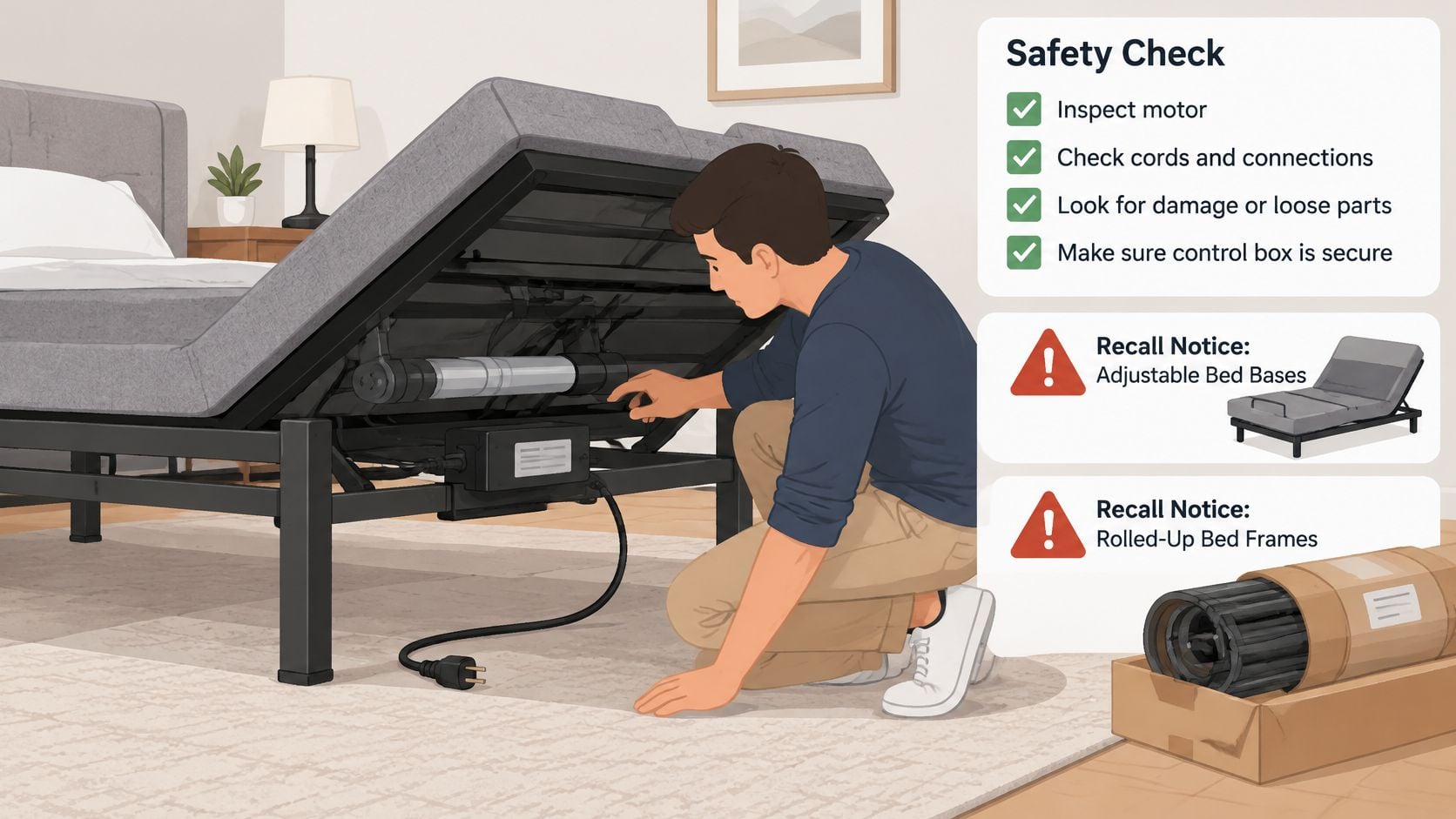
Motors, cords, and control boards aren't accessories. They're the parts that lift the bed, and they deserve the same scrutiny as lift range, noise, and warranty coverage. Two recalls show why.
In the U.S. Consumer Product Safety Commission recall from 2017, approximately 50,000 adjustable beds were recalled because side-mounted AC outlets could be incorrectly wired and create an electric-shock hazard. A separate recall covered approximately 25,200 adjustable mattress bases whose motor-control board could short and overheat, with 29 overheating complaints reported.
Shoppers should also confirm recognized electrical safety certification for the specific model rather than assuming it from the product category. The UL 962 standard listed through ANSI addresses electrical safety requirements for household furnishings and related powered equipment.
Installation Checklist
- Confirm the path: Measure doorways, hallways, and stairs before delivery day.
- Set a level base: Place the unit on a level, properly supported frame.
- Use a grounded outlet: Plug in directly and avoid extension cords.
- Inspect the electrics: Check the power cord, control components, and remote for damage.
- Run the full range: Cycle every position once with nothing on top.
- Check the model number: Compare it against current recall notices before regular use.
Don't modify wiring or outlets to make a base fit a room. A damaged cord or control board is a stop sign, not a minor defect.
Delivery is part of safety, not an afterthought. Heavy powered bases need correct placement, assembly, and a full motion test in the room where they'll be used. Readers can review how furniture delivery and assembly works before scheduling, and Willis Furniture & Mattress provides expert delivery and setup as part of the shopping experience, so the base is installed and tested before use.
Choose Your Adjustable Base Before You Buy
A sensible order prevents most mistakes. Start with the mattress, define the job, then pay only for features that do that job.
A Five-Step Decision Sequence
- Confirm construction first: Memory foam, latex, many hybrids, and pocketed-coil models are the usual starting point.
- Name the main need: Reading comfort, easier entry and exit, leg elevation, snoring comfort, or separate sides for two sleepers.
- Match features to that need: Choose memory presets, a split base, or a basic anti-snore setting only when it'll be used often.
- Verify the details: Confirm warranty, weight limits, doorway access, and recall status before delivery.
- Talk through the fit: Use a complete mattress buying guide to check the mattress and base as one system.
Willis Furniture & Mattress offers a free consultation, which customers can book, and customers can call at (757) 340-2112 to discuss mattress compatibility. Because a premium base and mattress together are a larger investment, shoppers can also ask about financing options. A base is a comfort tool. Medical questions still belong with a clinician.
Visit Willis Furniture & Mattress to compare adjustable bases alongside compatible mattresses and book a free consultation before choosing. The team can talk through sizing, split options, and financing, then provide expert delivery and setup so the base is installed, leveled, and tested at home.