
White Glove Delivery Fee: What You Pay and Why


The sofa is selected, the upholstery looks right, and checkout suddenly adds a delivery charge that needs explaining. For a homeowner furnishing a Virginia Beach living room, that charge might cover a finished setup or little more than getting a carton through the door.
What you pay depends on furniture weight, access conditions and which services the fee includes. Two quotes carrying the same white-glove label can buy very different work inside your home.
The useful comparison is total landed cost: the furniture price, delivery labor and any access, assembly or removal charges needed to make the room usable. Audit the fee line by line, and the headline price becomes a total you can approve with confidence.
White Glove Delivery Fee Ranges at a Glance
The same white-glove label can carry very different costs. A retailer's established delivery route spreads crew time across many stops, while a separately arranged heavy-furniture appointment bills the whole trip to a single order. Read the ranges below as a budgeting tool that turns a headline price into a landed total, line by line.
Estimated local delivery fee by furniture weight
Planning benchmarks for major U.S. markets.
| Furniture weight | Estimated local fee | What drives the price up |
|---|---|---|
| Under 100 lb | $200-$400 | Stairs, long carry and placement |
| 100-300 lb | $400-$700 | Two-person crew time, tight access and assembly |
| Over 300 lb | $700-$1,500 or more | Specialized handling, hoisting and a larger crew |
| Cross-country transportation | Adds $1,000-$3,000 | Long-haul freight on top of local delivery |
The bands shift with distance, local labor rates, access, order size and dimensions. Willis Furniture & Mattress provides delivery and setup as part of its shopping experience and sets its own terms, so confirm any quote against your actual order. Hoisting deserves a written line of its own, because a weight band alone does not guarantee the crew arrives equipped for it.
Use weight as a starting point
A 120-pound recliner headed up a flight of stairs, with assembly expected, sits in the table's middle band. Budgeting toward that band's upper half is more realistic than assuming its lowest figure will cover the job. That cushion is a planning allowance rather than a calculated surcharge.
Dimensions matter alongside weight. A broad, awkward cabinet demands more maneuvering than a compact piece of similar mass, especially around stair landings where the crew has to pivot the load.
Budgeting rule: Find the heaviest piece's weight on the manufacturer specification sheet, identify its delivery band, then disclose the complete access route before accepting a price.
Check the specification sheet for assembled dimensions versus shipping dimensions. A carton is often larger than the furniture inside it, and removable components only reduce the fee when the delivery team is authorized and equipped to take them off.
The practical result is a delivery budget set before shopping, priced from your heaviest piece and your worst access point, so the checkout total confirms the plan instead of breaking it.
What White Glove Service Covers Inside Your Home
The defining difference is where the crew's responsibility ends. Warematch's white-glove service guide distinguishes threshold delivery from room placement and fuller services that can include assembly, installation, testing and debris removal.
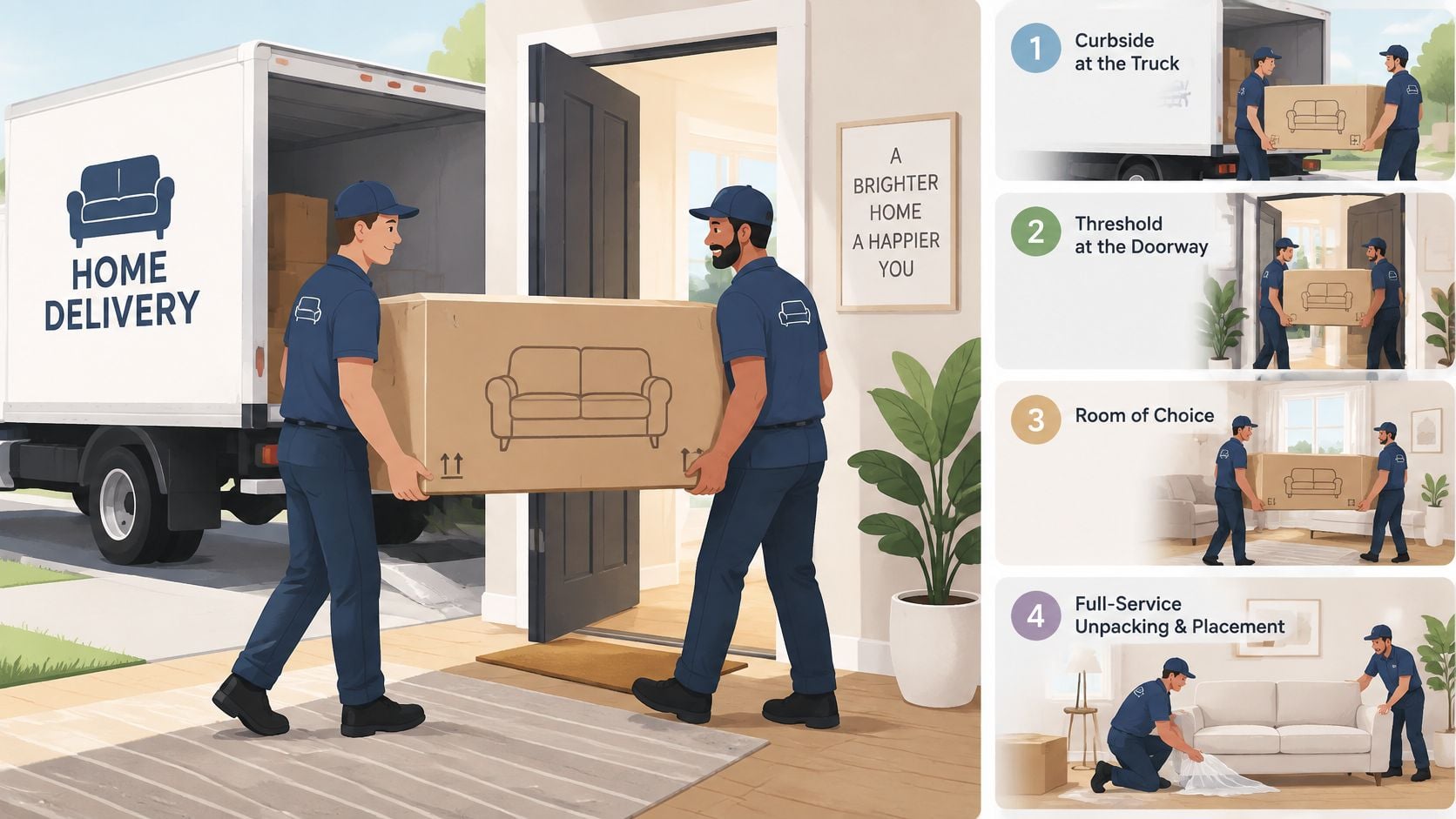
Service levels compared
| Service level | Where the crew stops | Placement | Unpacking and packaging |
|---|---|---|---|
| Curbside | At the curb or driveway | Not included | Not included |
| Threshold | First dry area inside the door | Not included | Not included |
| Room of choice | The room selected | Included | Confirm explicitly in the quote |
| Full white glove | The room selected | Included, with assembly and inspection | Unpacking and packaging removal included |
Follow the appointment from arrival to cleanup
A complete service can be audited against the actual crew sequence:
- Confirm the appointment window. Dispatch coordination ensures someone can admit the crew and direct placement.
- Carry each piece inside. Maneuvering a sofa through an entry requires controlled lifting and attention to walls, floors and upholstery.
- Place it in the chosen room. Positioning a recliner includes allowing operating clearance, not merely setting it against a wall.
- Unpack and assemble. Attaching components or preparing a mattress setup adds hands-on work beyond transportation.
- Inspect and test. The crew and homeowner should check visible condition and relevant moving components before completion.
- Remove packaging and debris. Cartons, foam and wrapping shouldn't become an unexpected homeowner disposal project when removal was purchased.
Providers don't always attach the same tasks to the same label. A written policy, such as the information available through delivery from The White Kitchen Company, offers another useful opportunity to examine how delivery responsibilities are described before ordering.
Willis Furniture & Mattress provides expert delivery and setup as part of the shopping experience. After a design client approves the plan, the business handles ordering through white-glove delivery and setup.
For homeowners reviewing furniture delivery and assembly considerations, the decisive check is simple: mark every task included on the quote and flag every missing task before payment.
Factors That Push the Fee Up or Down
A failed delivery is expensive before anyone even talks about damage. An illustrative bulky-item logistics model puts the cost at approximately $116 for a failed delivery attempt, counting original and repeat-visit labor, vehicle time, return handling, warehouse work, scheduling and customer support, according to Locus's bulky-item delivery guide.
That $116 is carrier operating cost, and no carrier mails it to you as an invoice. It gets absorbed into how delivery work is priced, which is why accurate access details matter: the crew and the truck get paid even when the furniture comes back to the warehouse.
Read your own fee the same way, line by line. The underlying charge can include a two-person crew, truck time, dispatch, staging, protective materials, carrying, assembly, placement, debris removal and an allowance for rework. A quote worth signing identifies which of those parts apply to your order.
Match each cost driver to a checkable detail
- Stairs and narrow hallways: Record the number of flights, landing depth, handrail positions and the tightest turn. Every added carry or pivot point adds labor time.
- Elevator access: Measure the door opening and usable cab space, then confirm whether the building requires an elevator reservation or restricts delivery hours.
- Weight and dimensions: Supply the manufacturer's listed specifications for every substantial piece. Crew size and equipment decisions need numbers, and a product photograph cannot provide them.
- Delivery territory: Give the complete address early. Travel beyond the normal service area adds vehicle and labor time.
- Route consolidation: Identify everything arriving together. Separate appointments can duplicate dispatch, travel and handling work.
- Assembly requirements: Name the actual tasks, such as attaching a base or connecting sectional pieces. An undefined assembly promise is where unpriced labor hides.
A lower quote may assign more of that work to you. For Virginia Beach buyers, the delivery line only becomes comparable once you know which labor and risk controls it covers.
Plan the space before dispatch
Willis Furniture & Mattress design consultants can help plan scale and flow so placement is settled before the truck is scheduled. Design presentations include floor plans, and design clients receive an itemized breakdown, including pricing, for approval before anything is ordered. Booking an appointment with a design consultant starts that process.
On the homeowner's side, a tape measure, access photographs and a rough floor sketch make measuring furniture for delivery far more reliable than estimating by eye.
Access documentation is knowledge transfer at household scale: the measurements you hand to the scheduler determine whether the crew arrives prepared. Readers who want to see that teach-what-you-know principle practiced at organizational scale can explore Pacific Mobile Structures community involvement. Applied to a delivery quote, it means the purchaser, scheduler and crew all price the job from the same set of facts.
Budget Moves That Lower the Final Bill
A lower number on the delivery line does not guarantee a lower bill. The reliable cuts remove work the crew would otherwise perform: extra trips, idle time, repeat visits. Strip away handling a heavy piece still requires, and the expense reappears as equipment rental, outside help or damage repair.
Make savings match the work removed
Consolidate the order. Ask for one bundled price for the sofa and two chairs; a single appointment avoids a second crew dispatch. Have the bundled figure written into the quote so the reduction appears as a real number on the delivery line.
Ask which day suits the crew's route. A delivery that slots into an existing run costs less in travel and labor than a dedicated trip. Before accepting the first slot offered, ask whether a different day or a wider arrival window changes the price.
Choose an appointment window you can keep. A realistic window protects the quote better than an optimistic one. The dependable saving is avoiding rescheduling fees, redelivery charges and the missed-delivery exposure a failed trip creates.
Match placement service to the piece. Threshold delivery suits a light item when indoor handling and assembly are already arranged. The quoted placement or setup line shows the saving exactly.
Price old-furniture removal separately. If the quote includes haul-away, compare it against independent clearance and find out which clearance costs still apply before treating an advertised collection offer as cost-free.
Review the itemized breakdown before approving. Willis design clients receive an itemized pricing breakdown for approval, which gives a line-by-line view of the job. A duplicated trip charge or an unneeded add-on costs nothing to strike at that stage.
Judge each option by the landed total: furniture price plus the delivery work required to make it usable.
Read line by line, the quote turns the headline price into a landed total you can act on. An avoidable failed appointment can consume savings accumulated through smaller household economies. Gratuities also sit outside contracted charges; white-glove delivery tipping considerations help separate optional recognition from the service already purchased.
The final comparison should use matching service levels from separate providers, with the same access conditions and removal requirements disclosed to each.
When White Glove Pays for Itself
Industry reporting summarized in Cigo Tracker's furniture-delivery guidance places ordinary furniture freight damage commonly around 5% to 10%, while operations using dedicated handling protocols have been reported below 3%. Those figures describe reported operations, not a promised result for any individual order.
Damage can require more than a repair. Bulky furniture may need specialized pickup, repacking, inspection, refurbishment and eventual resale or disposal.
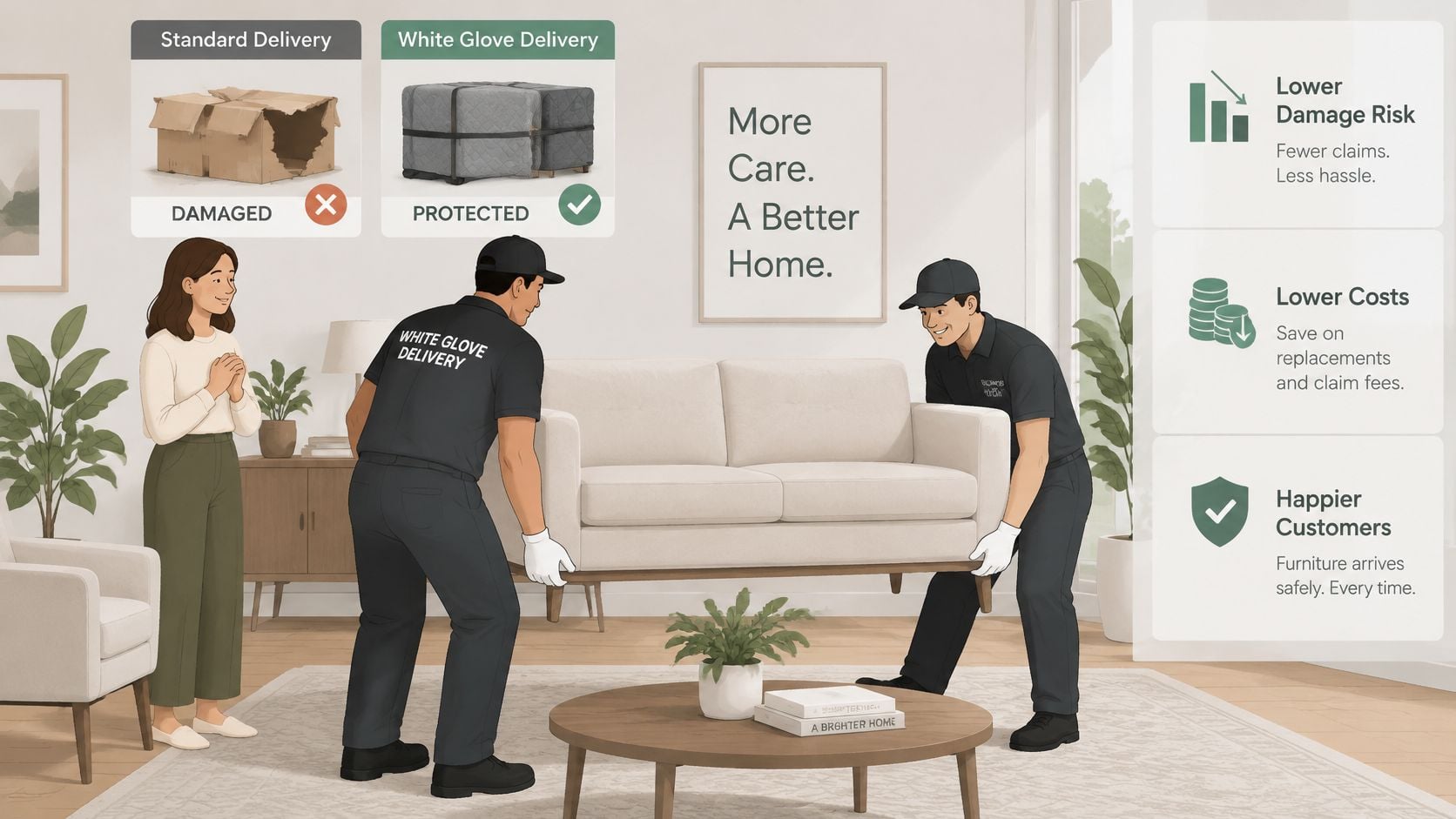
Separate financial protection from convenience
Expected avoidable loss equals the probability of damage or failed delivery multiplied by the total replacement and recovery cost.
Recovery cost can include reverse freight, labor, scheduling, customer-service time, delay and, for the seller, a possible lost sale. A household should distinguish expenses it would bear from costs covered by the seller's written damage policy.
Consider a hypothetical $4,000 recliner set, with an assumed 10% chance of damage or failed delivery and $1,500 in recovery costs. Multiplication produces an expected loss of $150. These are scenario assumptions, not a delivery forecast.
A hypothetical white-glove upgrade costing $150 to $250 is near that expected-loss amount at its lower end. It doesn't automatically break even: the upgrade must reduce the relevant risk, and any remaining risk still counts. Difficult access, avoided lifting and a usable finished setup may justify the balance for the homeowner.
Sort the order by handling difficulty
White glove is easier to justify for:
- Heavy or delicate furniture: Controlled carrying and protection matter more when mistakes are difficult to correct.
- Coordinated room packages: Completion requires several pieces to arrive, fit and function together.
- Stairs and restricted access: The household would otherwise need suitable equipment and capable helpers.
- Mattresses and mobility-limited buyers: Avoiding physical handling can be the main benefit, regardless of replacement value.
Light furniture, straightforward ground-floor access and manageable assembly make a lower service tier more reasonable. The practical distinction is illustrated by white-glove service examples, but the written scope still determines the purchase.
Before paying for the upgrade, confirm that inspection, damage reporting and resolution procedures are documented. Premium handling reduces exposure; it doesn't replace a clear remedy if something goes wrong.
Confirm the Scope and Book with a Written Quote
Every white-glove booking rests on a written scope. Across the furniture trade, published delivery policies treat room placement, unpacking, professional assembly and packaging removal as the standard list, with moving services left outside it, and missed appointments can carry a flat rebooking charge. The same clarity needs to appear in your own quote before money changes hands.
Moving an existing sofa upstairs or hoisting a cabinet through a balcony opening is a distinct job. Neither should be assumed covered because the new furniture receives white-glove handling.
Turn exclusions into written questions
Some answers are settled while choosing a service level; the rest belong in writing before a deposit makes changes inconvenient. Six questions close the remaining gaps:
- Does the fee include moving existing furniture? Distinguish placing new purchases from rearranging belongings already in the home.
- Is there a long-carry charge? Some quotes price the distance from the truck to the door separately from stair work.
- What is the missed-appointment charge? Record the rescheduling deadline, required notice and method of contacting dispatch.
- What happens if a piece won't fit? Establish responsibility for return transport, storage, redelivery and any authorized disassembly.
- Are stair carries or hoisting extra? Describe the actual route and obtain approval for unusual access before the truck is loaded.
- Does a second trip cost extra? Clarify whether a partial shipment, a refused item or a failed first attempt generates another delivery charge.
Establish who has authority to approve additional work on delivery day. Extra work priced at the doorway should be written and signed before it starts, and the signed scope should stay with the order documents so a dispute compares paperwork to paperwork rather than memory to memory.
Require predictable communication
The appointment terms should identify who confirms the arrival window and how changes are communicated. If tracking is available, the customer should know how to access it, whom to contact when the expected arrival changes, and which access arrangements the scheduler has on file.
The receiving homeowner should be available to direct placement and inspect the finished setup. Pets, children and loose rugs should be kept away from the carrying path, and the destination area should already be clear.
Before signing: Check exposed surfaces, upholstery, legs and moving mechanisms, photograph concerns, and record exceptions on the delivery paperwork.
Build a decision-ready landed total
A practical booking sequence keeps the purchase and delivery decisions connected:
- Measure the furniture and its destination. Include the footprint, operating clearance and the route described in the quote.
- Record weight and piece count. Identify separate cartons and substantial components that affect handling.
- Request an itemized quote. Name the service level, assembly, stair or hoisting work and every applicable surcharge.
- Confirm appointment policies in writing. Keep missed-delivery, rescheduling and failed-fit terms with the order documents.
- Book a placement consultation before ordering. A room plan should establish where the furniture belongs and whether the arrangement leaves usable circulation space.
Practical space-planning guidance connects access measurements with the finished room layout, which keeps delivery decisions tied to a plan rather than a checkout charge.
A decision-ready quote names what arrives, where it goes, what gets assembled and what remains the homeowner's responsibility.
Willis Furniture & Mattress offers a free consultation, financing options and expert delivery and setup, and mattress shoppers can use BedMatch and the Mattress Guide when selecting their setup. Visit Willis Furniture & Mattress or call (757) 340-2112 to book a free consultation, and bring the furniture specifications, doorway measurements and access photographs.


