
Bonded Leather vs Genuine Leather: Which Fits Your Home


23.2% of respondents believed “bonded leather” meant genuine cowhide leather, according to survey evidence discussed in the Federal Trade Commission's leather-labeling guidance. That misunderstanding can turn an attractive sofa into an expensive disappointment. The important question in bonded leather vs genuine leather isn't whether both look convincing in a showroom. It's what sits beneath the finish, how that construction handles daily use, and what happens when the surface wears out.
For Virginia Beach and Hampton Roads households, the decision also involves coastal humidity, pets, maintenance, and replacement costs. Genuine leather is usually the stronger choice for long-term seating, but the word genuine alone doesn't establish quality.
Bonded and Genuine Leather at a Glance
Genuine leather is continuous animal hide, while bonded leather is a reconstructed sheet of leather scraps held together with a polymer binder. They are different materials, not just different grades of the same upholstery.
A 2025 Szoneier Leather guide states that bonded leather typically contains 10–20% actual hide, with the remainder mainly polyurethane or similar binders. That composition explains much of the difference in surface behavior, breathability, and repair options.
Bonded vs genuine leather on every buying criterion
| Criterion | Bonded leather | Genuine leather |
|---|---|---|
| Main material | Leather fibers and scraps bound with polyurethane, latex or acrylic | Continuous animal hide |
| Actual hide content | About 10–20%, the rest mainly binders, as described in the guide above | 100% hide in the leather substrate, excluding applied finishes |
| Surface | Polymer coating with embossed grain | Natural grain that can develop a patina; some products are corrected, embossed or heavily finished |
| Typical failure | Cracking, flaking or peeling of the coating | Drying, abrasion, staining and finish wear |
| Repairability | Limited; a damaged coating usually means panel replacement | Conditioning, cleaning and refinishing possible |
| Breathability | Lower, through a polymer surface | Higher, through a fibrous structure; heavy finishes reduce this advantage |
| Upfront price | Lower | Higher |
Choose the row that matters most
For a family sofa, repairability should carry more weight than a small difference in purchase price. For a warm bedroom chair, breathability and the feel of the actual finish deserve closer attention. For occasional seating, lower upfront cost may reasonably take priority.
The table describes typical products, not a guarantee attached to every label. A heavily coated split-hide chair and a lightly finished grain-leather chair both contain genuine leather, yet they won't feel or age identically.
Practical rule: The most important buying criterion is the one tied to the room's hardest everyday use, not the most impressive word on the tag.
Shoppers who haven't settled on leather at all can use the leather-versus-fabric upholstery comparison to widen the shortlist before choosing a particular leather construction. Fabric may deserve consideration when washable covers, texture, or a different maintenance routine matter more than leather's appearance.
For a quick showroom screening, the first checks should be actual leather content and surface finish. If neither appears in the product information, the piece isn't ready for a confident purchase decision.
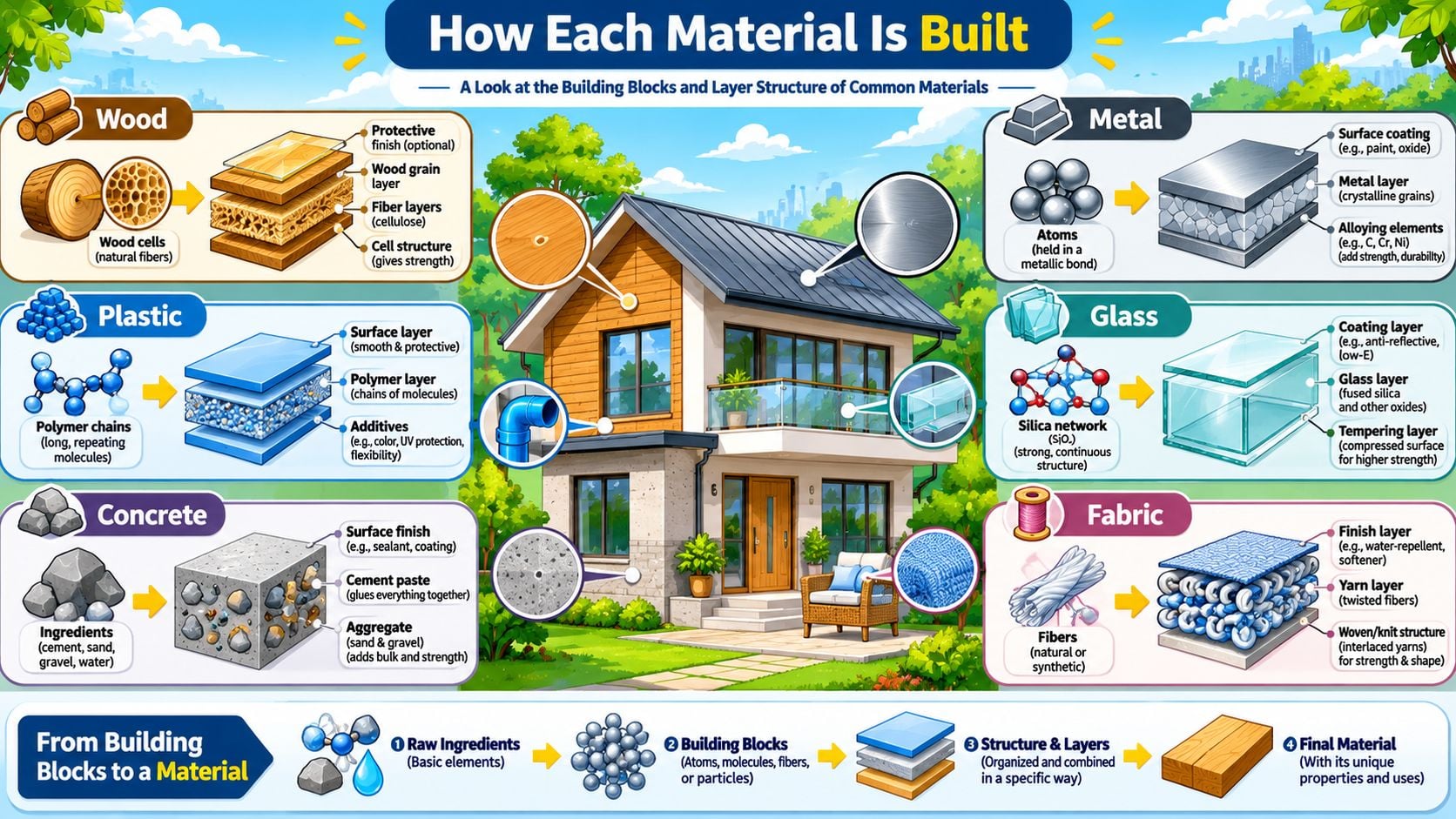
How Each Material Is Built
Bonded leather starts with leather that has lost its original structure. Leather Naturally's explanation of ISO 15115:2019 describes leather mechanically or chemically disintegrated into fibers, small pieces, or powder, then formed into sheets or other shapes, with or without a binding agent. The standard explicitly states that those reconstructed sheets or forms are not leather.
That distinction concerns construction, not appearance. A convincing grain pattern doesn't restore the continuous hide that was broken apart.
From scraps to a finished upholstery sheet
Manufacturers grind scraps and fibers, combine them with binders such as polyurethane, latex, or acrylic, and form the mixture into sheets. Furniture-grade constructions commonly add a backing for support and an embossed, coated surface that imitates hide.
The visible grain is therefore a manufactured finish. Its consistency can look appealing across a large sectional, but the material beneath it remains a fiber-and-binder composite.
- Ground material: Leather remnants provide the leather-fiber component.
- Binder and backing: These help hold the reconstructed material together and support the sheet.
- Embossed finish: A repeating grain pattern and surface coating create the leather-like appearance.
This process makes an economical, uniform covering possible. It doesn't give the finished sheet the same underlying fiber network as intact hide.
Genuine identifies the material, not its rank
Genuine leather begins with an animal hide that is tanned and finished while retaining its continuous fibrous structure. The hide can be separated into layers, including grain-bearing upper layers and lower splits.
Under the FTC's Leather Guides, the distinction between hide and reconstituted material matters, but genuine leather isn't a promise of top grade. A description still needs to identify the hide layer, finish, thickness, and construction well enough to support the intended use.
Consider a hypothetical sofa with bonded seat cushions and genuine-leather arms and back. A broad leather description would leave the most heavily used surfaces poorly explained. The purchase specification should identify each surface separately rather than treating the sofa as a single material.
Inspect an edge, not just the grain
With permission, a shopper can examine a sample's cut edge, unfinished reverse, or an existing worn corner. A bonded sheet often shows a relatively uniform reconstructed layer and backing; intact hide shows a more irregular fibrous cross-section.
Appearance alone isn't conclusive because coatings can conceal the substrate. The sample supports the written specification; it doesn't replace it. Scratching, scraping, or applying liquid to showroom furniture isn't an appropriate identification test.
Durability Ratings and What They Mean
An abrasion number measures performance in a particular laboratory test, not years of useful life. ASTM D4157 Wyzenbeek double rubs, common in North America, and EN ISO 12947-2 Martindale cycles, common in Europe, use different methods. A higher number from one cannot establish superiority over a lower number from the other.
The upholstery testing overview published by The Desk Riser cites the benchmarks and published ranges below: approximately 50,000 Wyzenbeek double rubs or 40,000 Martindale cycles for heavy-use procurement, 100,000 or more Wyzenbeek rubs for some high-traffic applications, and widely separated bonded-leather results across comparisons.
Abrasion benchmarks and what each one measures
| Benchmark or test | Method | Reference value | What it tells the buyer |
|---|---|---|---|
| Heavy-use procurement benchmark | ASTM D4157 Wyzenbeek double rubs | About 50,000 rubs | Common North American reference for heavy use |
| High-traffic specification | ASTM D4157 Wyzenbeek double rubs | 100,000 or more rubs | Reference used for commercial high-traffic applications |
| Heavy-use procurement benchmark in Europe | EN ISO 12947-2 Martindale cycles | About 40,000 cycles | European heavy-use reference, not a direct conversion |
| Published bonded leather, comparison A | Martindale cycles | 10,000–20,000 cycles | Lower published range; binder and coating affect performance |
| Published bonded leather, comparison B | Wyzenbeek double rubs | 30,000–100,000 rubs | Wide published range under different test conditions |
| Genuine leather | Martindale or Wyzenbeek | Product-specific tested result required | Grade and finish matter; the actual report is necessary |
The heavy-use rows are procurement references, not universal minimum requirements for a household sofa. The high-traffic figure doesn't mean a chair will last proportionally longer at home.
The bonded-leather ranges also shouldn't be combined into one performance scale. Binder chemistry, coating thickness, backing, and test conditions help explain their spread. Genuine leather can return higher or lower results according to its finish and grade.
A genuine-hide Martindale result and a bonded-leather Wyzenbeek result aren't a valid head-to-head comparison.
Tear strength and coastal moisture require separate checks
A 2025 Szoneier Leather comparison reports tear resistance of 50–100 N for bonded leather, compared with 200–300 N for corrected genuine leather. That is a directional pattern from one comparison, not a tested result for every sofa or recliner.
Lower tear resistance makes seams, arm edges, and repeatedly flexed areas important inspection points. It doesn't establish where a particular piece will fail. Seam-strength and flex-point results are needed before drawing that conclusion.
Virginia Beach's humid coastal setting adds another consideration. Polymer coatings can deteriorate through moisture-driven hydrolysis, even when their initial abrasion performance looks acceptable. That general risk doesn't prove that every bonded product will fail in a coastal home, or that every genuine-leather finish is unaffected.
The useful request is for certified hydrolysis testing tied to the actual upholstery, not a verbal assurance that the material handles humidity. Indoor climate control and avoiding damp storage remain sensible precautions.
Before purchase, the document set should include:
- Abrasion test report: The named method, tested material, result, and failure criterion.
- Hydrolysis result: Evidence relevant to the coating being purchased.
- Warranty exclusions: Written treatment of peeling, delamination, moisture, and ordinary wear.
The durable upholstered furniture guide can help shoppers evaluate the rest of the piece rather than allowing an upholstery score to stand in for overall construction quality.
Caring for and Repairing Each Material
Care should match the finish, not merely the word leather. Genuine leather can gradually darken, dry, stain, and wear through its finish. Bonded leather more often develops visible damage in its surface coating, where cleaning or conditioning can't rebuild a missing film.
An industry guide to seating materials distinguishes bonded leather's cracking, flaking, and delamination from genuine leather's more gradual drying, abrasion, staining, and finish wear. It also identifies conditioning and repair as potential advantages of intact hide.
A practical maintenance routine
- Dust weekly with a soft cloth. Remove grit from seats, arm tops, and cushion creases without scrubbing the finish.
- Blot spills within minutes. Start with a dry, absorbent cloth, then use a barely damp cloth if the finish's care guidance permits it. Avoid soaking seams.
- Assess genuine-leather conditioning every six to twelve months. Use a product made for the particular leather finish, and apply it only when the manufacturer permits conditioning. Suede, nubuck, and some protected finishes need different treatment.
- Test cleaners on a hidden spot first. Let the area dry before checking for color transfer, a changed sheen, or tackiness.
- Keep both materials away from direct sun and heaters. Placement matters because concentrated heat and sunlight can dry or fade upholstery.
These intervals are maintenance starting points, not permission to override product-specific care instructions. The guide to cleaning a leather sofa at home offers a practical framework for choosing a gentle cleaning approach.
Avoid the conditioner trap
Heavy oil-based conditioners and solvents aren't a rescue treatment for bonded leather. They can soften, discolor, or lift an incompatible coating. Only cleaners explicitly labeled safe for the particular bonded or polymer surface belong on that upholstery.
Pets create a different repair question. Shallow claw scuffs on genuine leather may become less conspicuous as the grain wears, but deep scratches remain damage. On bonded leather, a claw that cuts through the coating can leave an exposed edge that continues to lift.
Repair decision: A small genuine-leather scuff may justify a professional color touch-up. A peeling bonded arm usually calls for panel replacement or reupholstery, not another bottle of conditioner.
A responsible lifespan estimate must come from the specific product, household use, and maintenance history. Category-wide year ranges aren't reliable enough to promise, particularly when finish quality and repair access remain unknown.
Long-Term Cost and Sustainability Trade-Offs
Bonded leather generally requires less money upfront. Cost per year of useful service is the better comparison for a piece expected to carry daily household use.
Consider a clearly hypothetical example, not a product quote or lifespan forecast. A $2,000 bonded-leather sofa replaced after four years costs $500 per year of use; a $3,500 genuine-leather sofa kept for fifteen years costs about $233 per year. Those assumed purchase prices and service periods illustrate the calculation, not expected results for either category.
Calculate the household's replacement exposure
The useful calculation includes purchase price, delivery, maintenance, likely repairs, and eventual replacement. A family-room sofa or frequently used dining chair deserves a more demanding estimate than a guest-room chair.
- Daily seating: Repair access and replaceable panels can justify a higher purchase price.
- Occasional seating: A lower initial investment may be sensible when wear will remain light.
- Changing households: A planned move or changing room requirements can shorten the useful ownership period regardless of upholstery quality.
Recycled scraps don't settle the environmental question
Bonded leather puts leather remnants into another product, but binders, coatings, backing, foam, and other furniture components complicate separation and recycling. Genuine leather retains natural hide, yet finished upholstery can also contain polymer coatings. It shouldn't automatically be described as plastic-free or easy to recycle.
Neither category has a universal environmental advantage. Repairable upholstery on a sound frame may stay useful longer, while an inexpensive piece that requires early replacement can create additional disposal waste. The sustainable sourcing guide provides broader context for evaluating materials and purchasing decisions without reducing sustainability to one label.
Willis Furniture & Mattress offers American-made furniture craftsmanship and brands including Daniel's Amish and American Leather. Flexible financing options can spread the cost of a premium piece, while the Willis Outlet is the place to consider budget-friendly furniture for lighter-use situations.
The decisive question remains practical: How many years will this piece be used before it needs replacing?
Match the Leather to Your Household and Verify It
For most long-term household seating, genuine leather is the better buy when the budget allows and the specific construction supports the intended use. Bonded leather suits lighter wear, limited budgets, and shorter ownership plans, provided the material disclosure and warranty are clear. Neither recommendation excuses an incomplete specification.
Best leather by household situation
| Situation | Better fit | Why | Check first |
|---|---|---|---|
| Daily pet use with claws | Genuine leather | Shallow claw marks can soften visually into the grain rather than opening a bonded surface film | Finish and available scuff-test report |
| Young children and frequent spills | Genuine leather with a sealed finish | A suitable finish supports cleaning and may allow professional refinishing | Finish type and cleaning guidance |
| Coastal humidity, such as Virginia Beach | Genuine leather, or bonded only with hydrolysis-tested coating | Moisture resistance needs separate verification from abrasion resistance | Certified hydrolysis report |
| Main family sofa kept ten years or more | Genuine leather | Repairability better supports a long ownership plan | Grade, thickness and warranty terms |
| Occasional guest seating | Bonded leather | Light wear can make lower upfront cost reasonable | Warranty covering peeling and delamination |
| Tight first-home budget | Bonded leather, checked for disclosure | Lower purchase price can suit light use | Leather-fiber percentage on the label |
| Custom color or size | Either, chosen with the Design Center | In-house consultants can help evaluate available custom upholstery options | Construction for each surface |
For pet households, upholstery selection should include more than a scratch discussion. Cushion access, seam placement, and the pet's climbing habits also matter. The guide to furniture materials for dogs helps frame that broader decision.
Custom upholstery should solve a room problem rather than disguise a material compromise. The Design Center can help shoppers coordinate available leather and fabric choices, assess scale, and check which customization options apply to the selected piece.
Read the disclosure before accepting the description
The Edgepedia explanation of the FTC Leather Guides describes percentage disclosure for bonded materials and reproduces the example “Bonded Leather Containing 60% Leather Fibers and 40% Non-leather Substances.” That example isn't a universal recipe or minimum content requirement. A leather-sounding label doesn't establish that most of the finished material is hide.
Material terminology also appears on smaller household and office purchases. Quote My Wall's resource to compare leather document folders UK provides a related accessory-shopping context, although furniture still requires its own upholstery specifications and test evidence.
The pre-purchase checklist
- Request the leather-fiber percentage. The tag or written specification should disclose composition rather than relying on a broad material name. Missing information should delay the decision, not become an assumption in the product's favor.
- Map every upholstered surface. Seats, arms, backs, sides, and cushion reverses may use different coverings. The highest-contact areas deserve the closest scrutiny.
- Identify the coating and reports. Record the finish type and obtain available abrasion, hydrolysis, seam, and flex documentation for that exact upholstery.
- Read peeling and delamination coverage. Warranty length alone doesn't establish useful protection. Exclusions, cleaning requirements, and the remedy offered matter just as much.
- Inspect seams and moving areas. With permission, operate reclining mechanisms and examine cushion edges, piping, and tightly stretched arm corners. A showroom inspection can reveal workmanship concerns, though it cannot predict long-term chemical deterioration.
- Compare cost per year of intended use. Include likely maintenance and repair costs, and distinguish a planned ownership period from an advertised durability claim.
At Willis Furniture & Mattress, shoppers can compare pieces side by side and bring this checklist to the sales team. The store's categories include Living Room, Bedroom, Dining Room, Entertainment, Home Office, Home Decor, Rug Market, Mattresses, and Willis Outlet, allowing the upholstery decision to sit within a complete room plan rather than an isolated sofa purchase.
The Design Center supports custom upholstery and room planning; the Willis Outlet offers a route for budget-conscious choices. Financing options are worth discussing for larger purchases, with terms reviewed before committing. Every comparison should begin with the room, the intended years of use, and the household's biggest wear risk.
Willis Furniture & Mattress offers leather seating, American-made craftsmanship, and Design Center assistance to help match upholstery construction to daily life. Bring a room photograph, approximate dimensions, and the material checklist to Willis Furniture & Mattress to compare finishes, review available specifications, and discuss Outlet or financing options without choosing on appearance alone.