
Solid Wood vs Veneer Furniture: How to Choose


The advice you'll hear in almost every showroom is to buy solid wood and walk away from veneer. It's tidy, it's memorable, and it's wrong often enough to cost you money. A walnut-veneered door on a plywood core will outlast a wide solid walnut panel that was screwed tight to a frame in a Virginia Beach living room, because the panel fights the humidity and the veneered door doesn't. What decides whether a piece survives ten summers or fifty is the whole build: the core under the face, the joinery, the finish, and whether the edges are sealed. The label on the tag tells you the least of those four.
Flip the question. Instead of asking which material is better, ask what the piece has to do and what the room will do to it. Legs, rails, aprons, and drawer boxes carry load and take knocks, so they want thick material with grain running the length. Wide doors, cabinet sides, and big flat tops want to stay flat through a humid summer, so they want cross-banded construction. That's the whole solid wood vs veneer furniture argument in two sentences, and it's settled by the job, not the species.
What Solid Wood and Veneer Actually Mean
Veneer is real wood. It's a thin sheet of a species like oak, walnut, or cherry, sliced from a log and bonded to a stable panel, and it has been a mainstream industrial material for longer than most buyers have been shopping. Solid wood is the other use of that same log: sawn timber, thick through the part, milled and joined rather than glued down to a core.
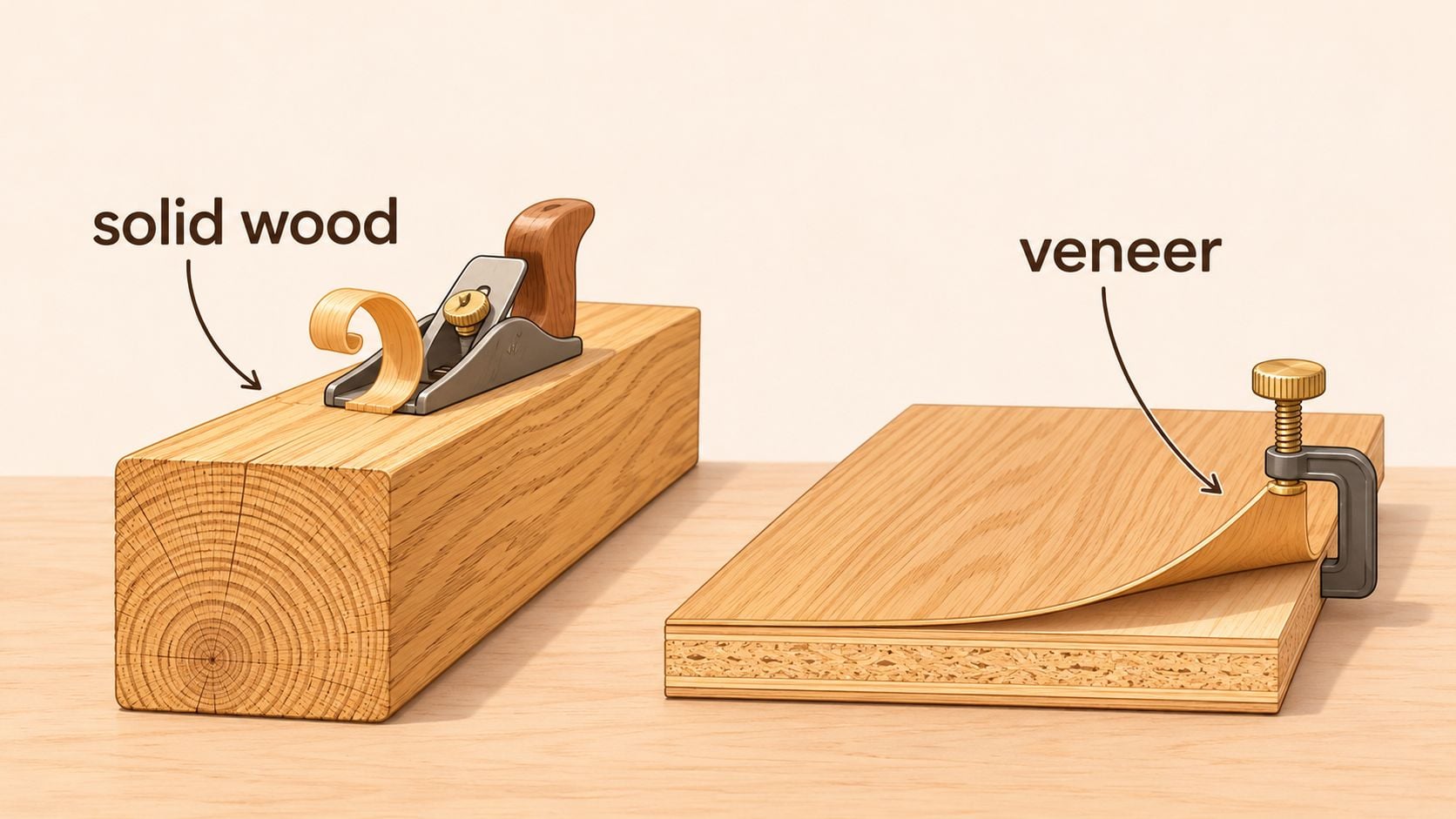
Two Ways to Use One Log
Solid construction keeps material where a part needs it. A leg, a rail, an apron, a drawer side, and a tabletop edge all gain from thickness you can shape, drill, sand, and later refinish. Grain runs continuously through the piece, edges can be molded or chamfered, and a dent becomes a sanding job instead of a replacement order. Species choice sits on top of that, and choosing the right hardwood for longevity and style covers how grain, hardness, and finish behave on the pieces you'll live with.
Veneer takes the same species and spreads it. One log becomes hundreds of faces, matched so a wide door reads as a single continuous surface. That's why the scale matters: the Food and Agriculture Organization's forest products data records veneer and plywood output at 162 million cubic meters in 2014, or 42% of all wood-based panel production worldwide. Nothing that large survives on cost alone, and nothing that large is a fringe material.
The buyer's test follows from that. What sits under the face, how the joints are cut, how the finish is built up, whether the edges are sealed, and what the piece will face in your house predict service life far better than the word on the tag.
What veneer isn't: a laminate, a printed photograph, or a synonym for particleboard. A veneered panel is a wood panel, and the core is a separate decision from the face.
So the split is practical rather than moral. Solid thickness belongs where structure and future repair carry the load. Balanced veneer belongs where a wide, flat panel has to stay flat in air that changes with the seasons. The at-a-glance comparison below puts both against the same criteria, which is the fastest way to shortlist before the sales conversation starts.
Solid Wood vs Veneer at a Glance
The surface label is a poor buying guide. Compare the whole build: core, joinery, finish, and edge seal, then match it to the piece's job and room.
Solid wood versus quality veneer by buying criterion
| Criterion | Solid wood | Quality veneer |
|---|---|---|
| What you are buying | Thick sawn timber through the part | Thin real-wood face over plywood, MDF, or particleboard |
| Best jobs | Legs, rails, aprons, heirloom cases | Wide doors, cabinet sides, large flat tops |
| Look | Continuous grain and shaped edges | Matched grain across broad panels |
| Seasonal movement | Needs floating panels or flexible joinery | Cross-banded core helps restrain cupping |
| Repair reserve | Can be sanded, stained, patched, or partly replaced | Limited sanding depth; suited to light care |
| Main failure | Split or cupped board if movement is locked | Lifted face, open seam, or swollen edge if core or seal fails |
| Price position | Higher for thick premium species | Uses less of the visible species |
| What predicts lifespan | Joinery, finish, and refinishing plan | Core density, face balance, edge seal, and bonding |
Two rows settle most purchases: seasonal movement and repair reserve. The first matters on broad panels; the second determines how much damage the surface can tolerate before repair becomes difficult.
Treat veneer as a finished face, not a repair allowance. Clean spills promptly and avoid aggressive sanding. Solid wood allows more scope for refinishing or replacing a damaged part, but only when the joinery lets the wood move rather than locking it in place.
Use the table as a filter, not a verdict. For a piece with exposed edges and joints that may need repair, solid wood can be the better fit. For a broad, flat panel, a balanced veneer construction can keep the surface stable. In either case, inspect what supports the panel and how its edges are sealed.
The last row deserves close attention. Two tables with the same wood face can have different service lives if one has well-bonded, balanced panels and sealed edges while the other leaves the core vulnerable to moisture.
Construction beats the label. A well-built veneered panel can serve better than a solid top with poor joinery. Choose by the whole panel build and the conditions it will face.
How Humidity Moves Wood in Coastal Homes
Humidity puts the panel build to the test. A wood board moves most across its grain, so a wide tabletop needs room to expand and contract as indoor conditions change. In a coastal home, a humid summer and a heated winter can pull the same top in opposite directions.
Where Solid Tops Go Wrong
A solid top fastened tightly to an apron can split, cup, or open at a glue line when seasonal movement has nowhere to go. The floor responds to the same changes in moisture. For practical guidance, browse humidity tips for wood floors.
Good solid construction gives movement a path:
- Floating panels: The panel sits in a frame and can expand or contract within the opening.
- Elongated fastener holes: Slots let screws move with the board instead of holding it rigidly.
- Breadboard ends: End pieces help keep a top flat while allowing seasonal movement.
- Flexible joinery: Joints and frames accommodate movement rather than locking a panel in place.
For wide tops and doors, American-made hardwood furniture can include construction designed around that movement. Engineered panels restrain movement rather than eliminate it. Alternating grain in plywood helps stabilize the panel, making it a practical choice for broad doors and cabinet sides, especially near an exterior wall.
The coastal rule. Choose balanced construction for a large door or wide top: veneer on both faces, sealed edges, and a plywood or dense, well-sealed composite core.
Veneer can still fail when the face and core respond differently to moisture, the bond is poor, or the piece faces repeated humidity swings. Look for bubbles, open seams, or edges swollen beyond the banding. Check that the back is veneered too. A panel finished on only one face is more prone to cupping.
What Sits Under the Veneer
Two dressers can have matching walnut faces and very different structures. The core determines how well the case holds screws, resists swelling, and stays square. Check the whole panel build: core, joinery, finish, and edge seal.
The U.S. EPA's consumer guidance on formaldehyde standards for composite wood lists limits of 0.05 ppm for hardwood plywood, 0.11 ppm for MDF, and 0.09 ppm for particleboard. These limits distinguish panel emissions, not strength or service life. Core material still matters for fastening, moisture exposure, and repair.
Cores under a wood veneer face. Formaldehyde limits are from EPA consumer guidance linked above.
| Core | Formaldehyde limit | Fastening and stability | Sensible use |
|---|---|---|---|
| Hardwood plywood, veneer core | 0.05 ppm | Strong screw hold and cross-band stability | Doors, sides, and wide tops |
| MDF | 0.11 ppm | Smooth face, moderate screw hold | Painted panels and low-impact parts |
| Particleboard | 0.09 ppm | Weaker screw hold, more swell if edges get wet | Backs and other low-stress panels |
Repairability depends on the face and the structure beneath it. A light scratch may respond to careful touch-up, while aggressive sanding or a deep gouge can cut through veneer. Solid legs and rails give a repairer more material to work with, though refinishing removes wood and can affect how a joint fits. Choose the surface based on the likely damage, then check whether the underlying parts can be repaired or replaced.
A plywood-core veneered top is often the more durable choice in a humid room with a wide panel. Its layered construction helps the top stay flat, provided the veneer, finish, and edges are properly sealed.
For a dresser, inspect the case as closely as the visible face. Press along the edges and look for lifting, open seams, or bubbling. Ask whether the back face is also veneered, and whether the core is plywood, MDF, or particleboard. The face sets the style; the core and edge treatment help determine how the piece handles moisture and wear.
For new doors on existing cases, kitchen cabinet refacing before and after illustrates how much a finished look depends on the face and edges. The same distinction applies to furniture: a good-looking surface cannot compensate for a weak or poorly sealed panel.
Ask for the panel specification in writing. A description that names the core, face, and edge treatment gives you more useful information than a list of wood species. Use this guide to read furniture product descriptions and buy with confidence, then check the piece in person: open a drawer, inspect the seams, and confirm the back-face material.
Price Resource Use and Service Life
Sticker price is the least interesting number in this comparison. The number that matters is cost per year of service, and the questions behind it are what happens when the piece is damaged, when the household moves, and when the finish finally goes.
Where the Saving Comes From and Where It Goes
A thin face of oak, walnut, or cherry covers far more furniture than the same volume of solid boards, which is why manufacturers use it to keep a solid-wood look within reach. That saving is real when the core, the adhesive, and the finish hold up. It evaporates when a swelling particleboard panel gets replaced in a few years, because building a replacement case uses more material than refinishing a solid rail or re-hanging a plywood-core door that stayed in the house.
Life-cycle accounting makes the same point. Environmental product documentation for wood furniture counts drying, adhesives, joining methods, resource use, and the carbon held in the wood rather than assuming one construction is greener by category. That cuts both ways. An efficiently veneered panel can use less forest resource, while a repairable solid frame that lasts four decades can carry a lower lifetime impact than a cheap panel replaced three times over. Sourcing documentation is worth reading for the same reason, and sustainable wood furniture explains how to judge it.
Two household cases show why the panel spec matters more than the species name:
- Health-conscious bedroom buyers: ask for the panel specification and the emissions compliance behind it, not just the species, because a bedroom is where a piece sits closest to you for the longest hours.
- Investment buyers: pay for the solid parts that take load and can be repaired, meaning legs, aprons, rails, and drawer boxes, and accept veneer where stability protects a wide top.
American-made casegoods often mix the two deliberately, with solid structural parts and veneered panels, and that mix is a feature when the seller discloses it. The showroom at Willis Furniture & Mattress offers American-made furniture craftsmanship, and a written spec is the difference between a designed mix and a quiet cost cut.
Take this checklist shopping: species and origin, the share of solid versus veneer, the core type, emissions compliance, the finish system, the repair path for a scratch and for a gouge, and the replacement pathway, meaning whether parts can be ordered or the whole piece goes to the curb. A seller who answers all seven is selling a specification. A seller who answers two is selling a photograph.
Which Construction Fits Each Room
The room sets the specification. A panel that's ideal on a dresser in a conditioned bedroom is the wrong build for a bench on a screened porch, and no material label fixes that mismatch.
Sanding a top back to bare wood is the repair a thin face can't offer, and it's why solid stock keeps its place on surfaces that get used daily.
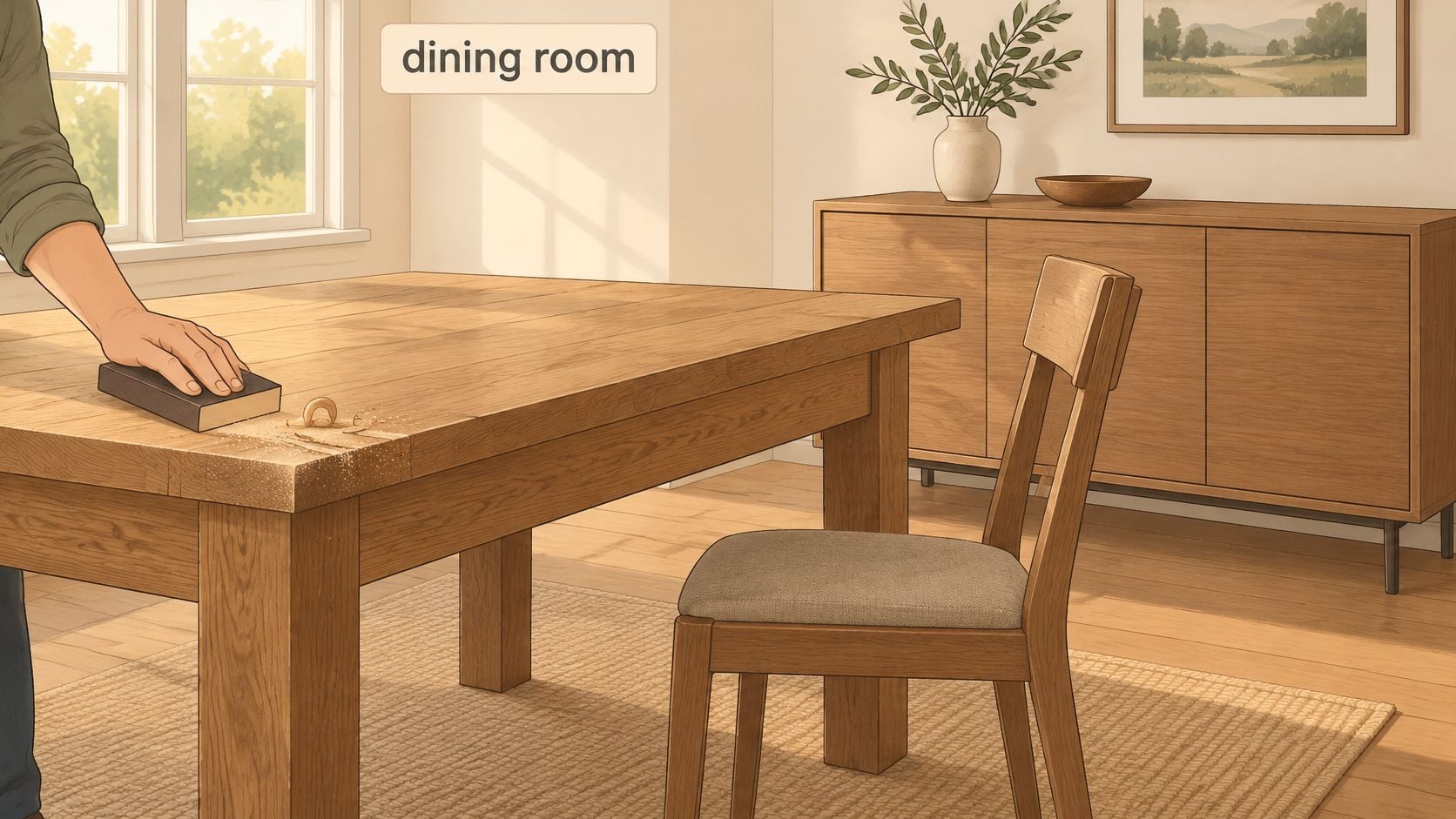
Room-by-room construction choices
| Piece | Prefer | Avoid | Why |
|---|---|---|---|
| Dining table | Solid legs and aprons; solid or plywood-core top | Unsealed particleboard top | Daily wear plus humidity across a wide span |
| Bedroom dresser | Balanced veneer panels, solid drawers and rails | Raw edges and unknown composite | Stability against exterior walls and cleaner indoor air choices |
| Coffee or end table | Veneer on a stable core, or solid if edges take hits | Thin face with no edge band | Light loads but visible damage at corners |
| Home office desk | Solid frame and legs; veneer only on a supported top | All-veneer rails at the knee | Screw holding and long sitting loads |
| Coastal case piece | Veneer both faces, sealed edges, plywood core | Wide solid panel locked to the frame | Salt air and air-conditioning swings |
| Heirloom chair or bed | Solid joints in the species you want to refinish | Decorative veneer at stress points | Repair and part replacement over decades |
The daily dining table earns solid where hands and chair backs hit it. Legs, aprons, and the joints holding them should be thick stock, and the top can go either way: a solid top that can be sanded back after a decade of homework and holidays, or a plywood-core veneered top if the room swings hard between wet summers and dry winters. What it shouldn't be is a particleboard top with an unsealed edge. Care matters as much as construction here, and how to care for wood furniture covers the polish and humidity habits that keep a finish alive.
The bedroom dresser runs the other way. Doors and sides that stay flat against an exterior wall, with solid drawer boxes and rails where the load and the sliding happen, beat an all-solid case that fights the wall every July. For anyone thinking about indoor air, it's also the piece to ask about panel compliance on. Coffee and end tables sit in the middle: light loads, but corners take hits from vacuums, toys, and feet, so a veneered top needs an edge band and a solid leg, or the piece should be solid throughout.
Coastal case pieces in a sunroom or a beach rental want sealed edges and stable panels, not a wide solid board locked to a frame in salt air and air conditioning. Heirloom chairs and beds go the opposite direction, with solid joints in a species you plan to refinish, because a decorative veneer at a stress point can't be repaired, only replaced.
Willis Furniture & Mattress's design consultants plan whole rooms rather than single pieces, and the Design Center can specify that mix item by item, with solid where the joints take load and veneer where a panel must stay flat. The store offers design services, custom order, furniture repair, and a Protect Your Furniture plan, across categories that run from living room and dining room to home office and the Outlet. Qualified buyers can use Synchrony HOME promotional financing, including 6 months of deferred interest on purchases of $299 or more, when the right build costs more than the first pick.
When the budget is the constraint, the Willis Outlet on the Virginia Beach campus beats a thinner unspecified core. Floor samples and overstock still carry construction you can inspect, and the saving comes from the piece's history rather than from the panel underneath. Circle one row in the table before shopping. The row you circle names the construction, and everything after that is finish, scale, and price.
Choose the Construction Then Place the Order
A showroom visit works best when you arrive with a room and a use in mind. Set a clear checklist before comparing finishes or prices:
- Name the job from the room table. Write down the piece, the room, and the toughest condition it will face, such as a west-facing wall, a sunroom, or frequent air conditioning. That gives you a practical starting point for comparing builds.
- Open a door and a drawer. Ask whether the visible surface is solid wood or veneer, whether the drawer boxes and structural rails are solid, and whether the panel core is plywood, MDF, or particleboard.
- Inspect faces, edges, and finish. Look for bubbles, open seams, unfinished edges, and a raw back panel. On veneered furniture, sealed edges help limit moisture exposure.
- Ask about emissions compliance for composite cores. For bedroom furniture, request the written product specification so you can confirm what the panel is made from and whether it meets applicable requirements.
- Set the budget around the piece's role. Willis Furniture & Mattress offers curated collections of American-made and premium brands. Ask what construction details are specified for the piece you're considering, and ask about promotional financing for qualified buyers. If the budget is fixed, compare the construction of Outlet pieces rather than choosing by price alone.
- Use design help when scale or finish is the sticking point. Willis offers design services and custom orders. Call (757) 340-2112 to ask about design help or furniture repair.
Before ordering, ask the sales team one specific question: What is the panel core, and how are its edges sealed? The answer helps you judge the whole build against the room's conditions, rather than relying on the surface label. Willis Furniture & Mattress carries American-made and premium collections, and you can discuss the construction details of individual pieces with the team. Visit Willis Furniture & Mattress in Virginia Beach to compare options before you order.


