
Hand Knotted vs Machine Made Rugs: Which Is Worth It?


The Pazyryk carpet, dated to roughly the 5th to 4th century BCE, carries about 36 symmetrical knots per square centimeter, or 232 knots per square inch, a density that would still read as fine work in a showroom today, according to the recorded history of the Persian carpet. That single surviving object reframes the entire hand knotted vs machine made rugs question. Knotting by hand isn't a decorative style with a folk story attached. It's a production system, at least 2,500 years old, in which pattern detail, knot count, fiber quality and labor hours all rise together.
Machine production is a system too, and a far younger one. It separates the two categories on economics as much as on appearance, which is why the price of a rug says more about how it was made than about how it looks.
The buyer's real question isn't which construction is better. It's which rug returns more value per year of use in the room it will live in, with the traffic, pets, sand, humidity and furniture that room contains. That calculation looks different in a Virginia Beach living room than it does in a seasonal rental two blocks from the ocean.
Hand Knotted and Machine Made Rugs at a Glance
Neither construction wins everywhere. A hand knotted rug is the better buy where a room will keep the same floor covering for twenty years or more and repair matters more than replacement. A machine made rug is the better buy where price, spill frequency, or a décor you'll change in five years sets the terms.
Volume shows where most buyers land. Machine made carpets represented 65.2% of the global woven carpet and rug market in 2025, while handmade products represented 34.8%, according to Dataintelo's woven carpet and rug market report. That split describes what sells, not what survives.
| Criterion | Hand Knotted | Machine Made |
|---|---|---|
| Construction | Yarn knotted individually around warp threads | Pile inserted mechanically on power looms |
| Production time | About 12 to 14 months for a large rug in one documented process | Minutes to hours per rug |
| Typical service life | About 50 to 100-plus years when well maintained | About 8 to 20 years |
| Price per square meter | Up to $210 | About $55 on average |
| Repairability | Often repairable by reweaving if the foundation is intact | Usually replaced rather than repaired |
| Pattern flexibility | Custom and highly detailed patterns | Consistent, repeatable designs |
Judging construction rewards the same habit that pays off with any high-craft object: turn it over, study how it was made, and learn to read the tells. Spotting authentic museum grade Buddha sculpture applies that discipline to bronze and stone, where tool marks and casting seams separate handwork from a mold, and the same logic carries straight over to a rug's back.
The rule worth carrying into any showroom: the label tells you how a rug was made, not how long it will last in your room or whether it fits the space. The rows above are only useful once you test them against a specific room, which is what the rest of this comparison does.
How Each Rug Is Built From Yarn to Finish
Flip a rug over and the construction is usually visible in under a minute. On a hand knotted rug, a weaver wraps each knot of yarn around the warp threads, row by row, cutting and securing the knot before starting the next row. The pile becomes part of the rug's structural foundation rather than something attached to a separate backing. No adhesive holds it in place, which is exactly why a professional can reweave a worn area when the foundation is still sound, as Rugaz's construction comparison explains.
The cutaway below shows where the three main constructions part company.
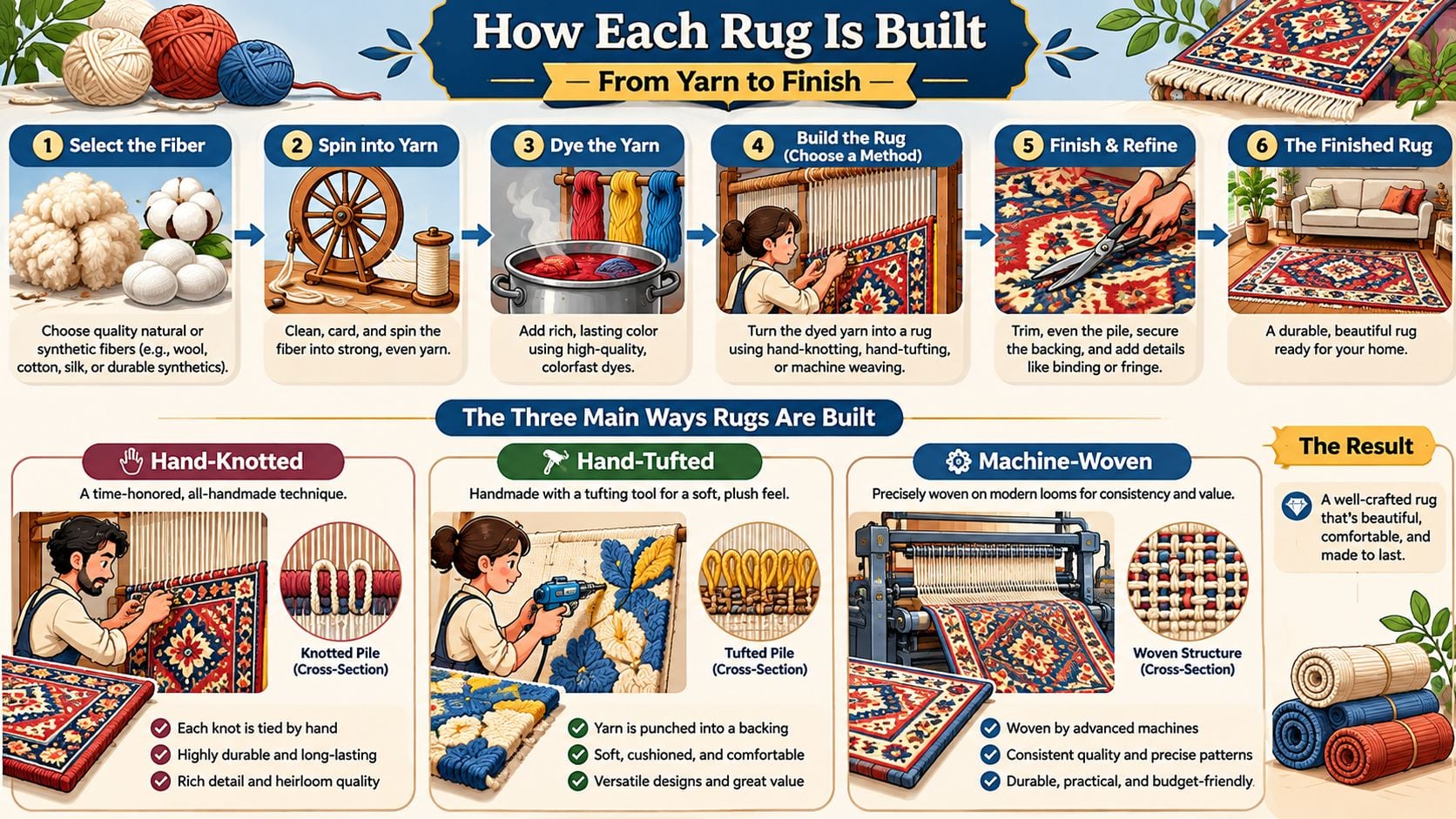
Power looms take the opposite approach. Pile yarn is inserted mechanically into a ground structure in one continuous pass, which is fast, uniform, and the reason two rugs in the same pattern are effectively twins. The industrialization of that process was quick. Erastus Bigelow's carpet power loom, developed in 1839, reportedly doubled output within its first year and tripled production by 1850, according to a handwoven versus machine-made investment comparison.
Why an hour of weaving costs more than a yard of wool
Labor intensity is where the price gap starts. One documented handmade process uses two to three master weavers working eight hours a day for roughly 12 to 14 months on a single large rug, while a power loom turns out the same footprint in a small fraction of that time, as Rugsonnet's production breakdown describes. A hand knotted rug's price reflects labor hours, specialized skill and limited capacity before it reflects fiber or pattern. That's why two rugs in the same wool, the same size and a similar palette can sit thousands of dollars apart.
What the price is telling you: you're paying for the number of individual operations a person performed, not for a brand story.
Seeing the two side by side settles it faster than any spec sheet. Browse hand-woven area rugs and study the backs of a few pieces at close range.
The back test
The back of a hand knotted rug is a near mirror image of the front, with individual knot ends visible and slight variation in size and color. A machine made back usually looks rigid and uniform, often grid-like, and frequently carries a coating or a sewn-on fringe. Hand tufted rugs form a third category between the two: a tufting gun punches yarn through a canvas backing, then latex adhesive locks the pile in place. Tufting is much faster than knotting and much cheaper, but the adhesive becomes the weak point as the rug ages, and a tufted rug's back is always covered by a glued fabric layer.
What Durability Really Depends On
The familiar assumption is that handmade means durable and machine made means disposable. Construction matters, but it isn't the mechanism that decides wear. What decides wear is how densely and how tightly the pile was built, in either category.
The four variables that decide wear
A peer-reviewed textile study of handwoven wool rugs identified four variables governing wear performance: knot density, pile height, the number of plies in the pile yarn, and yarn twist. Together they determine abrasion resistance and how well the pile recovers after compression, as Rugaz's density and construction guide details.
The useful test: a high knot count with a short, loosely twisted pile can wear through faster than a moderate knot count with a deep, tightly twisted pile.
That cuts both ways. A high knot count alone isn't a complete quality test, and a dense machine made rug with a sturdy backing can hold up for many years in a moderate-traffic home.
Service life in real households
Indicative ranges put well-maintained hand knotted rugs at roughly 50 to 100-plus years and machine made rugs at roughly 8 to 20 years, according to Payless Rugs' lifecycle comparison. Traffic, fiber, pile height, sunlight, moisture and maintenance shift those outcomes substantially. A hand knotted rug in a sun-drenched sunroom with a dog bed on it won't automatically outlast a machine made rug in a guest room nobody enters.
Three checks you can run in the showroom
- Press the pile with a thumb. Release it and watch. Pile that springs back has body and twist; pile that stays flattened will mat under furniture legs and footfall.
- Feel across the surface with a flat palm. Density shows up as resistance under the hand. Thin, spongy patches in the middle of a rug signal where it will crush first.
- Read the fiber and backing labels. Wool content, ply count, backing material and cleaning instructions tell you more about service life than the words "handmade" or "machine made" ever will.
For rooms that take a beating, it helps to compare rugs that were built for it, and this roundup of the best area rugs for high traffic areas shows what dense construction looks like in practice. Matching construction, fiber, pile height and expected foot traffic beats trusting either label.
Real Cost Per Year of Use
The sticker gap is real and large. Handmade carpets can cost up to $210 per square meter, compared with an average of $55 per square meter for machine made alternatives, according to Research and Markets' 2025 report. Divide both by years of service and the picture changes.
Take a 3 by 3 meter rug, which is 9 square meters of floor coverage. At $55 per square meter, the machine made option costs about $495 and might serve 15 years in a family room, or roughly $33 per year. At $210 per square meter, the hand knotted option costs about $1,890 and might serve 60 years, or roughly $31.50 per year. These are illustrative figures built on the averages above, not a quote for any specific rug.
| Over the life of the rug | Machine Made (9 sq m) | Hand Knotted (9 sq m) |
|---|---|---|
| Purchase price | About $495 | About $1,890 |
| Assumed service life | 15 years | 60 years |
| Cost per year | About $33 | About $31.50 |
The catch is everything the division hides. A pad, annual cleaning, a repair after a chair leg gouges the pile, and early replacement when a cheap rug flattens in year four all move the annual number. So does the very real cost of tying up $1,890 today versus $495.
Do the division before you decide. A close cost per year doesn't erase a four-figure upfront gap, and pretending otherwise is how buyers talk themselves into the wrong rug.
That upfront number is where financing earns its place. Willis Furniture & Mattress offers promotional financing through the Synchrony HOME credit card, with 6 months of deferred interest on purchases of $299 or more, which spreads a premium hand knotted purchase across a season instead of a single statement. Buyers working with a tighter budget can look at the Outlet, where overstock and floor samples carry deep discounts and a machine made rug becomes a low-stakes purchase.
Fiber choice drives the math more than most shoppers expect, and the practical benefits of wool rugs explain why the hand knotted column tends to hold its value.
Caring for and Repairing Each Rug Type
Hand knotted care starts with the vacuum. Run the wand without a beater bar, rotate the rug every few months so traffic wear evens out, and expect some shedding from new wool for the first year. Shedding settles. Matting doesn't. Deep cleaning belongs with a professional who tests dyes before washing, not with a rental machine in the driveway.
Repair potential is what separates the two categories most sharply. Localized wear, a worn fringe, or a pulled knot can be corrected by a reweaver when the foundation is intact, and the repair is often invisible from above. Pile worn thin across the whole surface is a different verdict. That's resurfacing, not repair, and the rug has reached the end of its useful life.
Machine made care runs in the opposite direction. Vacuum regularly, blot spills immediately, and follow the care label, since many synthetic rugs tolerate moisture and cleaning agents better than untreated wool. If deep cleaning isn't something you want to manage, the vetting questions matter more than the price: ask what method a provider uses on wool, whether they test for dye bleed, and whether they carry insurance. A guide to comparing Gulf Shores cleaning services covers the questions worth asking before booking anyone. For everyday upkeep between professional cleanings, this walkthrough on how to clean a wool area rug at home covers the safe sequence.
Three signs mean a machine made rug is finished: pile that stays flat after a thumb press, a backing that separates or cracks when folded, and fading that has shifted the room's palette.
Repair-or-replace rule: if the damage covers a hand-width area and the foundation is sound, repair it. If the pile is thin across most of the surface, or the backing is failing, replace it.
Sustainability follows the same arithmetic. The greenest rug in a Virginia Beach home is the one that stays attractive, repairable and usable in its actual room for the longest, whether that rug was tied by hand or woven on a loom.
Choosing the Right Rug for Each Room
The decision rule is straightforward. Choose hand knotted where repairability, aging and a custom look carry weight. Choose machine made where initial price, easy replacement or hard use matters more. The room, not the label, sets which of those applies.
| Room or Situation | Better Fit | Why | What to Check |
|---|---|---|---|
| Primary living room with daily traffic | Hand knotted wool | Repairable and ages well | Pile height and knot density |
| Coastal entryway with sand and humidity | Machine made synthetic | Easy to replace and clean | Backing and colorfastness |
| Pet-heavy family room | Machine made | Dense weave with a sturdy backing resists wear | Stain-resistant fiber and pile height |
| Children's room or play area | Machine made | Low cost and easy to replace | Washable fiber and low pile |
| Formal, low-traffic sitting room | Hand knotted | Heirloom potential and custom sizing | Fiber content and warranty |
| Rental or seasonal decor | Machine made | Lower initial cost and quick style changes | Size and return policy |
Sizing logic transfers across categories. The same way equestrian rug sizing and materials depend on the animal's build and the work it does, a living room rug depends on the furniture footprint and the traffic crossing it, so measure both before comparing price tags. A precise rug sizing guide for a living room keeps a buyer from spending hand knotted money on the wrong dimensions.
In the living room, a dense wool hand knot earns its price because the rug sits at the center of the house for decades and a reweaver can fix a burn or a pet stain without replacing the whole piece. The coastal entryway reverses the logic: sand grinds into pile, humidity works on backing, and a rug you can hose down, dry and eventually replace at low cost wins. Pet households want tight construction and stain-resistant fiber, because the failure mode is liquid, not age.
Children's rooms and play areas rarely justify a four-figure rug. Low pile, washable fiber and a forgiving price matter more than knot count. Formal sitting rooms sit at the other end, where a hand knotted piece can be sized to the room and, with a documented warranty, become the heirloom. Rentals and seasonal décor favor machine made for the same reason people rent rather than buy in a beach town: circumstances change.
Construction is easier to judge in person than in photos. The Rug Market in Virginia Beach holds hundreds of hand knotted, artisan and one-of-a-kind rugs, and Willis Furniture & Mattress sells home decor and rugs, including throw pillows and area rugs, so a rug can be matched to the rest of the room rather than bought in isolation. Consultants at the Design Center can coordinate rugs with lighting and accessories through Total Room Solutions and help size a piece to a specific footprint. Machine made options for rentals and seasonal décor are available through the Outlet's everyday savings.
Choose the Right Rug Before You Buy
Choose a hand knotted rug for a primary room you plan to keep for decades, and a machine made rug where budget, children, pets or a coming change of décor matter more. That's the whole verdict, and it holds up better than ranking the two constructions against each other.
The questions that matter more than the label
No shopper should leave a showroom without answers to these, in writing where possible.
- Fiber composition: the exact percentage of wool, cotton, polyester or nylon, plus any treatment applied to it.
- Pile height: measured, not described as "plush," because pile height drives crush resistance and cleaning difficulty.
- Backing type: woven foundation, latex and canvas, or a coated synthetic back, since the backing often fails first.
- Knot density or weave construction: knots per square inch on a hand knotted piece, or the weave specification on a machine made one.
- Cleaning instructions: what the maker permits, and what voids the warranty.
- Documented warranty: the written terms, not a verbal assurance at the register.
- Return policy: the window and the conditions, especially for an oversized rug.
- Country of origin: where it was woven, which tells you something about the labor behind the price.
The answers to those questions predict service life far better than the word "handmade" on a hang tag. A rug with a tight weave, honest fiber content and a real warranty will outlast a loosely built one that carries a better story.
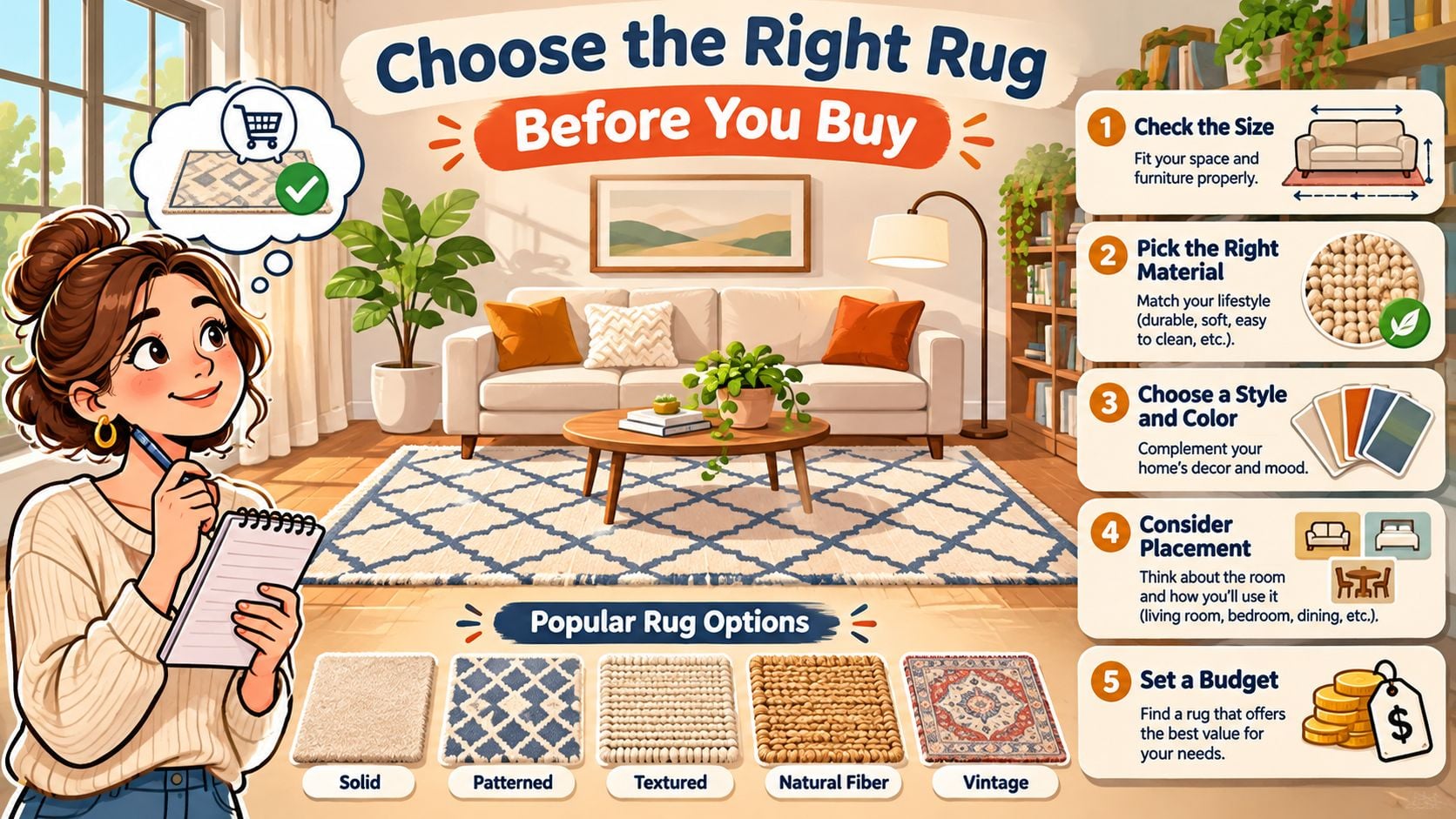
The next step is to compare both constructions in person at Willis Furniture & Mattress in Virginia Beach, where the Rug Market puts hand knotted and machine made pieces within a few steps of each other. The shop carries Living Room, Bedroom, Dining Room, Entertainment, Home Office, Home Decor, Rug Market, Mattresses and Willis Outlet categories, so a rug decision can be handled alongside the rest of a room. Use the Design Center for custom sizing and color coordination, ask about Synchrony financing for a premium piece, and check the Outlet when the budget is the binding constraint. The right rug is the one that suits the room and the household's real use, not the one whose label sounds better.
Willis Furniture & Mattress is a Virginia Beach landmark with a Rug Market holding hundreds of hand knotted, artisan and one-of-a-kind rugs, which means both constructions can be flipped over and compared in the same afternoon. Bring room measurements and a few photos, and the Design Center can match size, color and weave to the way the space gets used, with Synchrony financing available when a premium piece needs a longer runway. Visit Willis Furniture & Mattress to plan a visit and see what's on the floor.


