
How to Choose Mattress Firmness: A Guide to Restorative Sleep


Finding the right mattress firmness isn’t just about what feels comfortable at first touch—it’s the single biggest factor in getting deep, restorative sleep night after night. The real secret is matching that firmness to your specific sleep position and body weight.
When your mattress aligns with your body, it keeps your spine in a neutral position, providing critical pressure relief. The wrong one? That’s where you get chronic pain and restless nights.
Why Mattress Firmness Is The Key To Great Sleep
Walking into a mattress showroom can feel overwhelming with all the technical jargon and endless options. But if you can get a handle on firmness, you’re already halfway to transforming your sleep quality. It’s the perfect place to start, and we’ll break down exactly how to choose the right mattress firmness for you.
At its core, firmness is simply how soft or hard a mattress feels. But here’s the catch: it’s completely subjective. What feels like a cloud to a 200-pound back sleeper might feel like a plank of wood to a 130-pound side sleeper. This is precisely why a "one-size-fits-all" mattress just doesn't work for most people.
The Impact of the Right Firmness
The right firmness level does more than just feel good; it's a cornerstone of your physical health. When a mattress offers proper support, your spine maintains its natural alignment all night long. That means you wake up refreshed, not with nagging aches and pains.
Think about this: studies have shown that 55% of poor sleepers point to an unsupportive bed as the cause of their issues. It’s a huge problem, especially in the U.S., where North America holds a massive 34% of the global mattress market share, a figure that translates to about $15.8 billion in sales. Consumers are getting smarter and more data-driven about their choices, and it's easy to see why.
A mattress that correctly supports your body minimizes pressure points on your hips, shoulders, and lower back. This targeted relief doesn't just reduce tossing and turning—it actually improves blood circulation, paving the way for a much more restorative sleep cycle.
A Quick Guide to Mattress Firmness Levels
To make sense of it all, the mattress industry uses a 1-to-10 scale, where 1 is the softest and 10 is the firmest. Most mattresses fall between 3 (Soft) and 8 (Firm). Here’s a quick breakdown to help you find your starting point.
| Firmness Level (1-10 Scale) | Typical Feel | Ideal Sleeper Profile | Best For Body Weight |
|---|---|---|---|
| 1-2 (Extra-Soft) | Deep sinkage, "hugging" feel | Strict side sleepers, those with sharp pressure points | Under 130 lbs |
| 3-4 (Soft) | Plush with contouring | Side sleepers, some back sleepers who like cushioning | 130 to 230 lbs |
| 5-6 (Medium) | Balanced feel, gentle contouring | Combination sleepers, couples with different needs | All weight groups |
| 7-8 (Firm) | Minimal sinkage, "on top" feel | Back and stomach sleepers, those with back pain | Over 230 lbs |
| 9-10 (Extra-Firm) | Very rigid, no sinkage | Strict stomach or back sleepers needing maximum support | Over 230 lbs |
This table is a great starting point, but remember, the ideal firmness is a personal preference that depends on your unique needs.
Your Path To Personalized Comfort
Here at Willis Furniture & Mattress, we’ve spent decades helping our neighbors in the Virginia Beach community solve this exact puzzle. We're here to bridge the gap between inspiration and action by offering personalized, data-driven solutions that take the guesswork out of the equation.
Instead of just guessing, you can use our advanced BedMatch technology. It uses 18 statistical measurements to map your body's pressure points and create a scientific support profile just for you.
This guide will walk you through everything you need to know, but the ultimate goal is finding a mattress that feels like it was made just for you. As a legacy brand, we believe high-end living and optimal health should be accessible to everyone, and it all starts with building the right foundation for your sleep.
Matching Firmness to Your Body and Sleep Style
When it comes to mattress firmness, that number on the scale is just a starting point. The real magic happens when you find the right feel for your unique body. The two biggest pieces of the puzzle are your go-to sleeping position and your body weight.
These two things work together to determine how much support your spine needs and where you need cushioning for pressure relief. The whole point of a mattress is to keep your spine in a straight, neutral line, no matter how you sleep. Too firm, and you'll get pressure points on your hips and shoulders. Too soft, and you'll sink in too far, throwing your spine out of alignment.
Your Sleep Position is the Biggest Clue
How you spend most of the night is the number one factor in finding the right mattress. Each sleep style puts different kinds of stress on your body, so you need the right support to wake up feeling refreshed instead of achy.
Side Sleepers: Most of us are side sleepers! If this is you, you need a mattress that’s soft enough to let your shoulders and hips—the widest parts of your body—sink in just a little. A soft to medium-firm mattress (usually a 3-6 on the scale) hits that sweet spot between pressure relief and support.
Back Sleepers: Sleeping on your back is great for natural spinal alignment, so your mattress just needs to help maintain that. If it's too soft, your hips will sink lower than your shoulders, creating an uncomfortable curve in your lower back. A medium-firm to firm feel (5-8 on the scale) is perfect for keeping everything level.
Stomach Sleepers: This position can be tough on the neck and spine. To avoid strain, stomach sleepers need a firm mattress (a 7-8 on the scale). This prevents your midsection from sinking and keeps your body on a flat, even plane.
Combination Sleepers: If you're an active sleeper who tosses and turns, a medium-firm mattress (right around a 6) is usually your best bet. It’s the jack-of-all-trades—cushioning enough for when you land on your side but supportive enough for when you're on your back or stomach.
This handy chart breaks down how to narrow down your options based on how you sleep and how much you weigh.
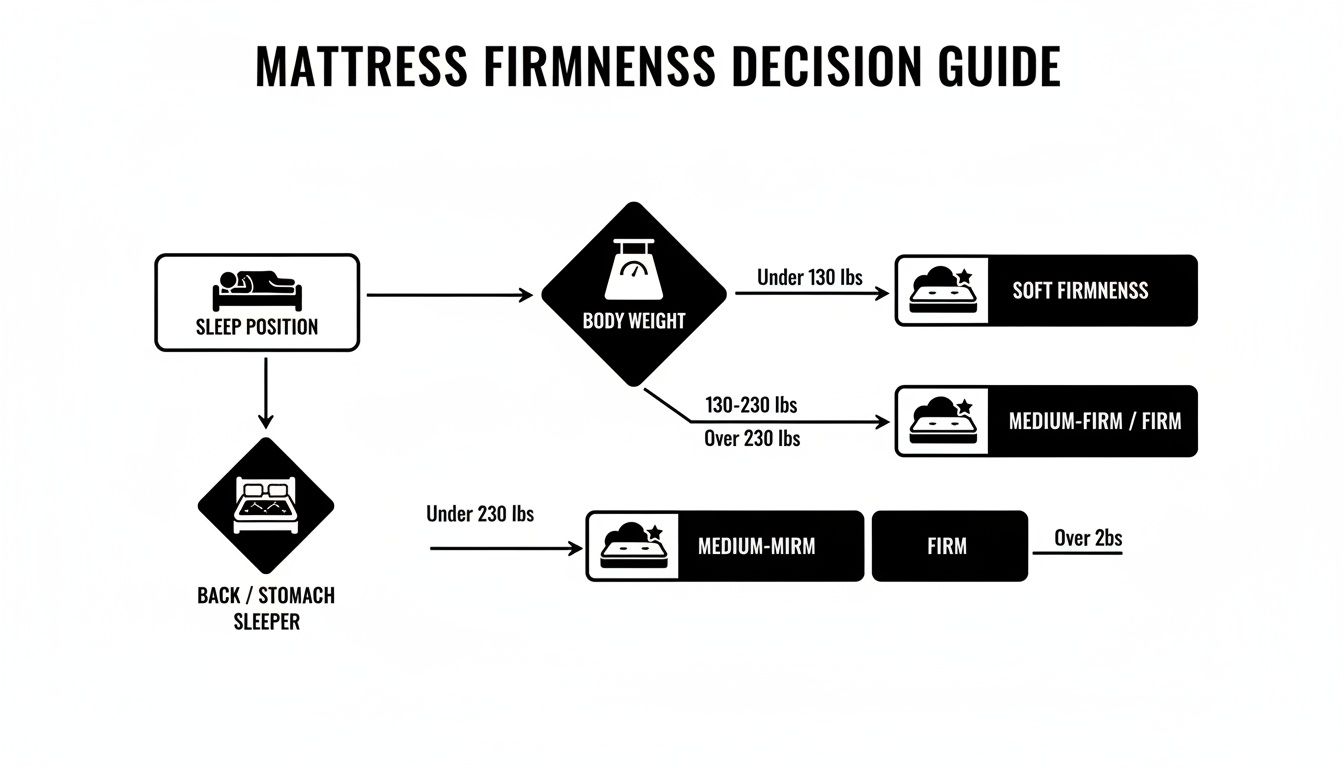
As you can see, you always start with your sleep position. That gets you in the right ballpark before you fine-tune the choice with your body weight.
How Body Weight Changes Everything
Your weight determines how much you're going to sink into a mattress. A bed that feels one way to a 125-pound person will feel completely different to someone who weighs 225 pounds. It's a critical part of the equation.
Here’s a real-world example: A petite side sleeper under 130 pounds might find a "medium" mattress (a 5) feels way too hard. They simply don't weigh enough to engage the comfort layers. For them, a softer mattress (a 3-4) would provide much better pressure relief on their joints.
On the flip side, a heavier back sleeper over 230 pounds would likely sink right through that same "medium" bed, causing their spine to sag. They need a firmer option (a 7-8) to get the durable support required to stay properly aligned all night.
Lighter sleepers generally need a softer feel to get pressure relief, while heavier sleepers need a firmer mattress to get proper support. It’s that simple.
Taking the Guesswork Out of It with BedMatch
Understanding the basics is great, but we know it can still be tricky to translate all this information into the perfect choice. That’s where our sleep experts and in-store technology come in. At Willis Furniture & Mattress, we use the BedMatch system to take all the guesswork out of the process.
This incredible tool uses 18 statistical measurements and over 1,000 scientific calculations to create a personalized support profile just for you. It maps your pressure points and analyzes your spinal alignment, then recommends the exact firmness you need.
For a deeper dive, check out our guide on how to choose the right mattress for your sleeping style. We don't just sell mattresses—we give you a data-driven path to your best night's sleep.
How Mattress Materials Affect Firmness and Feel
A mattress isn't just one big block of foam or springs; it’s a sophisticated blend of layers designed to work together. The materials in those layers are what really determine how a firmness rating feels when you lie down.
Think of it this way: a medium-firm memory foam mattress and a medium-firm innerspring mattress will feel worlds apart. One gives you that deep, body-hugging cradle, while the other offers a responsive bounce that keeps you feeling more "on top" of the bed. Neither is better than the other—it all boils down to the sensation you're looking for.
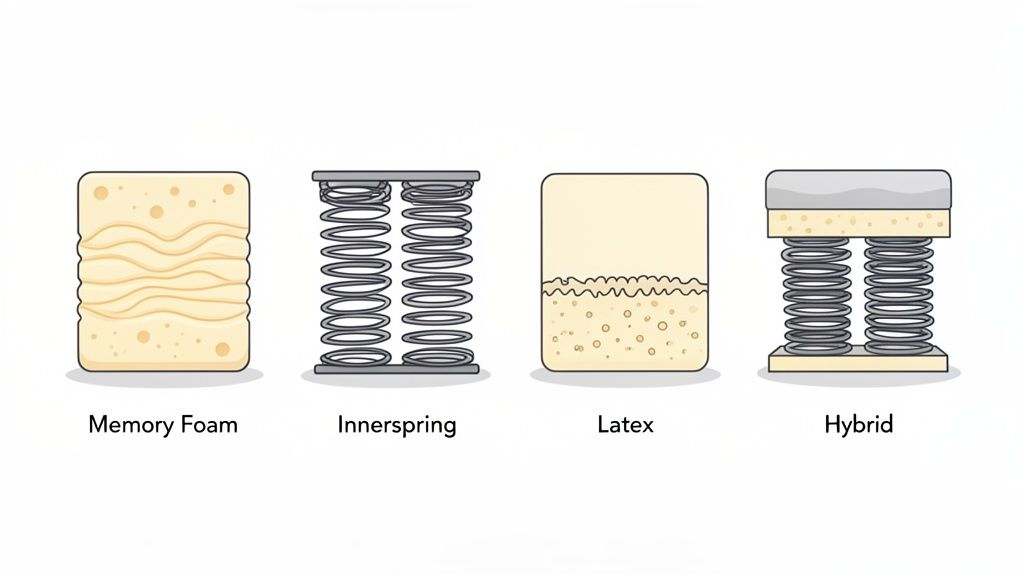
Let’s break down what to expect from the most common materials.
The Deep Hug of Memory Foam
Memory foam is legendary for its slow-sinking, body-contouring feel. It was actually developed by NASA, and this viscoelastic material reacts to your body heat and weight, softening and molding to your unique shape. People often describe this sensation as being "hugged" by their mattress.
This deep contouring is fantastic for pressure relief, making it a go-to for side sleepers who need serious cushioning for their shoulders and hips. A medium-soft memory foam bed, maybe a 3-4 on the scale, will let you sink in for a truly plush and enveloping sleep.
One thing to keep in mind is heat. Traditional memory foam can sometimes trap body heat, but modern versions have come a long way with cooling gels and open-cell designs to let air circulate. That signature "sinking" feeling isn't for everyone, either; some find it makes moving around a bit more challenging.
The Responsive Bounce of Innerspring
When you picture a classic mattress, you're probably thinking of an innerspring. These beds use a core of steel coils for support, giving them that familiar bouncy, responsive feel. With an innerspring, you feel like you’re sleeping on the bed, not in it.
The open coil system also means air flows freely, making innersprings some of the most breathable mattresses out there. You'll often find them in the firm to extra-firm range (think 7-9 on the scale), which is perfect for back and stomach sleepers who need that robust support to keep their spine properly aligned.
While they're champs at support and airflow, traditional innerspring models can sometimes fall short on precise pressure relief. Motion transfer can also be a factor, so you might feel your partner tossing and turning. To get a better handle on the differences, understanding spring versus foam mattresses is a great next step.
The Buoyant Lift of Latex
Latex mattresses offer a really unique balance of contouring and responsiveness. Whether it's natural latex from rubber tree sap or a synthetic version, this foam provides a buoyant, almost floating sensation. It cradles your body gently but bounces back into shape instantly.
Latex is a powerhouse material with some major perks:
- Durability: High-quality latex is one of the toughest materials around, often lasting 15 years or more.
- Cooling: It's naturally breathable and doesn’t hold onto heat the way some foams can.
- Support: It delivers resilient support that adapts well to any sleep position or body type.
Latex is a premium material, and its price tag usually reflects that. For many, though, its incredible longevity makes it a smart long-term investment. The feeling is less of a "hug" and more of a gentle "lift," making it incredibly easy to switch positions at night.
Willis Furniture & Mattress Pro Tip: A premium latex mattress is a significant investment in your health. To make this high-end living accessible, we offer flexible financing options through Synchrony HOME™, allowing you to enjoy the benefits of superior sleep now and pay over time.
The Best of Both Worlds With Hybrid Mattresses
Just like the name implies, hybrid mattresses combine the best features of different materials into one bed. The standard recipe is a supportive core of pocketed innerspring coils topped with generous comfort layers of memory foam, latex, or other advanced foams.
The goal here is simple: deliver the "best of both worlds." You get the sturdy, breathable support of coils paired with the targeted pressure relief of foam. It’s the bounce of an innerspring with the contouring comfort of a foam bed. For a deeper dive, check out our guide on what is a hybrid mattress.
Hybrids are incredibly versatile and come in a huge array of firmness levels, making them a crowd-pleasing choice. A hybrid with a thick memory foam top will feel more cradling, while one with a latex comfort layer will have more buoyant lift.
To make sense of it all, here's a quick cheat sheet comparing how each material stacks up.
Comparing Mattress Material and Firmness
| Material Type | Common Firmness Range | Key Feeling (Contour vs. Bounce) | Best For… | Average Lifespan |
|---|---|---|---|---|
| Memory Foam | 2-6 (Soft to Medium) | Deep contour and slow response | Side sleepers and those with joint pain | 7-10 years |
| Innerspring | 6-9 (Medium-Firm to Firm) | Bouncy and responsive | Back/stomach sleepers, hot sleepers | 5-8 years |
| Latex | 5-8 (Medium to Firm) | Buoyant and responsive contour | All sleeper types, eco-conscious shoppers | 12-15+ years |
| Hybrid | 3-8 (Soft to Firm) | Balanced bounce and contour | Couples, sleepers wanting a balanced feel | 8-10 years |
Ultimately, the right material comes down to the feel you love.
At Willis, our curated collections feature premier, American-made craftsmanship across all these mattress types. Our experienced team can help you navigate the nuances of each material. Better yet, our Design Center consultants can help you pair the perfect mattress with a custom headboard and bedroom suite for a complete, beautifully designed sleep sanctuary.
Your In-Store Mattress Testing Checklist
After all the online research, the most important part of choosing a mattress is still testing it out in person. A bed can tick all the boxes on paper, but you'll only know if it's right for you by actually lying on it. A quick visit to our Virginia Beach showroom can save you from years of buyer's remorse and restless nights.
Think of it less like a quick shopping trip and more like a fact-finding mission for your long-term health. Simply popping in and sitting on a few beds won't cut it. You need a plan to get the real answers.
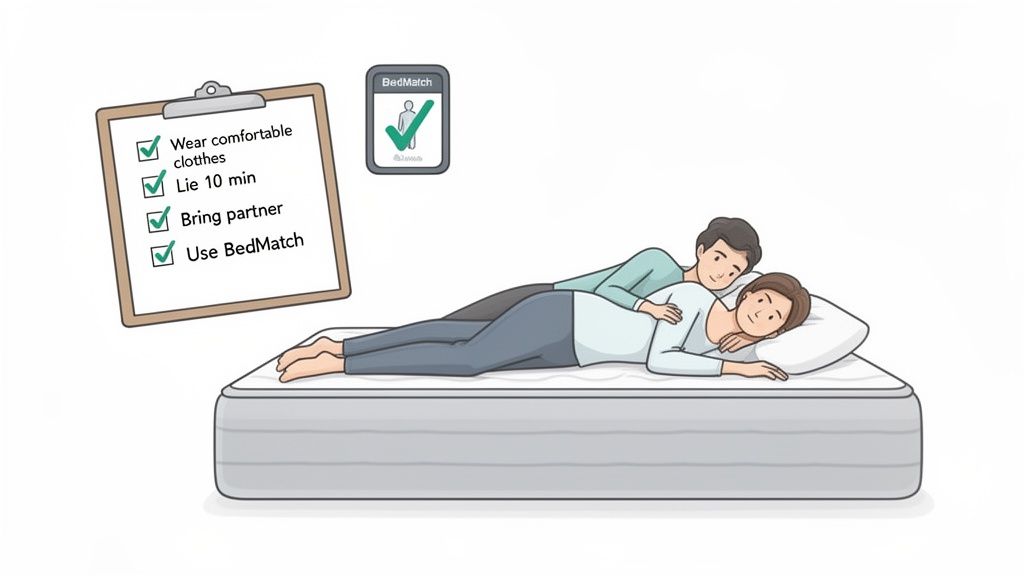
Prepare for Your Showroom Visit
A little prep work before you even leave the house goes a long way. It ensures you’re comfortable, focused, and ready to give each mattress a fair shake.
- Dress Comfortably: Wear loose-fitting clothes and shoes you can easily slip off. You’re going to be lying down, rolling over, and getting up, so you want to move without feeling restricted.
- Time It Right: Try to visit when you aren't tired or in a hurry. A rushed decision is rarely a good one, and if you're already exhausted, just about any mattress will feel incredible for a minute or two.
- Bring Your Partner: If you share a bed, their comfort is just as important. Testing a mattress together is absolutely non-negotiable.
Once you’re here, the goal is to mimic how you sleep at home. Don't be shy—this is a major investment in your well-being.
The 10-Minute Lie-Down Rule
So many people make the same mistake: they push on a mattress with their hand or sit on the edge for a few seconds. That tells you next to nothing about how it will support your entire body all night long.
The Willis Standard: We insist our customers lie down on any mattress they're seriously considering for at least 10 to 15 minutes. This gives your body enough time to relax and settle into the materials, letting you feel for any nagging pressure points or lack of support.
Get into your go-to sleeping position, whether that's on your side, back, or stomach. Close your eyes, breathe, and really pay attention to what your body is telling you. Is your spine aligned naturally? Do you feel a strain in your lower back or too much pressure on your shoulders and hips?
If you're testing with a partner, now is the time to check for motion transfer. Have one person roll over or get up while the other lies still. A good mattress will absorb that movement, so you won’t be woken up every time your partner shifts. For more great advice, check out our tips for buying a new mattress before you come in.
Let Technology Find Your Perfect Match
While your personal comfort test is vital, we back it up with hard data. The centerpiece of your visit to Willis Furniture & Mattress is our exclusive BedMatch system—technology that takes all the anxiety and guesswork out of the process.
Here’s how simple it is:
- You lie down on our diagnostic test bed for just a few minutes.
- The system takes 18 statistical measurements and runs over 1,000 scientific calculations to map your body's unique pressure points and support needs.
- BedMatch then generates a personalized profile and points you to the exact mattresses in our showroom that are scientifically recommended for you.
This data-driven approach is how we’ve built our legacy of expert guidance in the Hampton Roads community. It’s a game-changer, especially when you consider that 35% of adults are stomach sleepers, yet they suffer a 62% rate of morning aches from poor support.
Technology like BedMatch helps us slash the industry's average 25% return rate to under 5% for our customers. You get the right mattress the first time.
Making the Final Decision with Confidence
You’ve done the hard work. You’ve tested different firmness levels, used our BedMatch system to narrow down your options, and found a mattress that feels just right in the showroom. But we know a few minutes in-store is one thing; a full night's sleep is another.
A quality mattress is a real commitment to your well-being, and a big part of that commitment is feeling secure in your purchase. This is where understanding the fine print—sleep trials, warranties, and return policies—gives you genuine peace of mind. At Willis, we’ve built our reputation on being completely upfront, so you know you’re protected long after you leave our store.
Making Sense of Sleep Trials and Returns
Think of a sleep trial as an extended test drive in your own home. Most quality brands will give you a set period, usually 90 to 120 nights, to make sure the mattress is a perfect fit.
Why so long? Because your body needs time to acclimate. It can take anywhere from 30 to 90 days to fully adjust to a new sleeping surface, especially if your old one was unsupportive. During the trial, just sleep on it like you normally would. If it’s not working out, you can typically return or exchange it. We’ll always make sure you understand the specifics, like if there’s a small transport fee or a minimum trial period before you can start a return.
How to Actually Read a Mattress Warranty
Warranties can be tricky, but they're your safeguard against manufacturing defects. The single most important thing to look for is how the warranty defines "sagging" or "body impressions."
Pay close attention to the depth measurement. A warranty will only kick in after an indentation hits a certain depth, typically between 0.75 and 1.5 inches. A policy that covers a sag of just 0.75 inches offers far more protection than one that makes you wait until it hits 1.5 inches. That small detail can be the difference between getting a brand-new mattress and being stuck with one that’s lost its support. You’ll also want to see if the warranty is prorated (losing value over time) or non-prorated.
If you want a deeper look into the whole process, check out our guide on understanding the furniture buying journey from first research to final decision.
The Willis Standard: We believe high-end living should be accessible. Your health and comfort are our top priorities, which is why we ensure every step of your purchase is clear, fair, and supportive of your long-term satisfaction.
Making Your Investment Work for You
We get it—a premium, American-made mattress is a significant purchase. To help you bring home the right one without delay, we offer flexible financing options through our partnership with Synchrony HOME™. For qualified buyers, this program lets you get the sleep you deserve now and pay over time with manageable monthly payments.
And for those who love finding incredible value, the Willis Outlet is the place to be. We regularly feature high-quality floor samples, overstock items, and discontinued models from leading brands. It’s a fantastic way to get a mattress that meets our rigorous standards for a fraction of the price, making restorative sleep a reality for every budget in our community.
Common Questions About Mattress Firmness
Even after you know the basics, a few specific questions always seem to pop up. These are the real-world situations that can trip you up. We've gathered the most common queries we hear in our showroom to give you the clear, practical answers you need.
What Firmness Is Best If My Partner and I Disagree?
This is easily one of the most frequent challenges couples run into, but thankfully, modern mattresses have some great answers.
A medium-firm mattress is often a fantastic place to start. Its balanced feel can accommodate a wide range of body types and sleep positions, making it a solid middle-ground compromise.
The best solution, however, is often a split king mattress. This setup is simple: it’s just two Twin XL mattresses side-by-side in a king frame. This allows you and your partner to have a completely personalized firmness level on each side. No more arguing. Our Design Center can even help you find the perfect frame and headboard to seamlessly integrate this custom sleep solution into a beautiful, cohesive bedroom design.
Finally, look for mattresses with excellent motion isolation—think memory foam or high-quality hybrids with pocketed coils. These designs are brilliant at making sure that when one person tosses and turns, the other doesn't feel a thing. Our BedMatch system is perfect for this, as it can analyze both of you to recommend the ideal shared mattress or a perfectly matched split king.
Can a Mattress Topper Change the Firmness of My Mattress?
Yes, absolutely. A topper is a really effective way to adjust the immediate feel of your mattress surface. A soft memory foam or plush latex topper can add a pressure-relieving cushion to a bed that feels too firm. On the flip side, a dense, high-support topper can add a bit of stability to one that's just a little too soft.
A topper is a great modification tool, but it's not a long-term fix for a failing mattress. If your mattress is old, sagging, or has lost its core support, a topper is just a band-aid. The underlying lack of support will still wreck your spinal alignment and sleep quality.
Before you spend money on temporary fixes, we recommend checking out the high-value, quality options at the Willis Outlet. You might just find a brand-new, supportive mattress for a price that makes a lot more sense than trying to salvage an old one.
How Long Does It Take to Get Used to a New Mattress Firmness?
There is almost always an adjustment window, often called the "break-in" period, which can last anywhere from 30 to 90 days. Your body needs time to get used to a new, more supportive sleep surface, especially if your old mattress was worn out and putting your spine in a bad position.
The mattress materials also need some time to settle. Foams will soften up just a bit, and fibers will compress as the mattress conforms to your body. This is exactly why reputable brands offer a sleep trial of at least 100 nights. It's crucial to give both your body and the mattress a full month to sync up before you decide if the firmness is truly right for you. Our team at Willis Furniture & Mattress will always clearly explain the trial period for any mattress you choose.
Is a Firm Mattress Always Better for Back Pain?
This is a persistent myth we’re always happy to bust. While it’s true that an overly soft mattress that lets your hips sink is terrible for your back, a mattress that’s too firm can be just as bad.
An excessively firm surface creates painful pressure points on your hips and shoulders. It also fails to support the natural curve of your lower back, forcing your spine into an unnatural, straight line.
Study after study shows that a medium-firm mattress provides the best balance of contouring support and pressure relief to alleviate back pain for most people. For a deeper dive, you can learn about choosing the best mattress for back pain relief in our dedicated guide.
Ultimately, the goal is neutral spinal alignment. Our BedMatch technology is designed to pinpoint the precise support level your spine needs, taking out the guesswork so you can start sleeping pain-free.
At Willis Furniture & Mattress, we don't just sell mattresses—we provide a scientifically backed path to better sleep. From our data-driven BedMatch system to our flexible financing options that make high-end wellness accessible, we are your partners in creating a healthier, more comfortable home. Visit us today to experience the Willis difference.


