
How to Do Custom Upholstery from Start to Finish


A promising chair can look like an easy weekend project until its seat dips, the fabric hides loose joints, and the foam has lost its shape. Re-covering it may still be possible, but only after the frame and support system have been assessed. Custom upholstery is a measurement-and-assembly process first, and a fabric choice second.
A successful project starts with a clear picture of who'll use the furniture, where it'll sit, what needs repair, and which parts of the work match the upholsterer's skill. That makes it easier to decide whether to work at home, commission a custom piece, or find a ready-made option that fits the room and budget.
Plan Your Custom Upholstery Project
A homeowner finds a secondhand sofa with a frame that appears solid and a shape that suits the living room. Once the cushions come off, the webbing has sagged and the foam feels flattened. The sofa isn't just a fabric-replacement project anymore. Its support needs attention before any new cover goes on.
That first inspection can change the budget, tools, and skill level required. A sound frame with intact support may be manageable for a capable DIY upholsterer. Loose joints, damaged springs, or an unfamiliar shape can call for professional repair or a different route altogether. A new cover can't correct a frame that moves or a support system that's failing.
A useful project brief records the piece, intended users, room conditions, desired changes, available tools, and known damage. It should also state a stop point: for example, the project owner will handle stripping and measurements but will seek help if the frame needs rebuilding. For a durability-minded overview of furniture selection, see Willis's guide to durable upholstered furniture.
| Route | Best Fit | Customization | Trade-Off |
|---|---|---|---|
| Home upholstery | A DIYer with suitable tools and a frame that can be assessed and repaired safely | Fabric, finish, and some construction details can be chosen directly | Patterning, sewing, structural repairs, and fitting can demand more skill than expected |
| Design Center project | A homeowner who wants a tailored piece or professional guidance through choices | Consultants can help select among hundreds of fabrics and leathers and coordinate details | The project follows a custom-order process rather than the timing and choices of an existing item |
| Outlet purchase | A shopper flexible about exact fabric, finish, and configuration | Choices are limited to available inventory | Discontinued styles, floor samples, or overstock may have limited quantities or visible wear |
A route should follow the furniture's condition and the owner's priorities, not the appeal of a fabric swatch. When the piece's structure, intended use, and needed customization are understood, the work can be planned with fewer costly surprises.
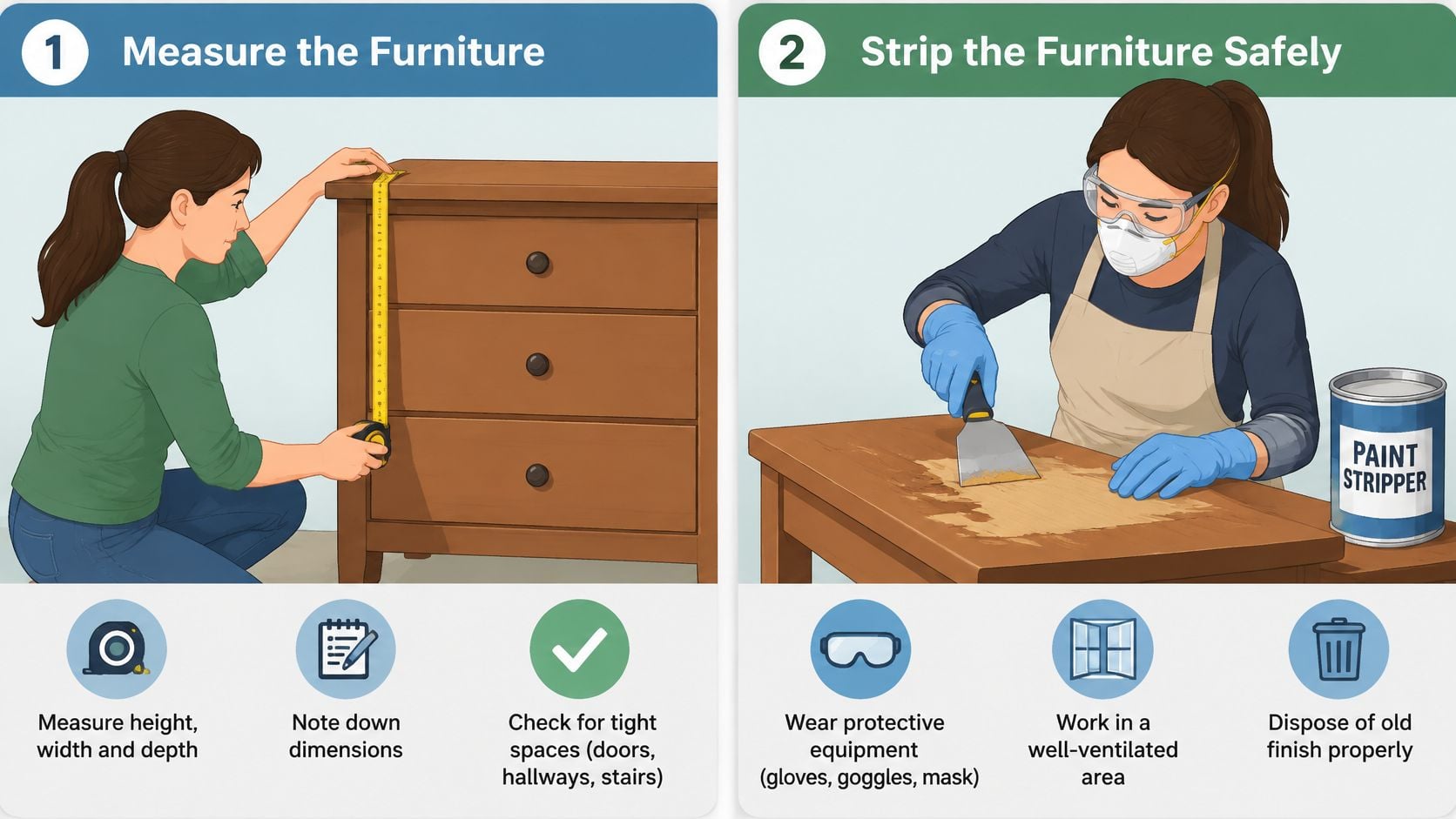
Measure and Strip the Furniture Safely
Before a staple comes out, create a record that can guide the rebuild. Measure the furniture's overall dimensions and each cushion, then note seam positions, piping or welt, fabric direction, and how panels meet at corners. Photograph the piece from several angles and take close-ups of details that'll be difficult to see once the cover is removed.
Removing old fabric reveals the order of assembly, but the old cover isn't a perfect pattern. Years of use can stretch fabric, compress foam, and change padding's shape. Keep panels intact where practical, label each one by location, and note the order in which they came off. Mark the front, back, top, and direction of any nap or pattern so they don't get reversed during reconstruction.
Compare the work before choosing a route
DIY, custom service, and outlet shopping solve different problems. A DIY project calls for measuring, safe staple removal, patterning, and the ability to sew and attach upholstery fabric. A custom service can help with decisions and construction, while an outlet purchase avoids rebuilding altogether but depends on what's available. Cost exposure also differs: DIY owners may uncover unplanned repairs, custom projects require a defined specification, and an outlet piece may need close inspection before purchase.
For accurate room planning, record the furniture's footprint and check pathways for bringing it into the room. Willis's furniture measuring guide can help organize those measurements.
Use a staple remover or upholstery pliers to lift fasteners carefully, keeping the tool away from finished wood and hands. Remove hardware only as needed, and store labeled pieces together. Once the cover is off, inspect the frame joints, webbing or springs, decking, foam, batting, and dust cover. The useful outcome isn't a heap of old fabric. It's a clear view of the bare frame and a decision about what must be repaired before new material is cut.
Choose Fabrics and Leathers for Real Use
Choose a covering by matching its performance to the room, not by appearance alone. A quiet sitting room, a family sofa used every evening, and a chair exposed to strong sunlight place different demands on fabric. Color, texture, and pattern still matter, but they should be evaluated alongside durability, cleanability, comfort, and the furniture's shape.
Two common abrasion tests are Wyzenbeek double rubs and Martindale cycles. The Association for Contract Textiles identifies ASTM D4157 as the Wyzenbeek method and ASTM D4966 as the Martindale method. In Wyzenbeek testing, fabric is rubbed back and forth against a standardized abradant, and the cycles completed before visible wear or yarn breakage are recorded. ACT gives approximate guidance of 15,000 Wyzenbeek double rubs for low-traffic or private spaces, 30,000 for high-traffic public spaces, and 50,000 for coated upholstery fabrics. Its Martindale guidance lists 20,000 cycles for low-traffic woven upholstery and 40,000 for high-traffic woven upholstery. These are comparison points, not promised years of service. Frame movement, cushion compression, sunlight, cleaning products, body oils, pets, and fabric construction also affect wear. See the ACT abrasion guidance.
Make the swatch earn approval
Request the supplier's test method and rating, then examine a physical sample in natural light and artificial light. Check its hand, color, pattern scale, seam strength, and suitability for curves or tight upholstery shapes. For homes with children or pets, consider how often the material will need cleaning and whether its feel and breathability are comfortable for daily use. In coastal rooms, also weigh humidity, sun exposure, and the practicalities of frequent care.
Cleaning codes are part of the specification. W permits water-based cleaners; S permits solvent-based cleaners only; WS allows either; and X calls for vacuuming or brushing without liquid cleaners. A beautiful light fabric with an X code may be a poor match for a busy family room if its care limits don't suit the household. Keep the manufacturer's care directions with the project record. For a broader material overview, consult Willis's upholstery fabric guide.
Before ordering, confirm usable fabric width, pattern repeat, direction, and required matching allowances. A swatch should be approved only after its appearance, maintenance needs, and performance information make sense for the room and the furniture's intended life.
Build Support and Cushions for Comfort
A comfortable cover can't compensate for a weak frame or collapsed cushion. Before adding padding, inspect joints and the load-bearing supports, including webbing, springs, and decking. Repair loose or damaged components first. If a joint shifts under pressure or the support system is beyond the upholsterer's experience, stop and get qualified help rather than hiding the problem beneath fresh foam.
Foam has two specifications that are easy to confuse. Density relates to durability and resistance to permanent height loss, while indentation force deflection (IFD) describes perceived firmness. A practical seating benchmark is approximately 1.8–2.8 lb/ft³ (29–45 kg/m³) with an IFD of roughly 25–50 lbf at 25% compression, according to the upholstery assembly guidance. Higher density alone doesn't necessarily create a firmer seat.
Match the cushion to the person and setting
A rarely used accent chair may not need the same recovery and support as a primary sofa used by several family members each evening. A rental or staging piece may need a practical, maintainable construction suited to frequent turnover. For someone who needs easier sit-to-stand support, firmness, seat depth, and seat height should be assessed together; a firm cushion by itself doesn't guarantee easier standing. Replacing collapsed foam can be more sensible than changing a sound frame.
Don't use excessive batting to conceal foam that has lost its load-bearing support. Batting shapes the surface and adds loft, but it can't restore a collapsed cushion core. For help comparing cushion options, see Willis's custom upholstery foam guidance.
Before cutting final fabric, make a muslin pattern and test it on the frame. Mark centerlines, seams, and seam allowances, then check the fit at corners and curves. Pattern repeat and one-way nap affect both yardage and layout. Plan the cut so adjacent panels align and all pieces face the same direction. Accurate preparation protects expensive material and helps the finished upholstery retain the furniture's intended proportions.

Cut Sew and Attach the Upholstery
Once the frame, support, and pattern are ready, fabric handling becomes the next major source of visible mistakes. Confirm the usable width and pattern repeat, then lay out every panel with the nap, pile, or directional design facing consistently. Add allowances for matching patterns and seams. If the material has a large repeat, a small offcut can't always replace a misplaced panel.
Transfer verified shapes from the muslin to the final fabric. Keep paired pieces oriented alike, label them, and double-check center marks before cutting. Sew a test seam if the fabric is unfamiliar. Curves may require careful clipping of the seam allowance where appropriate, while seam choice should leave the cover strong enough for its intended use. If the design includes piping or welt, plan its placement as part of the pattern rather than treating it as a last-minute trim. This piping technique for dressmakers offers a useful explanation of the basic covered-cord construction.
Fit, tension, and attach in sequence
A muslin test cover helps reveal tight areas and excess fabric before the final cover is sewn. If a zipper is part of the design, position it where it'll allow practical cushion access without weakening a high-stress seam. Test the cover on the frame, checking its alignment and ease of fitting before committing to the final attachment.
Position the sewn cover carefully, align its center points, and work outward while keeping the fabric smooth. Upholstery-grade staplers and experience with controlled tension matter: too little tension leaves wrinkles, while pulling unevenly can distort seams or pattern lines. At corners, fold and distribute fabric in a consistent way so bulk doesn't create a lumpy edge. Keep fasteners clear of visible surfaces and check the line as work progresses.
Before finishing, inspect the whole piece under ordinary room lighting. Check seams, pattern alignment, piping, cushion compression, loose edges, and wrinkles. Sit on the furniture and assess whether the cover shifts or pulls. If the shape won't fit without forcing the fabric, stop and revise the pattern instead of stretching the material until it distorts.
Estimate Costs and Completion Time
A useful estimate begins with the work required, not a guessed total. List the covering material separately from structural repairs, springs or webbing, foam, batting, thread, piping, fasteners, pattern making, sewing, and finishing. Then note which tasks are within the project owner's skill and which may need professional labor.
The scope can grow when a frame has hidden damage, dimensions are unusual, cushions need rebuilding, or the design includes complex seams. Pattern matching and directional fabric can increase yardage and cutting time. Leather, detailed piping, and difficult corners also require different handling than a straightforward slipcover. Delivery or furniture pickup can add logistics that a home project doesn't have.
Compare an estimate with what's included
For a custom project, ask what the estimate covers: inspection, stripping, repairs, padding, fitting, upholstery, and delivery may be separate elements. Willis Furniture & Mattress's Design Center can help customers explore customization with hundreds of fabrics and leathers. Qualified buyers can also ask about financing. The stated Synchrony HOME offer provides six months of deferred interest on purchases of $299 or more, subject to current terms and account approval. Under deferred-interest terms, promotional interest can accrue from the purchase date and may be assessed if the promotional balance isn't paid in full by the deadline. Minimum payments alone may not clear it, so review the account agreement and plan to repay the full promotional balance on time using the Synchrony HOME financing information.
An outlet purchase follows a different budget logic. Discontinued styles, floor samples, and overstock may cost less, but stock can be limited and the available piece may not match a particular fabric, finish, or layout. Inspect the item and confirm its fit before deciding. Custom upholstery offers greater specification control; outlet shopping works best when the buyer can adapt to available inventory.
Finish Maintain and Decide When to Hire Help
A finished piece needs a quality check before it returns to everyday use. Examine seams, piping, corners, fasteners, cushion fit, and frame stability. Check the fabric in the room's normal light and sit on the furniture to see whether the cushion compresses evenly or the cover shifts. Keep the cleaning code and manufacturer's care instructions with the furniture record, and use Willis's guide to cleaning upholstered furniture at home as a reference for routine care.
Repairability is a design decision, not just a repair-shop concern. A sound frame, replaceable cushions, suitable covering, and accurate yardage planning can help a piece remain useful through future repairs. Environmental life-cycle research assessed 25 furniture pieces across eight groups from 15 companies using ISO 14040 and ISO 14044 methodology, treating furniture as a system of materials, use, and impacts rather than appearance alone. Those considerations support choosing materials and construction for serviceability, not only for a new look. Read the peer-reviewed furniture life-cycle assessment.

Choose the next step that fits the project
A confident DIYer with a stable frame can proceed with careful measuring, patterning, and sewing. If the frame is compromised, the shape is complex, or the job requires repairs beyond the available tools and skills, professional help is wiser than improvising. A design-led homeowner can use the Willis Furniture & Mattress Design Center to translate a preferred silhouette, material, and cushion configuration into a custom project. A budget-conscious shopper with flexible specifications can explore the Willis Outlet, where inventory may include floor samples and overstock.
Before starting or ordering, confirm the frame's condition, identify who'll use the furniture, choose a covering suited to the room, and record cushion and care specifications. Check the estimate for repairs and finishing, and decide where outside help is needed. That preparation turns an attractive idea into a project with a clear path.
Visit Willis Furniture & Mattress to discuss custom upholstery, compare fabrics and leathers with the Design Center, or explore ready-to-buy options at the Willis Outlet. Bring measurements, photos, and a short list of comfort and care priorities to help shape a piece that fits the home and its everyday use.


