
American Made Mid Century Modern Furniture: A Buyer’s Guide


Does a walnut finish and a pair of tapered legs make a sofa American-made, or merely make it look the part? American-made mid-century modern furniture deserves a higher standard than a convincing silhouette. Buyers should verify the maker, the manufacturing origin, the materials beneath the surface, and the repairs a piece will allow.
For Virginia Beach and Hampton Roads households, there's another test: coastal living. Humidity, salt residue, sunlight, and sand can expose weak construction long before a style falls out of favor. The best purchase combines documented origin with construction that can survive everyday use and sensible maintenance.
Where American Mid-Century Modern Furniture Began
The Eames molded-plywood side chair entered commercial production in 1946 and remained in continuous production with Herman Miller, according to MoMA's account of Eames's design innovations. That's the useful starting point for buyers: an experimental form became a repeatable manufactured product, not merely a striking prototype.
Charles and Ray Eames helped establish a design approach that joined sculptural form with economical material use. Molded plywood created curved shells without carving an equivalent shape from a large block of wood. Later plastic and foam technologies expanded the possibilities for ergonomic seating and consistent production.

Separate the Appearance From the Construction
Tapered legs, walnut tones, and clean lines describe the look. Curved shells, bent plywood, and standardized components reveal how a piece was designed to be made. Neither appearance nor construction method, however, proves that a particular example was manufactured domestically.
Say a buyer finds a low wooden chair with a curved seat. The useful questions concern its manufacturer, shell construction, attachments, and production history. A recognizable outline is only the beginning of that investigation.
Willis Furniture was founded in 1892. That long retail history provides context, but an established showroom's name still shouldn't replace documentation for an individual piece.
A sound historical check includes:
- A documented maker. Labels, production records, or credible paperwork should identify who manufactured the piece.
- A coherent construction method. The materials and attachments should make sense for the documented design and manufacturing process.
- A traceable design history. Continued production or inclusion in established collections helps distinguish enduring design from anonymous imitation.
The practical lesson isn't to reject new interpretations. It's to avoid paying for historical significance that the seller can't substantiate.
Authentic Vintage, American Revival and Imported Pieces Compared
| Category | Origin and Provenance | Typical Materials | Main Trade-Off | Best For |
|---|---|---|---|---|
| Authentic vintage | Period-made, with a documented maker or era | Mature solid wood, period veneers, and original hardware | Rewiring, refinishing, reupholstery, or structural repair | Collectors and buyers who value age and provenance |
| American-made revival | New domestic production with origin stated by the maker | Current veneers, plywood, and modern foam | No assured collectible value; price reflects new production | Buyers seeking warranty support, custom fabric, and current dimensions |
| Imported mid-century-inspired | Overseas production, sometimes without clear maker documentation | Solid wood, plywood, MDF, or particleboard requiring inspection | Potentially lower price with uneven material transparency | Budget buyers willing to check construction carefully |
Authentic vintage offers something new furniture can't: a documented connection to its period. Mature wood and original hardware add appeal, but neither eliminates condition problems. A beautiful cabinet may need structural work, and a period lamp may require rewiring before use. In humid coastal air, old finishes and veneer adhesives also deserve a close look, since decades of expansion and contraction can leave joints loose even when surfaces photograph well.
American-made revival is the practical choice for demanding everyday seating. Newly manufactured pieces can offer current dimensions, customization, and warranty support, subject to the collection's terms. Buyers shouldn't assume that a new interpretation will acquire collectible value. Pay for the construction and the service terms, not for imagined future rarity.
Imported mid-century-inspired furniture can make sense for a secondary room, but price alone isn't a construction specification. Joinery, panel quality, hardware attachment, and repair access deserve close inspection. For reduced-price alternatives locally, the Willis Outlet is a useful place to examine condition in person.
Buy for the Room, Not the Trend
The category's historical importance rests on more than styling: MoMA's account of its Organic Design competition describes winning designs moving into manufactured furniture and public exhibition. Production and function were central to the movement.
Vintage interest also extends beyond this particular era. A House Beautiful report on a designer survey states that 81% of designers sourced vintage items from the 1920s through the 1990s in 2024, yet only 7% were looking for mid-century pieces in 2025, with Art Deco and Bauhaus gaining attention. For another national perspective, Enky Journal's a guide to British mid-century interiors provides useful context for comparing approaches to the style.
The buying verdict is straightforward:
- Statement chair or heirloom: Favor documented vintage when provenance matters.
- Daily-use living room sofa: Favor domestic revival with clear warranty and service terms.
- Secondary-room or rental bench: Consider an import if its joints, stability, and material documentation pass inspection.
Compare purchase price plus restoration, delivery, maintenance, and replacement parts, not the ticket alone. A vintage piece needing new upholstery and a revived finish can cost more than a domestic revival bought once and serviced under warranty.
How to Verify American Origin Before You Buy
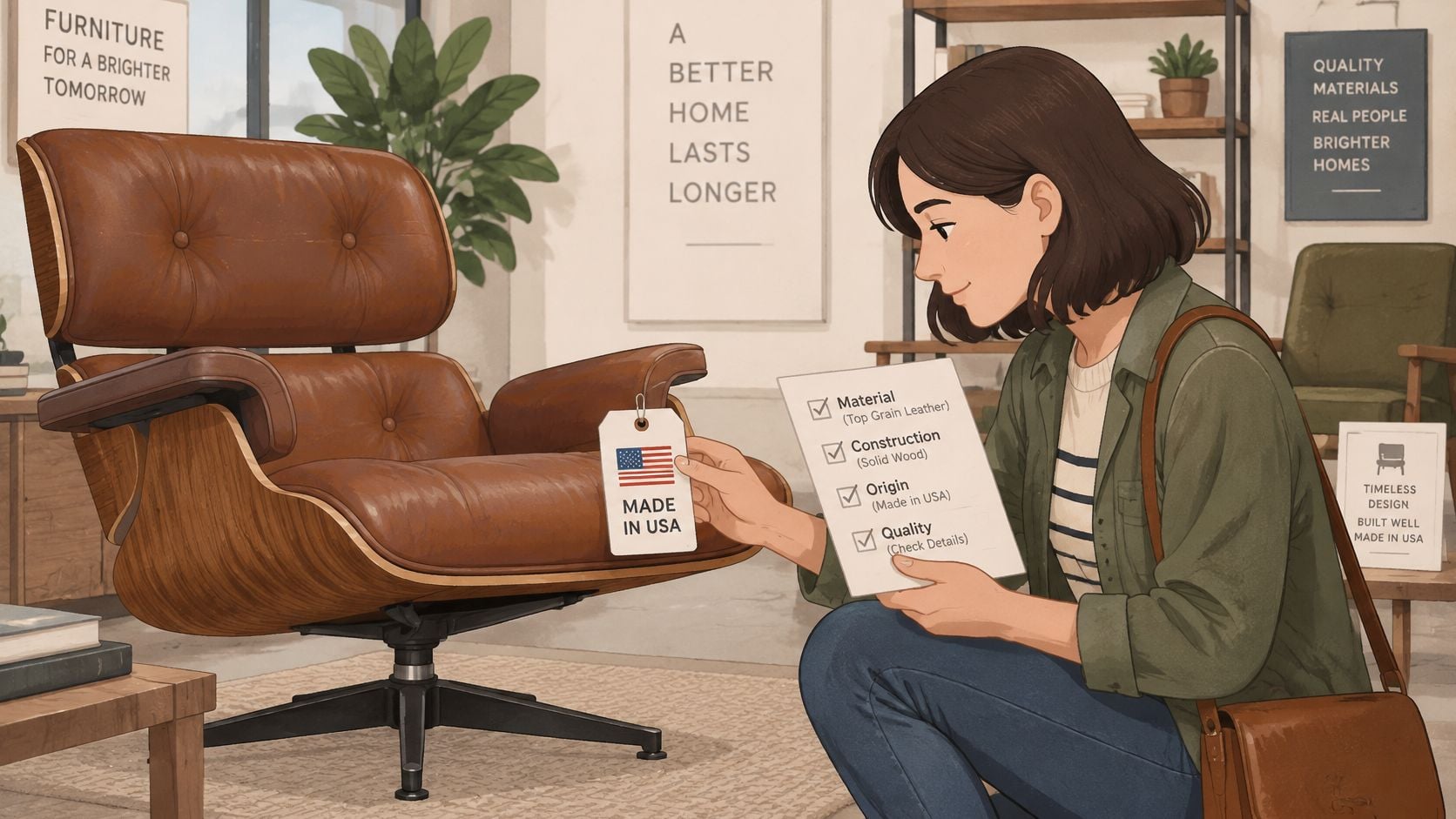
An unqualified Made in USA claim means that the product is all or virtually all made in the United States under the Federal Trade Commission's standard. A domestic retailer, an American-sounding brand name, or a retro silhouette doesn't establish that origin.
The wording on the actual product matters more than a general statement about the manufacturer. Buyers should preserve that wording alongside the item number and order paperwork.
Follow the Product, Not the Brand
Read the exact origin statement. Separate Made in USA from Assembled in USA and any qualified claim identifying imported materials. The common slip is treating those descriptions as interchangeable when they describe different manufacturing circumstances.
Identify component origins. Request details for the frame, wood parts, springs, foam, upholstery fabric, and finish. A seller may answer where final assembly occurs while leaving the origins of the principal components unresolved.
Locate the substantial transformation. Ask where the materials became the finished furniture item, rather than where packaging or inspection took place. The common mistake is accepting a warehouse or shipping address as evidence of manufacturing.
Request collection-specific documentation. Match the origin statement to the precise collection, model, and configuration under consideration. A brand may source different collections differently, so a company-wide answer isn't enough.
Match labels to paperwork. Check the maker name, factory information, and production date when available. Missing information warrants further investigation, while an unexplained mismatch between the item and invoice should stop the purchase.
Compare the construction specification. Read the panel and frame descriptions alongside the origin statement. Domestic assembly doesn't automatically establish that the plywood, upholstery, or other components are domestic.
Keep written answers. Save the product sheet, invoice description, label photographs, and relevant correspondence together. The common slip is relying on a verbal assurance that can't later be matched to the delivered piece.
Passing evidence is specific, written, and matched to the item being purchased.
For authentic vintage, the evidence shifts toward maker marks, stamps, labels, original hardware, and credible ownership or production records. A replacement pull doesn't necessarily invalidate a piece, but undisclosed replacements weaken claims of originality.
At the Virginia Beach showroom, buyers can ask Willis Furniture & Mattress to help obtain collection-specific answers and compare them with the physical item. Any unavailable information should remain identified as unknown rather than being filled in with assumptions about the brand.
Reading the Materials Behind the Veneer
| Panel Type | Limit (ppm) | What to Ask | Where It Appears |
|---|---|---|---|
| Hardwood plywood | 0.05 | Request TSCA Title VI documentation and the core layers | Veneered case goods and panels |
| Medium-density fiberboard (MDF) | 0.11 | Confirm the panel grade beneath the veneer | Drawer fronts and painted surfaces |
| Thin MDF | 0.13 | Ask whether the veneer sits on thin MDF | Thin-profile doors and panels |
| Particleboard | 0.09 | Ask for the core material in writing | Hidden cores and drawer boxes |
These are the formaldehyde-emission limits for regulated composite wood under the EPA's TSCA Title VI regulations, measured using ASTM E1333-14, and the requirements apply to domestic and imported products alike. They are panel-emission limits, not predictions of the concentration inside a particular living room.
A walnut, teak, or oak surface doesn't reveal the construction underneath. Thin hardwood veneer can create a broad, stable surface while using less solid lumber. Veneer isn't a shortcut, but an undisclosed core is a purchasing risk.
Understand What Each Core Does
Solid wood has natural grain throughout its thickness and responds to changes in moisture. Its repair potential can be useful, although board selection, joinery, and finish still matter.
Veneer-core plywood uses layered construction to support broad surfaces. MDF provides a smooth, uniform substrate for painted finishes or veneer, while particleboard uses bonded wood particles. Neither MDF nor particleboard should be judged by appearance alone, particularly around exposed edges and hardware fasteners.
Adhesive chemistry and panel construction influence formaldehyde release. Lower-emitting panels reduce the potential contribution to indoor concentrations, while tightly sealed rooms with limited ventilation give emissions less opportunity to disperse. A coastal address doesn't change the regulatory limits, but closed windows and continuous climate control make material transparency useful.
The buyer's documentation request should cover:
- Compliance evidence: Obtain the TSCA Title VI label or manufacturer's documentation.
- The actual core: Identify what sits beneath the decorative veneer.
- Secondary panels: Establish whether drawer bottoms, drawer boxes, cabinet backs, and doors use different materials.
A handsome exterior can conceal several panel types within the same cabinet. Drawer interiors and backs therefore deserve their own inspection rather than being treated as minor details.
For a broader construction comparison, the guide to American-made hardwood furniture helps frame the distinction between origin and material specification.
American-made origin doesn't substitute for a documented core. If the manufacturer can't identify the core or provide applicable compliance evidence, treat the emissions performance as unknown rather than assuming that a premium finish settles the question.
Judging Upholstery and Frame Durability
A sofa can pass every label and origin check and still sag within a few seasons. The frame and the upholstery are separate systems, and each fails on its own schedule. A rigid frame can outlast unsuitable fabric, and attractive upholstery can conceal inadequate seat support. Inspect both.
The CPSC's guide to furniture requirements identifies the voluntary UFAC program's component test methods, including fabric classification, interior fabrics, barriers, decking, filling, trims, welt cord, and laundering. UFAC addresses upholstered-furniture fire safety. Treat participation as a safety baseline, not a durability guarantee.
Follow the Failure Chain
Durability problems rarely start where they first appear. Weak decking allows excessive seat deflection, which forces the cushion above it to work harder. Padding that doesn't recover leaves the sitter feeling the support structure sooner. Poorly secured welt cord concentrates wear at the seams, and an unsuitable cover fabric can turn an otherwise serviceable sofa into a repair bill. Coastal humidity raises the stakes on every one of these: damp, salt-laden air is harder on metal suspension, adhesives, and thread than a climate-controlled showroom suggests.
The specification review should establish:
- Fabric performance: Request the abrasion or performance classification and the recommended cleaning method.
- Cushion construction: Identify the fill, foam density where applicable, and whether replacement inserts are available.
- Seat support: Ask whether the piece uses springs, webbing, or another documented suspension system.
- Frame materials: Confirm structural plywood or another specified panel grade rather than accepting an unexplained hardwood-frame description.
Laboratory data helps compare materials, but it doesn't replace a comfort test. Seat shape, cushion construction, and support need to suit the person who will use the piece.
Run a Deliberate Showroom Test
Sit in the center and near the arm, then stand and watch whether the seat returns to shape. Press the cushion edge and observe whether the seam pulls excessively or exposes stitching under ordinary pressure. Listen for movement at the frame joints without rocking or abusing the furniture.
Serviceability decides how long the comfort lasts. Reversible cushions spread wear across both faces, removable covers allow the specified cleaning method, and replaceable inserts let you restore the seat without reupholstering the whole piece. Confirm all three before you buy.
The guide to durable upholstered furniture adds construction context worth reading before a purchase. A piece worth keeping passes the frame check and the upholstery check. Mid-century proportions alone say nothing about either.
Sustainability Claims That Hold Up Near the Coast
Labels settle nothing. A chair that fails early, cannot be repaired, and ends up discarded is a poor environmental choice regardless of what its marketing claims.
A Home Accents Today report on a 2025 survey of 1,500 U.S. adults found that 57% said a sustainability label would make them more likely to buy, while 55% identified price as the main barrier. Price earns that weight only when it buys documented years of service, so the useful question is what evidence connects the cost to a realistic lifespan.
Make Repairability Part of the Comparison
The BIFMA/NSF e3 framework gives manufacturers a structured way to weigh materials, energy, human and ecosystem health, and social responsibility. For a single household, the practical version is simpler: establish what can be maintained, replaced, or recovered before money changes hands.
- Service life: Compare the price against a realistic ownership plan that counts reupholstery and refinishing as normal upkeep.
- Repair access: Establish whether cushions, covers, hardware, and upholstery can be replaced separately.
- End of life: Ask how the piece disassembles and which local reuse or disposal routes accept its materials.
The guide to sustainable sourcing practices explains how material claims are evaluated. Sourcing covers where the piece began, and repairability decides how long it stays useful.
The stronger environmental choice is often the piece that remains useful and repairable, not the one with the boldest green label.
Treat Coastal Exposure as a Maintenance Problem
Humidity changes can swell panels and stress joints. Salt residue corrodes metal and dulls finishes, direct sunlight fades upholstery and shifts wood color, and tracked sand abrades fabric fibers. Near the coast, durability is measured by how well a piece survives this routine exposure.
A workable routine removes salt film weekly during the months windows stay open, using a barely damp cloth on metal legs, hardware, and wood tops, then drying surfaces promptly. Rotate suitable cushions, vacuum sand with an upholstery attachment, and use window treatments or careful placement to limit direct sun. Steady indoor humidity limits the repeated moisture swings that loosen joints.
Wood finishes need a written inspection and maintenance schedule matched to the existing coating. Adding oil or another finish over an incompatible surface causes more harm than wear does. Maintaining the correct coating and repairing worn spots before moisture enters keeps a coastal household from replacing a solid piece years early.
Fitting Mid-Century Pieces into Coastal and Traditional Homes
Start with the room, not the chair. A clean silhouette works when its scale, upholstery, and surrounding palette suit the space. A photogenic piece can still be uncomfortable, undersized, or poorly matched to the household's routines.
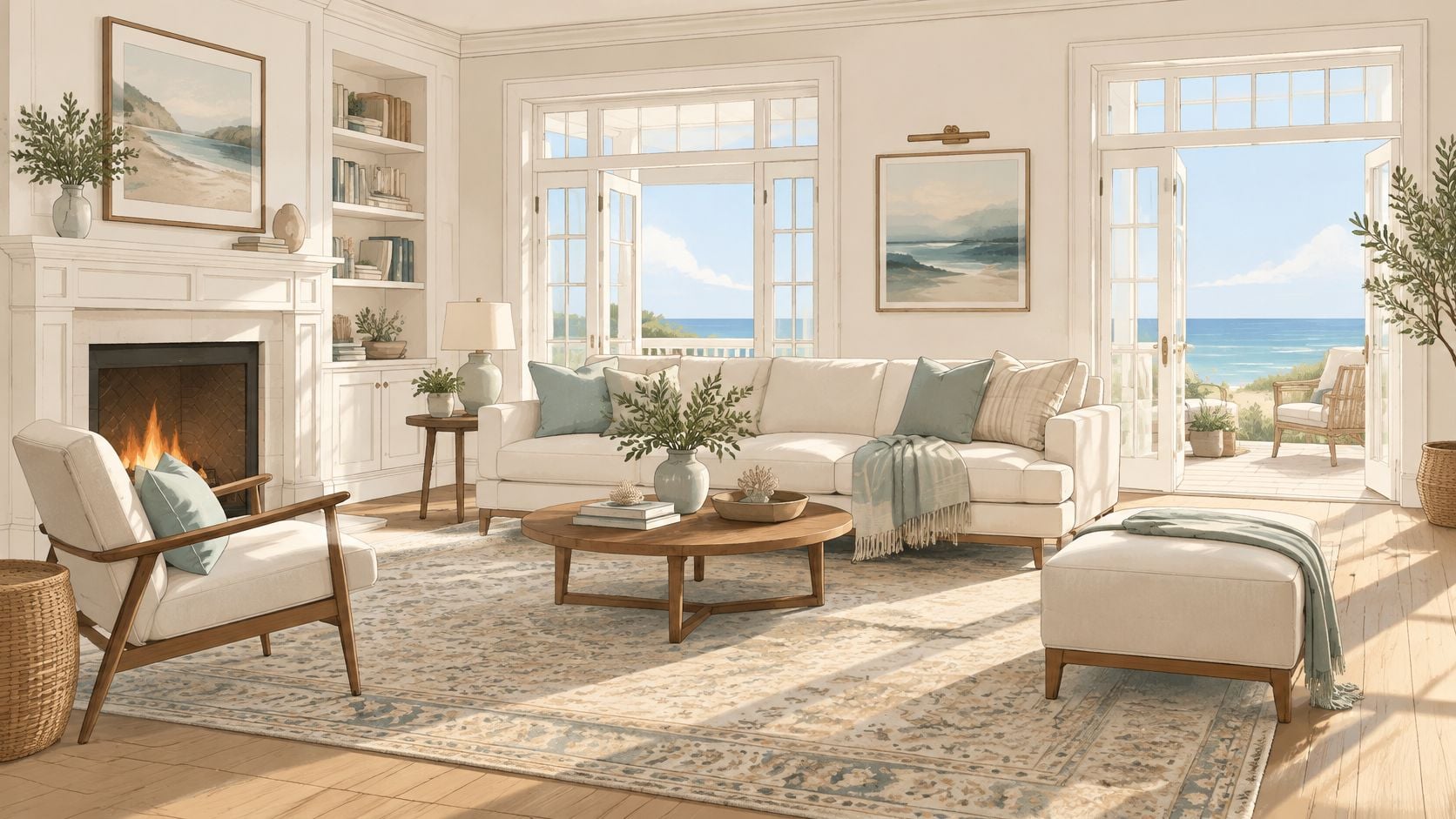
In a coastal home, lighter walnut or teak tones can sit comfortably beside sea-toned colors and textured neutrals. Performance upholstery should have documented suitability for the room's light exposure and cleaning needs, not merely a reassuring fabric name. Leather also requires a finish and care regimen appropriate to humidity and sunlight; it isn't automatically coastal-proof.
Connect the Piece to Its Surroundings
A traditional family home benefits from a less literal approach. A clean-lined sofa or sculptural chair can work with warm woods, a textured rug, and brass or aged-metal accents without turning the entire room into a period display. Repeating a wood tone or upholstery color elsewhere makes the contrast feel intentional.
Scale comes before style. Seat depth determines how comfortably the user's back and feet are supported, while leg height affects both appearance and cleaning access. Dining chairs need enough space to pull out without blocking circulation, even when the table itself looks visually light.
A useful planning sequence begins with the sofa, establishes the dining arrangement where relevant, and then adds a statement chair. The guide to mixing furniture styles can help connect those choices without making every piece match.
Customize the Profile to the Household
Willis Furniture & Mattress's Design Center supports custom upholstery with hundreds of fabric and leather choices, space planning, and coordination of rugs, lighting, and accessories. That process allows a recognizable mid-century profile to be adapted to a coastal retreat or a traditional family home.
The final room review should answer:
- Does the scale fit? Check seated comfort, furniture relationships, and clear walking routes.
- Will the covering suit the exposure? Match fabric or leather to sunlight, humidity, use, and cleaning.
- Does the palette connect? Carry selected colors, textures, or wood tones into neighboring pieces.
The aim isn't a showroom replica. It's a room whose furniture looks related and works together.
Shopping Locally in Virginia Beach
Buying in person connects the paperwork to the actual furniture. Labels, hidden surfaces, and comfort can all be checked before anyone commits to a purchase based on photographs.
For households comparing American-made furniture near Virginia Beach, treat the showroom visit as a working appointment rather than an unstructured browse. Room measurements, photographs, and a short list of priorities make the visit more productive. The origin documentation and upholstery checks covered earlier in this guide still apply at the showroom. What a local purchase adds is everything that happens after the decision: getting the piece home, settled, and covered.
Work Through a Logistics Checklist
- Measure the full route. Record door openings, hall turns, stairs, elevator space where relevant, and the path to the final room.
- Ask about disassembly. Confirm whether legs or other components can be removed during delivery without affecting the product's assembly requirements.
- Clarify acclimation. Check whether the manufacturer recommends a settling period after transport and how that affects final placement or assembly. A stable indoor environment matters more than an improvised waiting period.
- Get warranty terms in writing. Frame, upholstery, and finish often carry separate conditions, so ask for each one.
- Confirm repair logistics. Establish who schedules a local repair, what documentation is required, and whether labor or transport is billed separately.
Use the Services a Local Store Provides
A Design Center appointment at Willis Furniture & Mattress can use room photographs and measurements to resolve scale, circulation, and exposure concerns before an order is finalized. Delivery questions should cover how the team handles tight entries and protects surrounding surfaces. Willis's white-glove delivery includes inspection, assembly, and placement of each piece where it belongs, so confirm those steps are scheduled rather than assumed.
Choose Your First Piece and Plan the Budget
Floor samples offer a route to better construction without full-retail pricing. Willis Furniture & Mattress posts discounted pieces through its floor-sample furniture selection, which includes display models, discontinued items, and one-of-a-kind pieces. Every sample carries its own history of showroom handling, so condition and selection require an in-person check.
If the piece you want carries a markdown in the 30% to 50% range, here is what that does to a $2,000 sofa:
Example Discount Math for a $2,000 Sofa
| Scenario | Sofa price | Savings |
|---|---|---|
| Full retail | $2,000 | $0 |
| 30% markdown | $1,400 | $600 |
| 50% markdown | $1,000 | $1,000 |
Run the same arithmetic on the actual tag once you see the piece, since each sample is priced individually.
The Willis Outlet in Virginia Beach is the relevant destination for floor samples, overstock, and discounted inventory. Inspect upholstery fading, veneer edges, drawer operation, and leg attachments, and make sure any damage is recorded on the sales paperwork before paying. On a showroom piece near the coast, look hardest at metal glides and fasteners, since weakened hardware is where salt air damage shows first.
Budget for Ownership, Not Just Acquisition
Buy the piece that solves the household's biggest problem. An uncomfortable daily-use sofa deserves priority over a decorative cabinet, even when the cabinet makes the bolder style statement.
Set the budget against real numbers before falling for a silhouette. Accent and swivel chairs currently listed at Willis run from $1,691 for the B0032 Chairs up to $7,091 for the 1939-01sw Swivel Chair, and delivery, maintenance, and future replacement parts belong in the same total. A discounted sample that needs immediate upholstery work can cost more overall than a new piece already wearing the right fabric for a humid, salty room.
Willis Furniture & Mattress carries curated American-made and premium collections, including American Leather and Daniels Amish. A brand name alone does not settle the origin question, so confirm the construction and origin of the specific model before budgeting around it.
Understand Deferred Interest Before Signing
Willis's financing runs through the Synchrony HOME Credit Card: qualified buyers receive six months of deferred interest on purchases of $299 or more. If the full promotional balance is still unpaid at the deadline, interest can be charged back to the purchase date. The required monthly minimum will not retire that balance on its own, so set a repayment plan that clears the promotion inside the six-month window.
A Design Center consultation before purchase is cheap insurance against an expensive mistake in scale or upholstery. The concrete action for this week: take the origin and material checklist to the Virginia Beach showroom and request written documentation for the specific piece under consideration.
Willis Furniture & Mattress combines American-made craftsmanship, personalized room planning, and practical options for making high-end living accessible. Visit Willis Furniture & Mattress with room measurements and photographs to compare mid-century silhouettes, verify construction, and plan a piece suited to everyday life on the coast.


