
Swivel Rocker Recliner Buying Guide for Every Home


A living room can look perfectly arranged until someone tries to recline. The footrest reaches into the walkway, the chair faces the television instead of the conversation, and a nearby rug catches against the base. A swivel rocker recliner solves some of those daily frustrations, but only when its movement is planned as carefully as its upholstery and cushion comfort.
This chair isn't just a recliner with extra features. It changes direction, rocks, and reclines within one footprint, so the right choice depends on how people move through the room, where the chair will sit, and how much space its motion requires. That makes it especially useful in family rooms, coastal retreats, reading corners, and multipurpose spaces where one seat may need to serve several purposes.
What Makes a Swivel Rocker Recliner Different
A parent settling a baby may want a gentle rocking motion. Someone joining a conversation may need to turn toward the sofa without dragging the chair across the floor. Later, that same seat can recline for a film or quiet rest. A swivel rocker recliner absorbs three jobs that would otherwise demand three seats, while keeping the room easier to arrange.
Each movement serves a different purpose, yet the chair responds to where the user's attention goes. That matters in a reading corner, family room, or multipurpose space, where the chair may face a window in the morning, conversation in the afternoon, and a television at night. The compact footprint helps, but the motion envelope still needs planning. A chair that turns, rocks, and extends its leg support requires clear floor around its base, plus flooring that will not catch or shift during use.
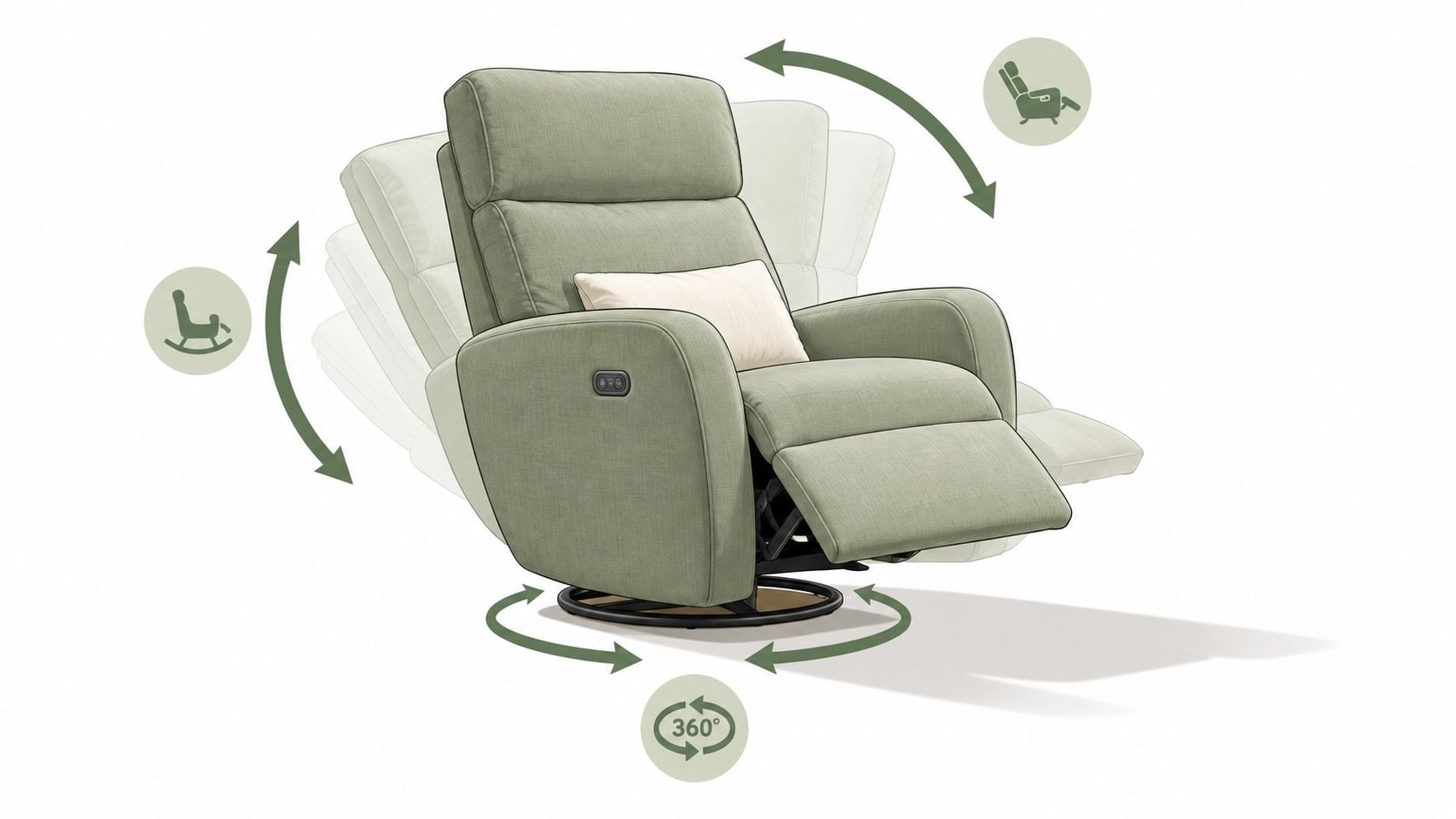
Three movements with three purposes
Swivel lets the seated person turn toward a window, television, side table, or another person. It can reduce torso twisting and the need to stand just to reposition the chair.
Rocking adds a soothing back-and-forth motion for reading, resting, or comforting a child. The base still needs stable support and enough open flooring for the movement.
Reclining changes the body position for lounging. The back angle and leg support shift together, either through a manual control or a powered system, depending on the design.
The category also has a long history. Its lineage includes an illustrated 1505 German manuscript, Thomas Jefferson's 1775–1776 modification of a Windsor chair with a central iron spindle and rollers from window sash pulleys, and a 1853 patent by Peter Ten Eyck that refined swivel-and-rocker seating. These milestones are documented in the history of swivel chairs.
The category sits within a substantial recliner market, as described in this market report. For shoppers, the practical point is simpler: demand reflects continued interest in seating that combines comfort with adaptable movement.
Willis Furniture & Mattress offers a swivel recliner collection for reviewing available formats. At the Willis Design Center, customization and white-glove delivery can also help align the chair's upholstery, controls, placement, and arrival plan with the room.
How Swivel Rock and Recline Mechanisms Work Together
Beneath the seat, two separate structures do two separate jobs. A central bearing or swivel assembly lets the chair rotate, commonly through 360 degrees. A load-bearing pivot structure supports rocking and reclining, managing the user's weight as the back and leg rest change position.
The chair's movement envelope affects placement as much as comfort. Rotation needs open space around the base, rocking needs stable flooring beneath it, and reclining needs clearance in front for the leg rest. A chair may feel comfortable in a showroom yet become awkward beside a wall, table, or high-pile rug.
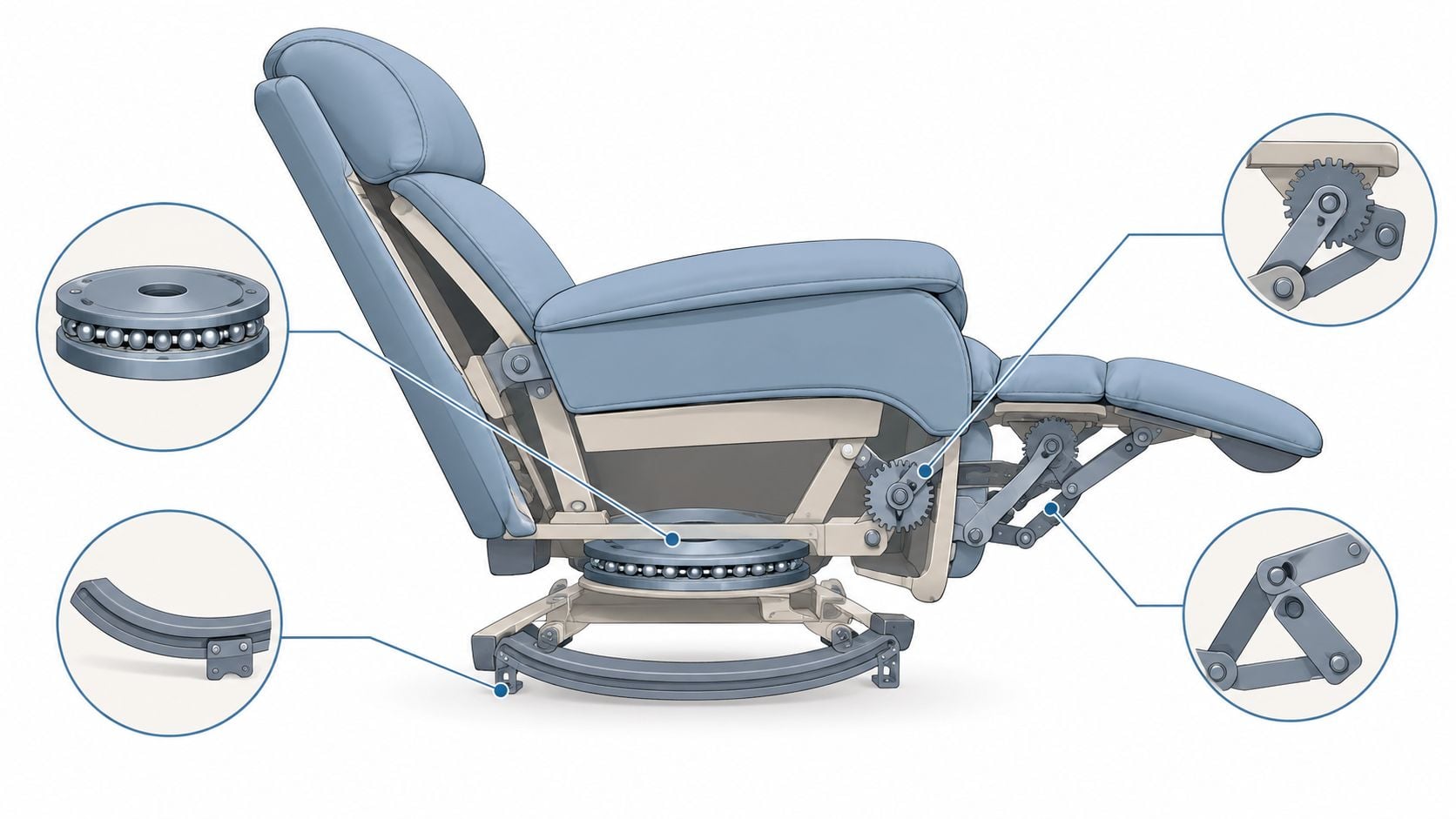
Why separate testing matters
A chair can swivel smoothly but feel weak while reclining. It can also recline comfortably while rotation becomes stiff. Examining the mechanisms separately explains how both outcomes can occur.
One independent furniture specification reports 120,000 swivel cycles at 90-degree rotation under a 122 kg seat load, while tilt and rocker mechanisms are tested to 200,000 cycles under load (furniture mechanism specification). These results do not guarantee identical performance across every chair. They show why durability information should identify the tested mechanism and applied load.
Mechanical insight: A swivel rocker recliner combines a rotating support system with a separate rocking and reclining support system.
Before purchase, check whether the base remains stable at different angles, rotation stays smooth with someone seated, and the move into recline feels controlled. Scraping, looseness, or binding deserves attention. Also check how the base meets the floor. Hard flooring may need protection from repeated movement, while a thick rug can interfere with rocking or rotation.
Manual and power controls change how the reclining structure operates. A manual chair uses a lever or body pressure. A power model uses an electric motor and controls, allowing incremental positioning. Hand strength, outlet access, and preferred control all matter. This comparison of power recliners versus manual recliners explains the practical difference before you choose a control type.
Swivel Rocker Recliner Compared to Other Recliner Styles
The right recliner depends on the room's constraints and the user's hardest daily task. A swivel rocker recliner adds directional flexibility and soothing motion, but another style may serve better when wall clearance, transfer support, or a fixed footprint matters more.
| Recliner style | Main movement | Space consideration | Suitable use |
|---|---|---|---|
| Swivel rocker recliner | Turns, rocks, and reclines | Needs room around the base and in front | Open family rooms, conversation areas, reading spaces |
| Wall-hugger recliner | Reclines with limited rear movement | Useful where the chair sits near a wall | Compact rooms with carefully controlled layouts |
| Glider recliner | Moves smoothly back and forth | Requires clearance for gliding motion | Nurseries, reading corners, calming routines |
| Lift recliner | Raises the user toward standing | Needs room for its lifting path | People who need more assistance during transfers |
| Stationary recliner | Reclines without swivel or rocking | Predictable footprint | Rooms where circulation and simplicity come first |
A wall-hugger model can be the smarter choice when the chair must sit close to a wall. A lift model deserves priority when standing is the main challenge, because swivel and rocking don't replace powered assistance. A stationary recliner may work better in a narrow passage where rotation could interfere with traffic.
Match movement to the room
A swivel rocker recliner earns its footprint when the user regularly changes focus. It can face the television during a program, turn toward guests during conversation, and angle toward a window without being dragged across a rug.
A glider recliner offers calming movement but usually doesn't provide the same directional flexibility. Shoppers who specifically want both gentle motion and turning can review a swivel glider recliner option, then compare its footprint with the room's circulation path.
The swivel-chair lineage reinforces that rotation has long served practical seated work and interaction, not only decoration. Jefferson's early design connected turning with seated ergonomics, while later motion seating adapted that idea for domestic comfort.
The Willis Design Center can help place each option into an actual floor plan. That matters because a chair that looks similar in a showroom may behave very differently beside a sofa, window, fireplace, or high-traffic doorway.
Essential Features Checklist Before You Buy
A long feature list can distract from the parts that determine whether a chair feels dependable. Buyers should start with the frame, base, motion quality, and user fit, then consider convenience features such as USB charging or powered adjustment.
Start with the structural essentials
The frame should feel solid when the user sits, swivels, rocks, and reclines. The base shouldn't wobble, scrape, or shift unexpectedly. A well-designed chair keeps the rotating assembly and rocking structure working together without making the user feel every transition.
The upholstery also has a federal baseline in the United States. Covered upholstered swivel rocker recliners used in homes fall under the Standard for the Flammability of Upholstered Furniture, codified at 16 CFR Part 1640 (federal upholstered furniture standard). Compliance doesn't determine whether a chair suits a particular room, but it belongs on a responsible buying checklist.
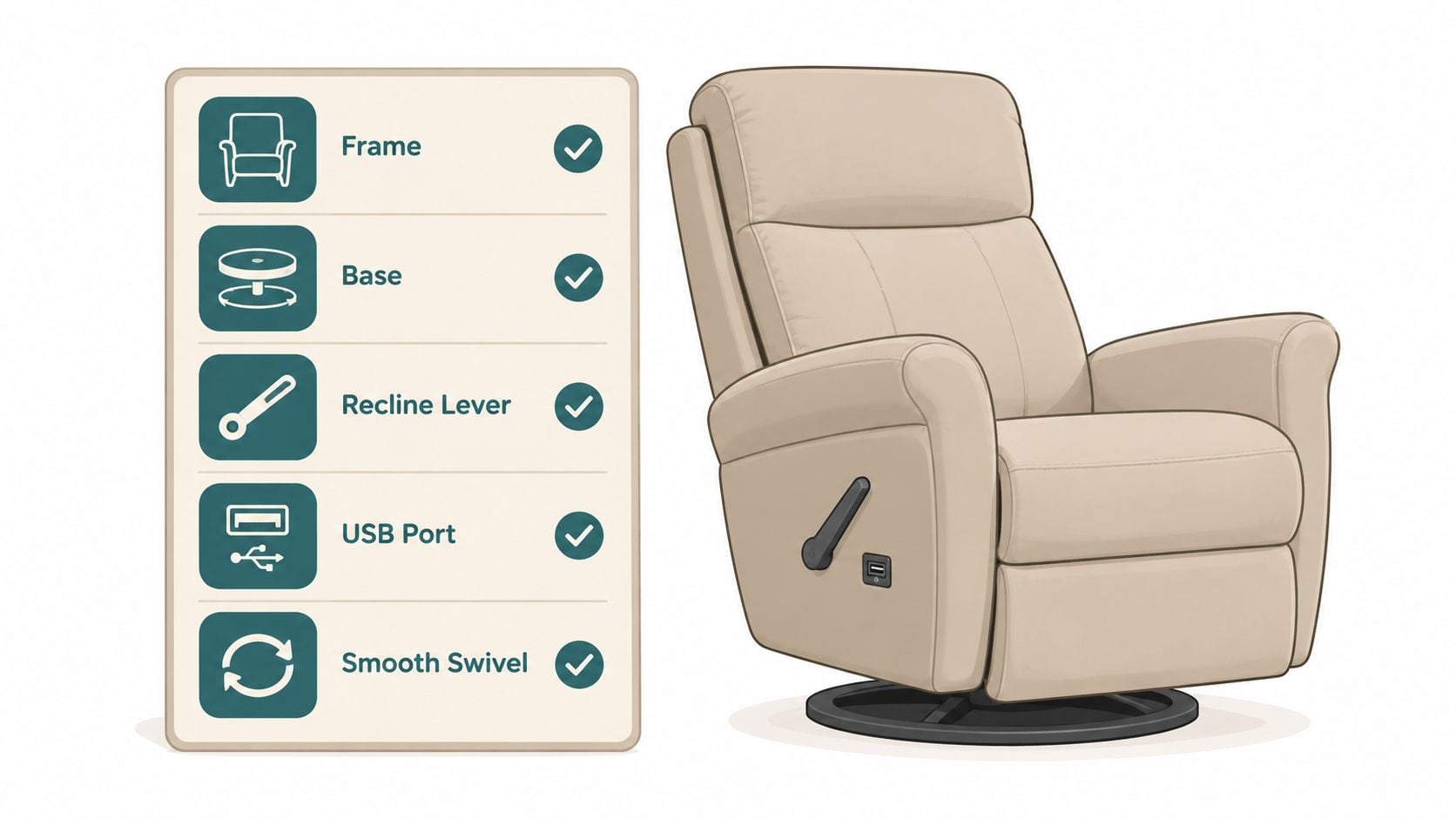
Use convenience features as tie-breakers
Manual versus power: Manual controls can suit users who prefer simplicity and don't need precise positioning. Power adjustment can help users who want gradual control or find a manual lever difficult to operate.
USB charging: An integrated port can be useful when the chair doubles as a reading station, but it shouldn't outweigh poor seat fit or an unstable base.
Smooth swivel: Rotation should feel even rather than jerky. A buyer should test the movement while seated, not only by turning an empty chair.
Fabric selection: Upholstery should match the home's cleaning demands, sunlight exposure, pets, children, and overall design language.
A short showroom checklist keeps the decision grounded:
- Test every motion: Rotate, rock, and recline while seated.
- Check entry and exit: Confirm that the arms provide useful support.
- Verify capacity: Compare the stated weight limit with the intended user.
- Inspect the base: Look for stable contact and quiet movement.
- Ask about upholstery care: Confirm the recommended cleaning method and fabric code.
- Review customization: The Willis Design Center can coordinate fabrics and leathers with existing décor.
- Consider payment flexibility: Willis financing options through Synchrony HOME can make premium power features easier to plan within a household budget.
Sizing Fit and Room Planning for Real Living Rooms
A swivel rocker recliner can fit an open corner yet fail once it reclines or turns. Plan it as a moving object. The room needs space for the chair's full reach, nearby traffic, and the floor beneath its base.
One listed model has a 350 lb capacity, upright dimensions of 33 inches wide by 40 inches high by 35 inches deep, and reclined dimensions of 33 inches wide by 33.5 inches high by 62 inches deep. Its depth grows from 35 inches to 62 inches, much like a door that needs a clear swing rather than only a clear frame. Measuring the closed chair alone can leave the footrest pressing into a walkway or table.
A practical measuring routine
Use painter's tape to mark the upright width and depth on the floor. Extend the outline to the fully reclined depth, then add the walking route, side-table position, and room for rotation. Sit in the planned location if possible. A taped floor plan makes tight spots visible before delivery.
Independent furniture guidance recommends about 42 inches of rear and side clearance for full swivel movement and at least a 30-inch base diameter for stable rocking motion. Treat these figures as planning benchmarks, then confirm the exact model. Arm width, back shape, and base construction can change the chair's motion envelope.
Room-planning rule: Measure the chair as a moving object, not as a rectangle that stays still.
| Model Example | Upright Dimensions | Reclined Dimensions | Weight Capacity |
|---|---|---|---|
| Listed swivel rocker recliner | 33 in W x 40 in H x 35 in D | 33 in W x 33.5 in H x 62 in D | 350 lb |
Protect circulation and flooring
The floor changes how the chair behaves. A swivel base may catch on a thick rug, drag across delicate flooring, or turn the rug instead of the chair. A low-profile, stable rug placement can reduce interference, but test the base on the actual surface whenever possible.
Window placement also affects the plan. A chair turned toward the view may cross a walkway. Near a fireplace, it needs separation from heat and enough room for safe movement. In a multipurpose coastal room, the chair may face the television at one time and the conversation area later. Keep that turning envelope clear.
Spills and regular household use deserve a care plan before the chair arrives. A practical guide to how to clean upholstery at home can help establish suitable routines. Willis space-planning support can review scale, circulation, and placement through space-planning techniques, especially when product dimensions do not show how the chair will move in the finished room.
Upholstery Durability Ergonomics and Easy Care
Upholstery affects more than appearance. It changes how the chair feels against the body, how easily a household can handle spills, and how well the piece fits a coastal or family interior over time.
Fabric brings softness and visual warmth. Leather offers a polished surface and can suit rooms where wipe-down care matters. Performance chenille can provide a plush, relaxed look while supporting everyday use, but each material still requires the care method specified by the manufacturer.
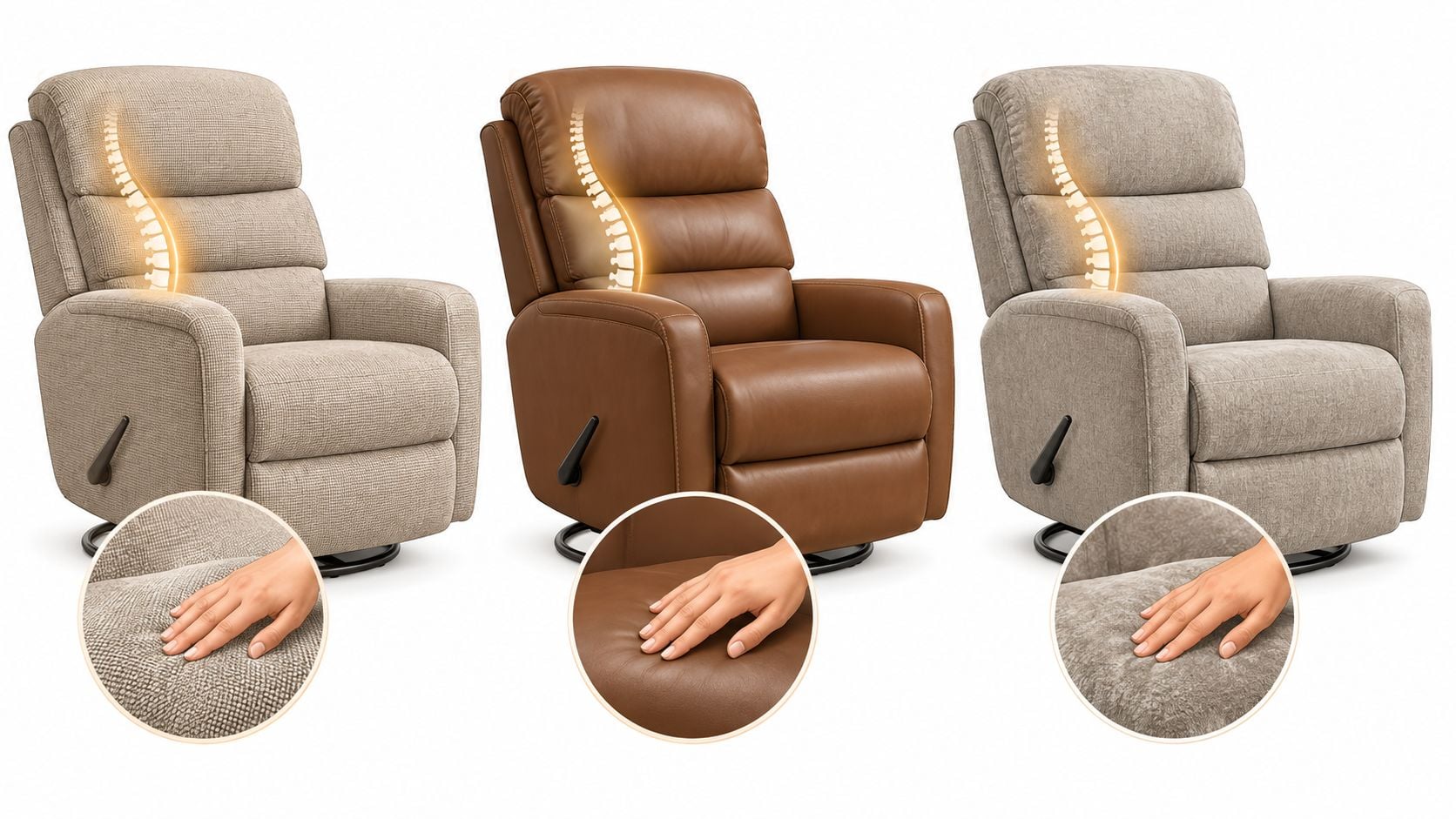
Fit the chair to the body
A listed manual 360-degree swivel glider rocker recliner provides concrete reference dimensions: 15.75-inch seat height, 19.29-inch seat depth, 22.05-inch seat width, 23.82-inch arm height, 23.62-inch back height, and a 350 lb weight capacity.
Those measurements matter during a showroom test. A lower seat may feel comfortable once seated but make standing harder. A deep seat can support lounging for one person while leaving another without firm back support. Arm height affects whether the user can push up comfortably, and the back shape should support the lumbar area without forcing the shoulders forward.
Seniors and users with mobility concerns should check whether both feet rest securely on the floor, whether the hips sit at a manageable height, and whether the arms provide stable support. A swivel rocker recliner can improve access to different room zones, but it isn't a substitute for a lift chair when the user needs assisted standing.
Build a care routine around the material
Households should follow the upholstery cleaning code rather than applying a universal spray. Blotting is generally safer than aggressive rubbing for a fresh spill, and a hidden-area test can reveal whether a cleaning product changes the color or texture.
Mechanism care also matters. Keep crumbs and debris away from moving joints, avoid forcing the chair through resistance, and follow the manufacturer's guidance for electrical components on power models. Wood accents can receive an appropriate polish, while leather needs products intended for leather rather than general household cleaners.
The Willis Design Center can customize the upholstery so the chair coordinates with existing seating, while the Rug Market can help connect the chair's texture and color with the floor covering. That combination turns durability into part of the room's design instead of treating maintenance as an afterthought.
Bringing Your Swivel Rocker Recliner Home with Willis
A comfortable showroom test is only the beginning. Before delivery, confirm that the chair suits its user, leaves traffic paths open, works with the flooring, and can reach its final position without forcing a tight turn.
Treat the chair's motion like a moving zone, not a fixed rectangle. As the seat swivels, rocks, and reclines, its footprint changes around the frame. The clearance benchmarks covered in the sizing section should be confirmed with the delivery team before placement day. The frame and base also deserve attention because the rotating plate, bearing, and rocking structure carry repeated movement at the chair's central support.
Turn a chair into a room solution
Willis Furniture & Mattress supports the choice through showroom testing, custom upholstery, and room planning. The Willis Design Center can adapt a preferred silhouette with fabric or leather selections, then coordinate the chair with rugs, lighting, and nearby furniture. That approach makes the recliner part of the room plan rather than an isolated comfort purchase.
Financing options, including Synchrony HOME programs for qualified buyers, can make premium furniture easier to budget. The Willis Outlet offers another practical route through floor samples and overstock pieces.
Placement day should verify more than the doorway. A white-glove team can inspect the route, assemble the chair, check the reclined footprint, and confirm that the turning envelope works on the actual floor surface. Review what to expect from white-glove delivery before scheduling so access concerns are addressed early.
Willis Furniture & Mattress offers motion seating, custom upholstery, room-planning guidance, financing options, Outlet savings, and white-glove delivery throughout the Virginia Beach area. Visit Willis Furniture & Mattress to test a swivel rocker recliner and plan its fit before delivery.


