
Custom Upholstery Seats: A Complete Buyer’s Guide


A family notices the problem on an ordinary evening. Their three-year-old sectional has begun to sag in the favorite seat, a spill has left a visible mark, and a faint squeak appears whenever someone leans back. The sofa looked right in the showroom, but it wasn't built around the household's traffic, room dimensions, pets, sunlight, or preferred way of sitting.
That realization is the starting point for custom upholstery seats. The important decisions aren't limited to color and silhouette. Foam density, frame construction, suspension, abrasion resistance, cleaning codes, and lightfastness determine whether a seat remains comfortable and presentable through years of use. A design consultant helps translate those technical choices into a piece that suits the people who will live with it.
What Custom Upholstery Seats Actually Are
Custom upholstery seats are pieces designed around a buyer's specific requirements, including dimensions, frame, suspension, cushion construction, upholstery material, and finish. A homeowner might request a deeper lounge seat for reading, a firmer cushion for upright dining, a sectional made to fit an unusual wall, or a recliner upholstered in a material selected for pets and frequent use.
That definition covers more than a fabric choice. The frame establishes the structure, the suspension controls how weight is distributed, the cushion determines recovery and comfort, and the upholstery protects the seat from daily contact. A beautiful textile can't compensate for a weak frame or an unsuitable cushion core.
Practical rule: A custom seat should be specified from the inside out, then finished from the outside in.
Fully custom and semi-custom are different
A fully custom piece allows broad control over size, proportions, materials, cushion feel, trim, and finish. A semi-custom collection usually offers a fixed design with a defined range of fabrics, dimensions, or configurations. A made-to-order piece is produced after purchase, but that doesn't automatically mean every structural detail has been customized.
Reupholstery is another category. It refreshes an existing frame, which can be sensible when the frame has sound construction and an appealing shape. It doesn't turn every older chair or sofa into a newly engineered seat. The upholsterer must first assess the frame, joints, suspension, cushion interiors, and overall condition.
Readers who want a plain-language introduction to the category can review what upholstered furniture means. That distinction helps prevent a common mistake, assuming that a new cover alone creates custom performance.
Why the process matters
American-made custom builders such as Willis Furniture & Mattress use in-house Design Centers to connect design decisions with practical specifications. A consultant can ask how a room is used, whether the seat faces a bright window, how often cushions will be moved, and whether the household needs easy-clean upholstery.
The useful framework is straightforward: evaluate materials, inspect construction, decode performance specifications, and understand the ordering process before approving the final piece. That approach turns inspiration into a seat designed for a particular home rather than a generic room photograph.
How a Custom Upholstered Seat Is Built
A seat can look finished while its working structure remains hidden. For a custom upholstered seat, that structure has four layers. Each addresses a different failure point, from wobbling and creaking to flattened cushions and worn fabric. The Willis Design Center process connects these layers before the final fabric is selected.
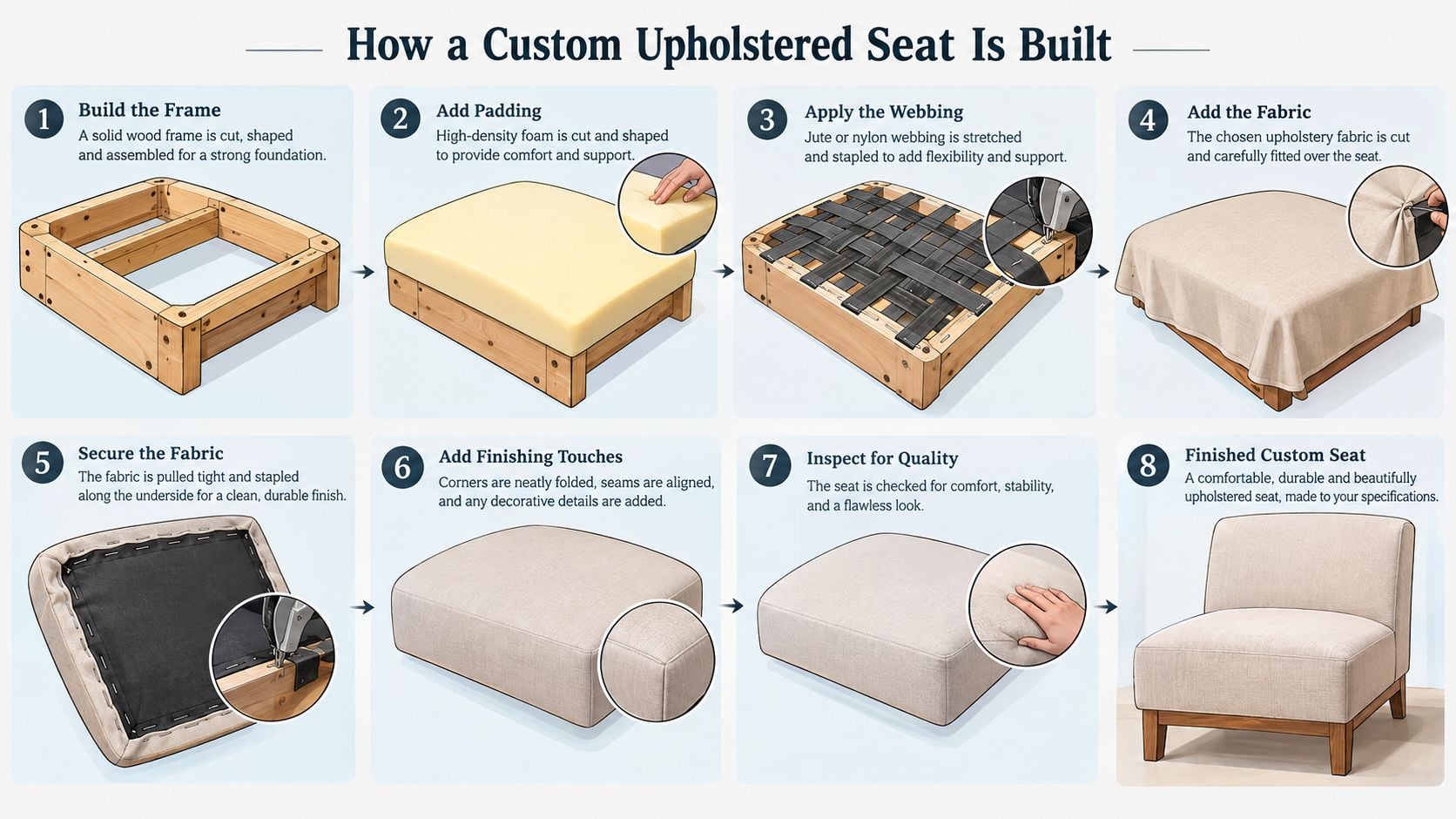
The frame carries the load
The frame is the seat's skeleton. Kiln-dried hardwood is valued because controlled drying helps limit movement. Engineered lumber and softwood can also perform well when selected, joined, and reinforced appropriately. The wood label alone does not determine durability. Joinery, corner blocks, fasteners, and quality control all work together.
A chair that begins wobbling may have weak joints, inadequate blocking, or movement where the rails meet. For an existing piece, homeowners can consult a practical guide to how to repair a sofa frame before deciding whether reupholstery makes sense. The frame must be sound enough to support the work that follows.
Suspension determines support
Suspension distributes body weight between the frame and cushions. Eight-way hand-tied springs can provide a responsive, traditionally supportive feel when installed correctly. Sinuous no-sag springs use shaped steel wires to create consistent support in many contemporary seats. Webbing uses woven straps and may produce a more flexible, relaxed sit, depending on its tension and construction.
The choice should match the intended feel, seat design, and daily use. Poorly selected or poorly installed suspension can lead to sagging, an uneven seat, or a frame that creaks under repeated loading. A Design Center consultant can help connect the preferred sitting feel with a suitable support system.
Cushion construction controls recovery
High-resilience foam wrapped in down combines a stable core with a softer surface. Down-and-feather-only blends feel relaxed and luxurious, though they need regular rearranging to maintain an even appearance. Pocketed coil cores provide a springier response and a distinct support profile.
Foam density indicates how much material resists cell collapse. Industry guidance places everyday residential foam around 30 to 35 kg/m³, commercial seating around 38 to 42 kg/m³, and heavier-duty seating at 45 kg/m³ or higher. Higher density generally resists compression set more effectively, helping limit the flattened “pancake” appearance caused by repeated use. (Industry foam guidance)
Upholstery creates the finished surface
The upholstery stage covers fabric cutting, seam placement, pattern matching, welt cord, and the choice between fixed upholstery and removable slipcovered construction. Stripes, checks, and large motifs require careful alignment across cushions and adjoining panels.
A custom seat typically has a cleaner, more architectural appearance. A slipcovered seat can offer a relaxed look and easier maintenance access when the cover is made for the specific frame and cushion shape. The furniture upholstery guide explains how these finishing choices shape the completed piece, from visual alignment to the way the seat is maintained.
Performance Specs That Decide How Long a Seat Lasts
A textile may look ideal under showroom lighting yet perform poorly beside an uncovered window. Performance specifications turn a beautiful sample into a practical choice, and the Willis Design Center uses them to connect each material to the way a seat will be used.
Foam density and firmness are separate decisions
Foam density describes the material's mass per volume and its resistance to breakdown. It does not determine whether a cushion feels soft or firm. That sensation comes from the ILD rating, which measures the force needed to compress the foam. A high-density cushion can still feel soft, medium, or firm, depending on its formulation and ILD selection.
For daily-use residential seating, guidance commonly places foam around 1.8 to 2.2 lb/ft³, or approximately 30 to 35 kg/m³. Commercial seating commonly uses 38 to 42 kg/m³, while heavier-duty applications use 45 kg/m³ or higher. Higher density generally helps a cushion resist compression set, the permanent flattening that creates a tired, uneven seat. (Foam density guidance)
Density and firmness answer different questions. One concerns how well the foam holds up. The other concerns how the seat feels when someone sits down.
Abrasion ratings need careful reading
Wyzenbeek reports double rubs, while Martindale reports cycles. Their test systems are not interchangeable, so the figures should not be compared as if they represented exactly the same measurement. (Abrasion standard explanation)
ACT guidance identifies 30,000 Wyzenbeek double rubs or 40,000 Martindale cycles as a relevant performance level for woven upholstery in high-traffic or public-space settings. (ACT woven upholstery guidelines) For lighter domestic use, commonly cited benchmarks are 15,000 double rubs or 20,000 Martindale cycles. Heavy-duty upholstery is often set at 30,000 double rubs or 40,000 cycles. (Textile quality standards)
These figures describe resistance during a controlled abrasion test, not a guaranteed service life. Cleaning products, sunlight, body oils, pets, fabric construction, and cushion movement can all change how the upholstery looks over time.
Cleaning and sunlight change the decision
Cleaning codes identify the method permitted by the manufacturer. W allows water-based cleaning, S calls for a solvent-based method, W-S permits either approved approach, and X generally limits care to vacuuming or light brushing. A mismatched cleaning method can turn a manageable spill into permanent damage.
Lightfastness measures resistance to color change from light. It matters in sunrooms, coastal interiors, and rooms with large uncovered windows. During a Design Center consultation, the seat's position, direct exposure, and window treatments should be reviewed before a sample is approved. A dining chair may need stain management and abrasion resistance, while a media-room sectional may place greater weight on recovery, comfort, and cleaning access.
| Spec | What It Measures | Recommended Minimum |
|---|---|---|
| Foam density | Resistance to breakdown and compression set | Everyday residential guidance around 1.8 to 2.2 lb/ft³ |
| ILD | Cushion firmness or softness | Select by sitting preference and body support needs |
| Wyzenbeek | Abrasion in double rubs | 15,000 for lighter domestic use, 30,000 for heavy-duty use |
| Martindale | Abrasion in cycles | 20,000 for lighter domestic use, 40,000 for heavy-duty use |
| Cleaning code | Approved care method | Match the code to likely spills and maintenance habits |
| Lightfastness | Resistance to color change from light | Choose a tested material suited to the room's sun exposure |
A practical checklist for evaluating these choices is available in how to choose durable upholstered furniture.
Choosing the Right Fabric or Leather for Your Home
The right material depends on how the seat will be used, not just on the color a homeowner likes best. A design consultant should compare the material's abrasion resistance, cleaning code, lightfastness, hand, and expected maintenance before approving a sample.
Four practical material paths
Performance fabric suits busy family rooms with children, pets, or frequent entertaining. Many performance textiles are engineered to manage stains, moisture, or repeated contact, but the buyer still needs to verify the specific fabric's cleaning code and abrasion result. A high rating doesn't make every treatment appropriate for every spill.
Natural linen brings texture and visual softness to a low-traffic formal room. Its appeal comes with a greater need for thoughtful placement and maintenance, particularly where frequent contact, pets, or direct sunlight could create challenges.
Top-grain leather works well for homeowners who value a durable surface that can develop character over time. Leather selection still requires attention to finish, care instructions, sunlight, and the desired balance between a consistent appearance and natural variation.
Performance velvet offers a soft, saturated surface for buyers who want a richer tactile experience without automatically accepting delicate everyday upholstery. The exact textile must still be checked for abrasion, cleaning, and lightfastness performance.
| Material | Best For | Typical Durability | Cleaning Code |
|---|---|---|---|
| Performance fabric | Busy family rooms, children, pets | Often selected for higher-use settings, verify the individual test result | Confirm the manufacturer's code |
| Natural linen | Low-traffic formal spaces | More dependent on careful use and placement | Confirm the manufacturer's code |
| Top-grain leather | Long-term use and developing patina | Durable when matched with suitable care | Follow the hide's care requirements |
| Performance velvet | Softness with practical stain resistance | Depends on the specific construction and testing | Confirm the manufacturer's code |
Homeowners comparing colors, textures, and quantities can also browse fabric by the yard to understand how broad fabric selection can be. A swatch, however, doesn't replace a performance specification.
Match the material to the room
A sunny Virginia Beach sitting room needs a different conversation from a shaded reading corner. The consultant should examine window direction, window coverings, pets, food and drink habits, cleaning confidence, and whether the furniture will receive continuous daily use.
The guide to upholstery fabric types can help homeowners learn the vocabulary before visiting a Design Center. The key decision isn't whether linen, leather, velvet, or performance fabric is universally superior. It's whether the selected material has the right specifications for that particular seat.
Inside the Willis Design Center Process
The process begins with a conversation, not a fabric wall. A homeowner describes the room, the people using it, the desired posture, existing furniture, access points, and visual direction. The design consultant turns those details into working specifications, including scale, seat depth, cushion feel, upholstery category, and practical performance needs.
Consultation turns preferences into measurements
A family may arrive saying it wants a comfortable sectional. The useful follow-up questions are more specific. Does the room need upright support for conversation, deeper lounging for films, or a combination? Will the sectional sit near a bright window? Does the household need a surface that can tolerate pets and frequent cleaning?
Room dimensions and delivery access matter just as much as style. Doorways, stairways, wall clearances, and the relationship between the seat and nearby tables should be considered before the order is finalized.
Samples reveal what screens hide
In the Design Center, homeowners can handle fabric swatches and leather samples in person. Texture, sheen, scale, undertone, and perceived warmth can change under different lighting conditions, so a sample should be viewed beside flooring, paint, rugs, and nearby wood finishes.
The consultant can place material options next to one another and connect each choice to the seat's intended use. Someone selecting leather for a reading chair needs a different discussion from someone selecting velvet for a rarely used formal accent chair.
American craftsmanship and final inspection
After approval, the piece is built by American craftspeople in domestic manufacturing facilities. The specified construction can include kiln-dried hardwood frames and serge-stitched seams, with the selected upholstery and tailoring details applied according to the order.
The final stage includes delivery coordination, inspection, assembly where needed, and placement in the home. White-glove delivery gives the team an opportunity to address dimensional or finish concerns before the furniture becomes part of the room. Homeowners considering leather can review the custom leather upholstery service while discussing hide selection and care expectations.
Pricing, Timelines, and Long-Term Value
Custom upholstery pricing reflects construction choices, not just the amount of fabric visible from across the room. Frame quality, cushion fill grade, fabric tier, leather selection, tailoring, and modifications such as a depth extension or contrast welt can all affect the final quote.
A buyer who wants a softer seat may select a different cushion construction from someone who prefers a firm, structured sit. A homeowner requesting unusual dimensions may also require more specialized cutting and production work. Clear budget communication helps the consultant preserve the desired look while adjusting specifications where appropriate.
Lead time requires planning
The typical custom lead time is eight to twelve weeks from order confirmation to delivery, depending on fabric availability and construction complexity. That window can change when a selected material is unavailable or when the design includes more involved modifications.
A written order should identify dimensions, upholstery, cushion construction, finish, tailoring, delivery expectations, and any approved performance specifications. Reviewing those details before production reduces the risk of discovering that a comfortable concept was translated into the wrong size or material.
Value continues after delivery
Custom upholstery can offer a different ownership model from disposable furniture. When the frame and structure remain useful, reupholstery or cushion replacement may refresh the piece after a fabric wears or a room's style changes. The decision depends on the frame's condition and the cost of the work, so buyers should ask about future service before ordering.
Keeping a repairable frame in use can reduce replacement waste and preserve the labor already invested in its construction. Industry coverage also describes circular upholstery strategies such as replaceable seat pads, removable covers, and designs made for disassembly. (Sustainable upholstery strategies)
For buyers who prefer monthly payments, Willis offers financing options through Synchrony HOME, subject to applicable credit approval and program terms. Premium construction becomes more approachable when the household evaluates the total ownership period rather than judging the purchase only by its initial price.
Your Next Steps Toward a One-of-a-Kind Seat
A custom upholstery project becomes manageable when the buyer treats it as a sequence of decisions. The first appointment should answer practical questions before the household falls in love with a material that doesn't suit the room.
Start with a design consultation
A homeowner can schedule an in-home or virtual appointment with a Willis Design Consultant. The consultation can include fabric swatch kits, room measurements, and preliminary quotes at no obligation. The buyer should bring room photographs, approximate dimensions, doorway information, and a short description of how the seat will be used.
The most useful questions concern the hidden specifications:
- Cushion feel: Does the household prefer structured support, a softer wrapped core, or a relaxed blend?
- Daily exposure: Will the seat face sunlight, pets, meals, frequent guests, or occasional formal use?
- Care routine: Is the household comfortable with specialized cleaning, or does it need a simpler approved method?
- Future flexibility: Could removable covers, replaceable cushions, or reupholstery matter later?
Choose a payment path or an outlet alternative
Qualified buyers can ask about Synchrony HOME financing, including promotional periods and the way credit decisions are handled. The available terms depend on the specific offer and approval, so the buyer should review the account terms before placing an order.
Budget-conscious shoppers should also visit the Willis Outlet for floor models, discontinued pieces, overstock, and last-of-kind custom orders at reduced prices. The Outlet is the practical route when a household wants quality furniture without commissioning every specification from the frame upward.
Follow the order in sequence
- Book the consultation: Share room constraints, intended use, comfort preferences, and budget.
- Finalize the specifications: Approve dimensions, frame, suspension, cushion construction, fabric or leather, cleaning requirements, and tailoring.
- Arrange delivery: Confirm the projected eight to twelve week custom window after order confirmation, then prepare the access route and room.
A buyer who needs custom upholstery seats for a specific season should schedule early because production timing depends on material availability and construction complexity. The right goal isn't just to own a distinctive seat. It's to approve a piece whose structure, surface, comfort, and maintenance demands fit the household from the first day.
Willis Furniture & Mattress offers custom upholstery consultations through its Design Center, with guidance on dimensions, fabrics, leathers, comfort, and construction performance. Visit Willis Furniture & Mattress to schedule a consultation, review financing options, or explore the Willis Outlet for a more immediate furniture solution.


