
Left vs Right Facing Sectional: Choose Your Perfect Sofa


A shopper finds the sectional. The silhouette is right, the fabric works, the seat depth feels comfortable, and the scale finally looks promising. Then the product page asks one question that stops the whole purchase cold: left-facing or right-facing.
That choice matters more than is often assumed. The wrong orientation can shove the chaise into the main path, crowd a doorway, or make the room feel clumsy even when the sofa itself is beautiful. The right one makes the room feel settled, balanced, and easy to live in.
A smart sectional decision starts with clarity, not guesswork. A little planning saves a lot of frustration, especially for homeowners trying to create your dream home on budget without buying twice. For anyone comparing shapes, scale, and room flow, this practical guide on what to know before buying a sectional adds useful context.
| Choice | What it means | Usually works best when | Common mistake |
|---|---|---|---|
| Left-facing sectional | The long chaise or extended seat is on the left when viewed from the front | Open space, entry path, or circulation needs to stay clearer on the right | Deciding from the seated position |
| Right-facing sectional | The long chaise or extended seat is on the right when viewed from the front | Open space, entry path, or circulation needs to stay clearer on the left | Measuring wall length but not room flow |
| Reversible sectional | Chaise position can be switched in a simpler format | Renters, frequent rearrangers, flexible rooms | Assuming every sectional is reversible |
| Modular sectional | Separate pieces can be reconfigured | Long-term flexibility and custom layouts | Underestimating how many pieces must connect correctly |
The Moment of Truth Choosing Your Sectional
A common living room problem looks simple at first. A family wants more seating, a cleaner layout, and one anchor piece that makes the room feel finished. They land on a sectional because it solves all three. Then the orientation question appears, and suddenly the purchase feels risky.
That hesitation is reasonable. Sectionals are large, directional pieces. They don't just fill space. They tell the room how to function. The chaise decides where people stretch out, how guests enter the seating area, and whether the layout feels inviting or boxed in.
Why this decision feels harder than it should
Most shoppers assume “left” and “right” refer to the person sitting on the sofa. That assumption causes most of the confusion. Others measure the wall, confirm the sofa fits, and stop there. Then the chaise blocks a pathway, covers an outlet, or points the room in the wrong direction.
The biggest sectional mistake isn't choosing the wrong fabric. It's choosing the wrong orientation for the room.
A good decision comes from looking at three things together: the room's shape, the traffic path, and the way the sectional opens into the space. Once those line up, the rest gets easier.
The practical mindset that works
Treat the sectional like architecture, not decoration. The room should move around it naturally. A homeowner shouldn't need to sidestep a chaise every day just because a product photo looked attractive online.
Design guidance matters. Inspiration is useful, but execution matters more. The Willis Standard is simple: if a home needs a specific look, the Design Center can customize it. If a premium brand is part of the plan, financing can make that decision workable. If the goal is value, the Willis Outlet gives budget-conscious shoppers a practical path without abandoning style.
The Golden Rule of Sectional Orientation
There's one rule that settles the whole left vs right facing sectional question. It's the only rule that matters, and the industry uses it consistently.
Stand directly in front of the sectional and look at it. If the longest chaise or extended seating portion is on the left, it's left-facing. If it's on the right, it's right-facing. That definition comes from Living Spaces' explanation of left-facing sectionals.
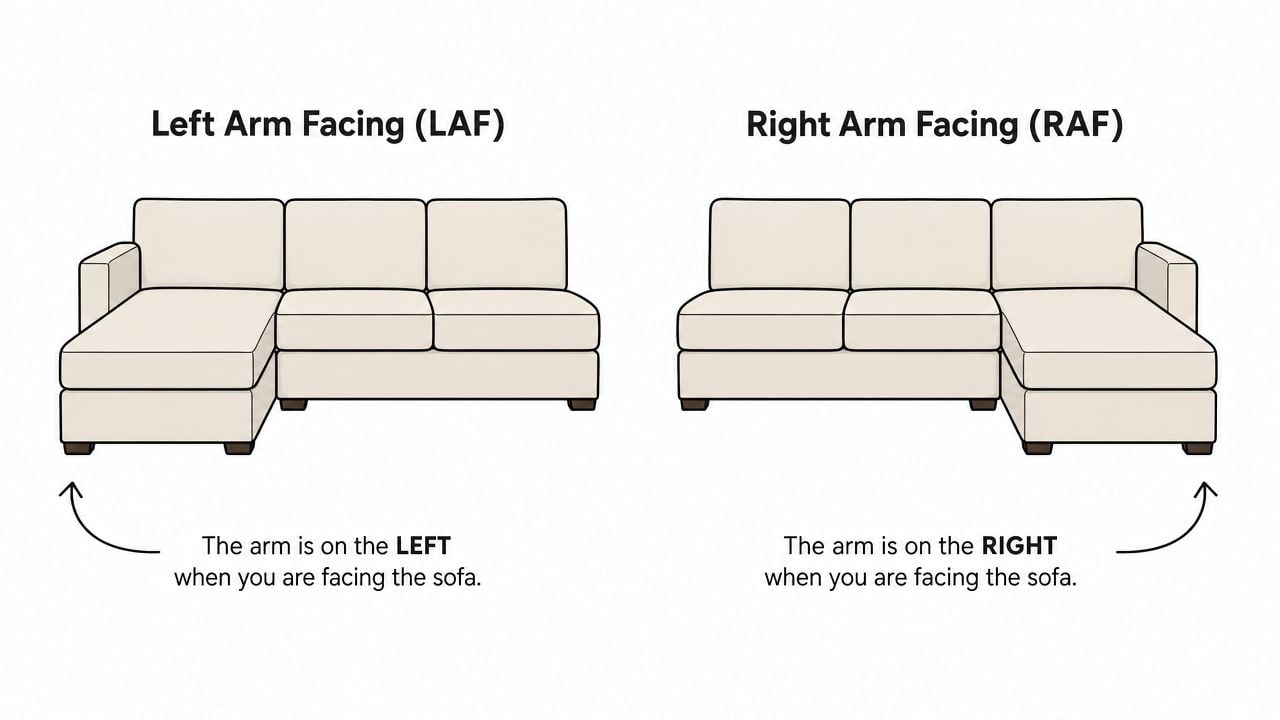
The only viewpoint that counts
Shoppers get tripped up because they test the answer from the wrong position. They sit on the sofa, imagine leaning back, and say the chaise feels like it's on their right or left. That's not how the furniture industry labels it.
Here's the clean way to read it:
- Left-facing sectional: The extended part is on the left when someone stands in front of it.
- Right-facing sectional: The extended part is on the right when someone stands in front of it.
- LAF and RAF: These stand for Left Arm Facing and Right Arm Facing, using that same front-facing perspective.
A fast visual check
Use this simple cheat sheet before ordering:
| If standing in front and looking at the sofa… | The correct label |
|---|---|
| The chaise extends to the left | Left-facing or LAF |
| The chaise extends to the right | Right-facing or RAF |
Practical rule: Never determine orientation while “sitting” on the sofa in your mind. That mirrors the layout and leads to the wrong order.
Why the rule matters
This isn't jargon for its own sake. It prevents expensive mistakes. A sectional with an asymmetrical shape has a built-in direction, and the room has to support that direction. If the shopper gets the label wrong, the piece may still fit on paper but fail in the room.
This is also why showroom tags and online dropdown menus seem stricter than expected. Retailers and manufacturers need one universal language, and the stand-in-front rule is that language. Once that clicks, the left vs right facing sectional decision stops feeling mysterious and starts feeling mechanical.
How to Measure Your Space Like a Designer
A sectional should never be chosen from wall length alone. That's how people end up with a sofa that technically fits but lives badly. Proper measurement looks at the room as a working space, not just an empty box.
The visual test matters as much as the tape measure. This floor-plan view helps show why footprint and circulation have to be considered together.
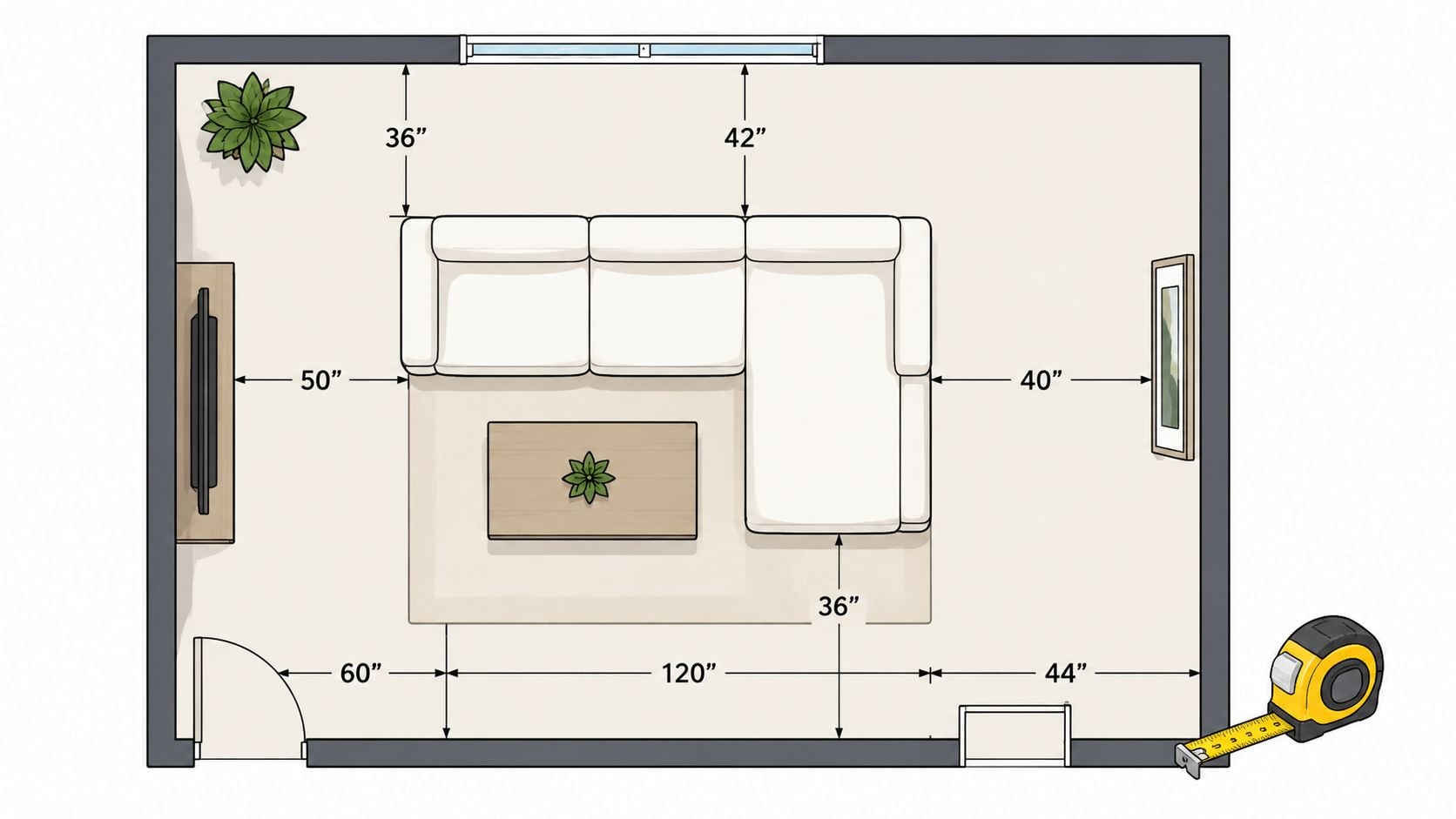
Start with the room, not the sofa
Measure the full wall where the main sofa portion will sit. Then measure the perpendicular side where the chaise will extend. After that, note anything fixed that the sectional can't ignore.
Use this checklist:
- Wall length: Measure the main wall and the return wall.
- Doorways: Confirm the piece can enter the home and the room.
- Windows and vents: Don't let the chaise land in front of features that need clearance.
- Outlets: Make sure lamp and charging locations still work.
- Traffic path: Preserve the route people already use naturally.
A detailed measuring guide like how to measure for a sectional couch is useful because it forces attention onto the trouble spots frequently missed.
Use the Tape Trick and live with it
This is the smartest step in the entire process. Before purchasing, experts recommend using painter's tape to mock up both left and right-facing footprints on the floor for 24 to 48 hours, so homeowners can test the “view feel” and confirm the setup doesn't block walkways or outlets, as explained in Koala's sectional orientation guide.
That timeline matters because first impressions can be misleading. A shape may look fine for five minutes and feel intrusive by the next evening.
Leave the tape in place through normal life. Walk past it with laundry, groceries, and a child on your hip. That reveals the truth faster than any showroom test.
What the tape outline should answer
A taped footprint should settle these questions:
- Can someone enter the room cleanly?
- Does the chaise interrupt the focal view?
- Does the layout keep outlets usable?
- Does the room still feel open instead of cornered?
If either orientation feels cramped in daily use, the problem may not be left versus right. The problem may be scale.
The benchmark designers watch
Main walkways should stay at 32 to 39 inches for comfortable movement. That benchmark is part of practical traffic-flow planning, and it changes how a sectional should be placed. It also explains why a sofa can fit dimensionally and still fail functionally if the chaise narrows circulation too much.
Professional space planning proves its worth. The same principles used in a do-it-yourself tape layout are the principles a design consultant uses in a full room plan. Under the Willis Standard, that bridge between inspiration and action matters. If a client wants a custom silhouette, fabric, or scale adjustment, the Design Center can tailor the solution instead of forcing the room to accept a bad fit.
Matching Sectional Orientation to Your Room Layout
The best orientation depends on how the room behaves. A sectional should support movement, frame the focal point, and make the room feel intentional. It shouldn't fight the architecture.
The image below shows the idea clearly. One room can require completely different answers depending on entry points and sightlines.
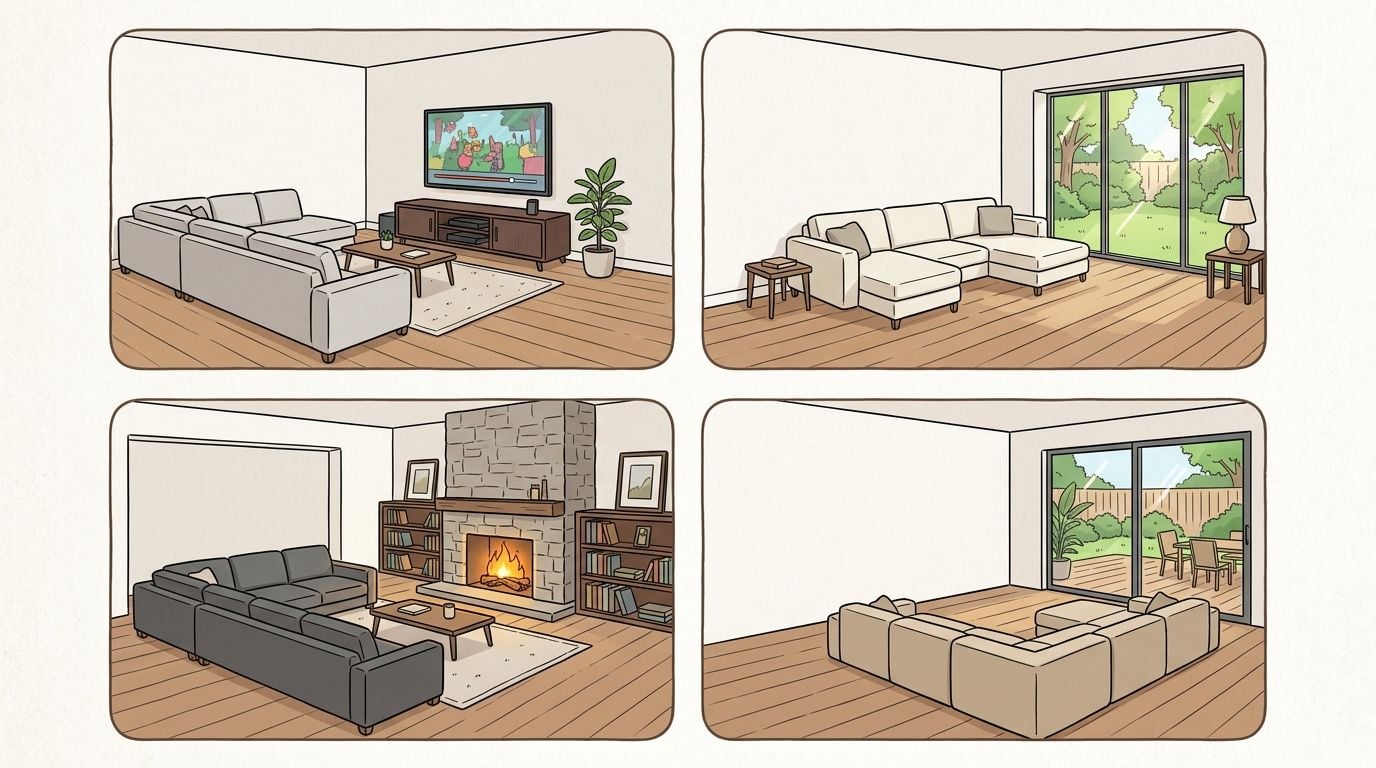
For scale, standard L-shaped sectionals typically run 95″ to 120″ on the long side, 60″ to 85″ on the short side, with an overall depth of 36″ to 40″, according to Coleman Furniture's sectional dimensions guide. Those numbers explain why orientation changes so much. The long run and short run don't just swap places. They redefine the room.
Four common room situations
Entry on the left side of the room
A right-facing sectional often makes more sense here. It keeps the chaise away from the incoming path and allows the room to open more naturally as someone walks in.
Entry on the right side of the room
A left-facing sectional usually handles this better. The chaise moves away from the main approach, so the seating area feels welcoming instead of guarded.
Open-concept living area
The sectional can act like a soft divider. In this case, the “open” side of the L should usually face the area the homeowner wants to stay visually connected to, such as the kitchen or dining zone.
Room built around a fireplace or television
The chaise should support lounging without hijacking the sightline for everyone else. If one orientation leaves a cleaner view across the room, that's usually the stronger choice.
When a small room needs a stricter answer
In tighter rooms, there's less forgiveness. A chaise in the wrong spot doesn't look mildly awkward. It makes the room feel blocked. That's why smaller homes and condos benefit from more disciplined planning and, often, more compact options like small sectionals for small spaces.
A sectional should guide the eye toward the focal point and guide the body through the room. If it can't do both, it's the wrong orientation.
Where custom planning helps
This is also where custom design becomes worth considering. Some homes need a narrower arm, a shorter chaise, or a cleaner fabric profile to keep the layout from feeling heavy. Under the Willis Standard, trend inspiration shouldn't stop at photos. The Design Center can customize upholstery and room planning so the final piece fits the home instead of forcing compromise.
For homeowners drawn to elevated looks from premium collections such as Barclay Butera, that matters even more. A directional sectional in a premium line is an investment piece, and financing options can make the right configuration easier to choose without settling for the wrong one.
Flexible Alternatives Reversible and Modular Sectionals
Some shoppers shouldn't buy a fixed left-facing or right-facing sectional at all. Renters, frequent rearrangers, and homeowners who move often usually need more flexibility.
The first distinction is mechanical. A sectional with a chaise on the left requires an LAF chaise paired with an RAF sofa, while a chaise on the right requires an RAF chaise paired with an LAF sofa, as outlined in Eye to Eye Interiors' explanation of sectional combinations. That means many sectionals are built for a specific direction from the start.
Reversible versus modular
| Type | How it works | Best for | Limitation |
|---|---|---|---|
| Reversible sectional | The chaise shifts from one side to the other in a simplified setup | Apartments, guest rooms, flexible furniture plans | Usually less tailored in shape |
| Modular sectional | Separate components can be rearranged into multiple layouts | Long-term versatility and custom living rooms | Requires more planning and usually a bigger investment |
| Fixed orientation sectional | Built in one direction | Rooms with a clear, stable layout | Little to no flexibility later |
A wedge-based layout can also help solve awkward corners or open plans more gracefully. For shoppers exploring that shape, sectional with wedge is a useful reference point.
Which one deserves the money
A reversible sectional is practical. It gives a household some freedom and removes pressure from the initial decision. But it's usually the simpler answer, not the most refined one.
A modular sectional is the stronger long-term investment when the room may evolve. It adapts better, it can grow with a home, and it supports more personalized layouts. Under the Willis Standard, that's where design customization matters. The Design Center can help plan bespoke modular arrangements, and financing options can make a premium configuration from lines such as Stressless more realistic for homeowners who want flexibility without giving up comfort or style.
Your Sectional Shopping Guide at Willis Furniture
You have the measurements. You found the wall the sectional should anchor. Now the crucial decision starts. The wrong showroom visit leaves people focused on color and cushions while they miss the details that decide whether the piece will work at home.
What matters when the buying gets real
Shop with a floor plan, room photos, doorway measurements, and a clear traffic path in mind. A sectional has to do more than fit the room. It has to protect movement, keep sightlines open, and support how the household uses the space.
Use a broader sofa buying checklist like what to look for when buying a sofa to judge seat depth, cushion support, arm scale, fabric durability, and frame quality while you confirm the correct orientation.
Do not shop the sectional in isolation.
The strongest results usually come from treating the seating plan as a full-room decision. That means checking rug size, cocktail table clearance, lamp placement, and whether the sectional blocks a window, vent, or key walkway. At Willis Furniture & Mattress, the Design Center helps turn those moving parts into one clear plan, especially when a client needs custom upholstery, a specific configuration, or guidance on scale.
Budget matters too. Financing through Synchrony HOME promotional plans for qualified buyers can make a better-fit sectional realistic instead of forcing a rushed compromise, and white-glove delivery with placement and assembly removes guesswork on installation day.
If setup is part of your concern, keep logistics in the plan from the start. Even outside the local service area, resources like Home Removals Sydney furniture assembly show why careful handling and correct placement matter with large upholstered pieces.
A good sectional purchase feels settled before it arrives. That is the standard to aim for.
Frequently Asked Questions About Sectionals
Some sectional questions don't fit neatly into a buying checklist, but they still matter at the point of purchase.
Quick-Reference FAQ
| Question | Answer |
|---|---|
| Do all sectionals have a left or right orientation? | No. Symmetrical sectionals and some corner-driven designs don't rely on a left or right facing designation in the same way an L-shaped chaise sectional does. |
| Can a sectional's orientation be changed later? | Usually not if it's a fixed configuration. Reversible and modular models are the exceptions. |
| Does the same orientation rule apply to sleeper sectionals? | Yes. If the sleeper sectional has a directional chaise or extension, the same front-facing orientation logic still applies. |
A buyer doesn't need more jargon. A buyer needs one clear answer: determine orientation from the front, test the footprint in the room, and choose the version that protects movement and sightlines. That's the whole game.
The next smart move is to bring room photos, measurements, and a rough floor plan into Willis Furniture & Mattress. A design consultant can help translate those details into a sectional that fits the room, the budget, and the way the home is used.


