
Guide to Sectional With Wedge: Style & Layout


You’re usually not shopping for a sectional with wedge because your room is easy.
You’re shopping because the living room has a bay window that interrupts the corner. Or the open layout in a Virginia Beach home needs seating that defines the room without blocking traffic. Or the standard L-shape you liked online suddenly looks too rigid once you picture it against real walls, real windows, and real walkways.
That’s where a wedge earns its place. It can soften a turn, improve conversation, and make a sectional feel intentional instead of forced. The right one solves layout problems. The wrong one creates them. The difference comes down to shape, scale, construction, and planning.
The Wedge Explained Beyond Just a Corner Piece
A sectional with wedge isn’t just a sectional with “something in the middle.” The wedge is the transition piece that changes how the whole seating plan behaves in a room.
In practice, that matters most when a sharp corner feels too abrupt or too bulky. A wedge opens the angle visually, gives the sectional a more relaxed footprint, and often makes the seating group feel more conversational. In larger great rooms, that can help people face one another more naturally. In smaller living rooms, it can keep the corner from feeling boxed in.
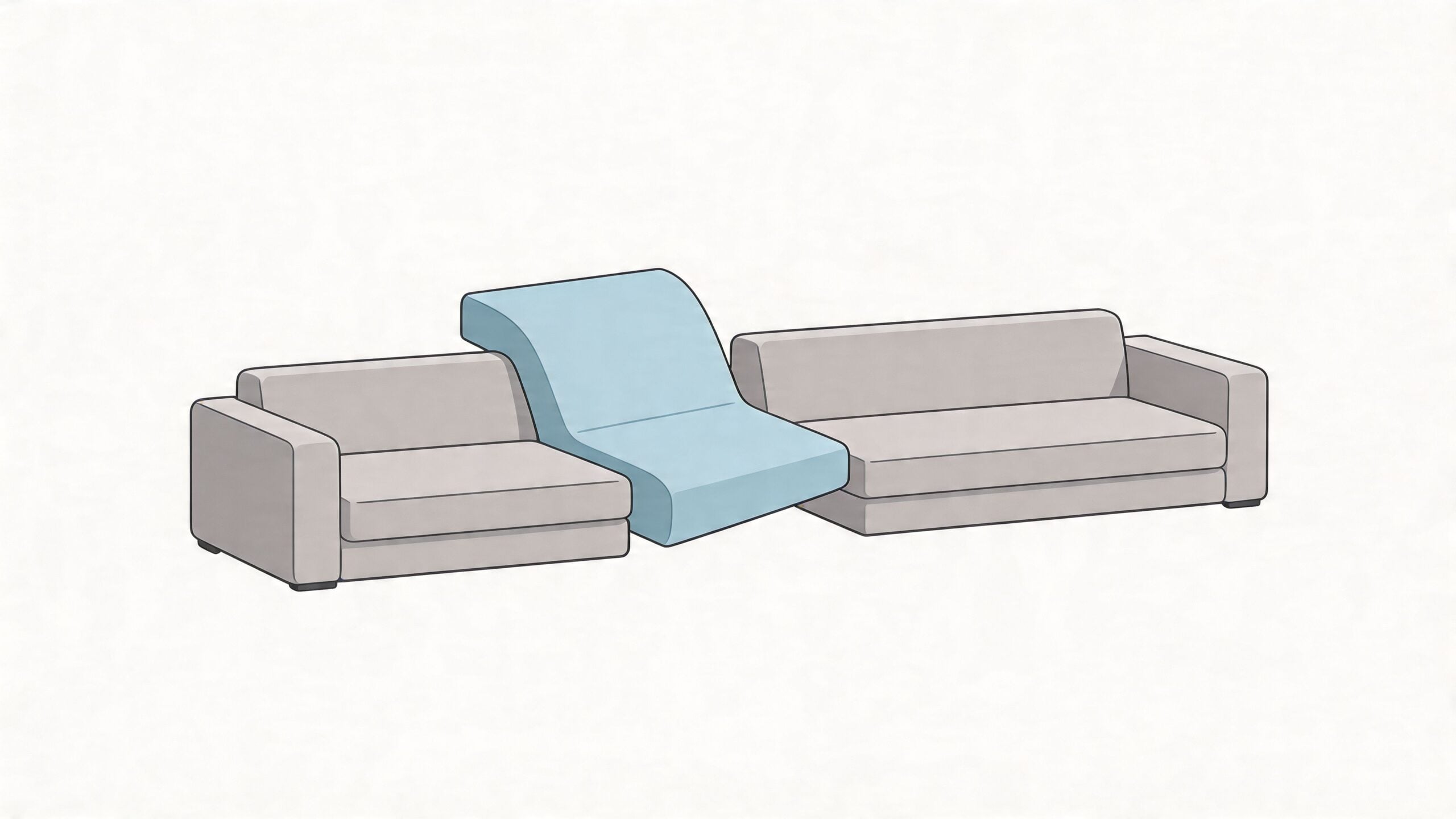
If you’ve been browsing components, a real example helps. A dedicated sectional wedge component shows how manufacturers treat the wedge as a planning element, not an afterthought.
The most common wedge types
Not every wedge does the same job; many shoppers are often confused by this.
- Squared 90-degree wedge: Works when you need a more defined turn and want the sectional to read clean and architectural.
- Curved wedge: Better when the room needs softer flow, especially in open layouts where a hard angle can look heavy.
- Console wedge: Adds function with storage or a surface area, which can help when end-table space is limited.
What each type changes
The wedge affects more than appearance. It changes how people sit, how the room circulates, and how much visual weight lands in the corner.
| Wedge type | Best use | Trade-off |
|---|---|---|
| Squared wedge | Tight corners, tailored layouts | Can feel more formal |
| Curved wedge | Open rooms, softer sightlines | Needs careful measuring |
| Console wedge | Multi-use family rooms | Adds bulk at the turn |
Practical rule: If the room already has a lot of sharp lines, such as angular windows, straight fireplace surrounds, or crisp built-ins, a curved wedge often balances the architecture better than a boxed corner.
When a wedge helps and when it doesn’t
A wedge works well when you want one seating group to do several jobs at once. It can anchor a TV room, support conversation, and keep the plan from looking too mechanical.
It’s less successful when the room really needs flexibility above all else. If you move often, rearrange constantly, or need separate seating pieces for entertaining, a wedge sectional can feel more committed than a sofa-and-chairs layout.
That’s the key mindset shift. The wedge isn’t filler. It’s a strategic piece that can solve an awkward room more elegantly than a standard corner unit.
Mastering Your Space How to Measure and Plan Your Layout
Most sectional mistakes happen before fabric is ever chosen. The issue isn’t color. It’s geometry.
That matters even more with a sectional with wedge because angled components don’t behave like a straight sofa. They change the usable footprint, the turning radius around the piece, and the space needed near windows, pathways, and adjacent furniture.
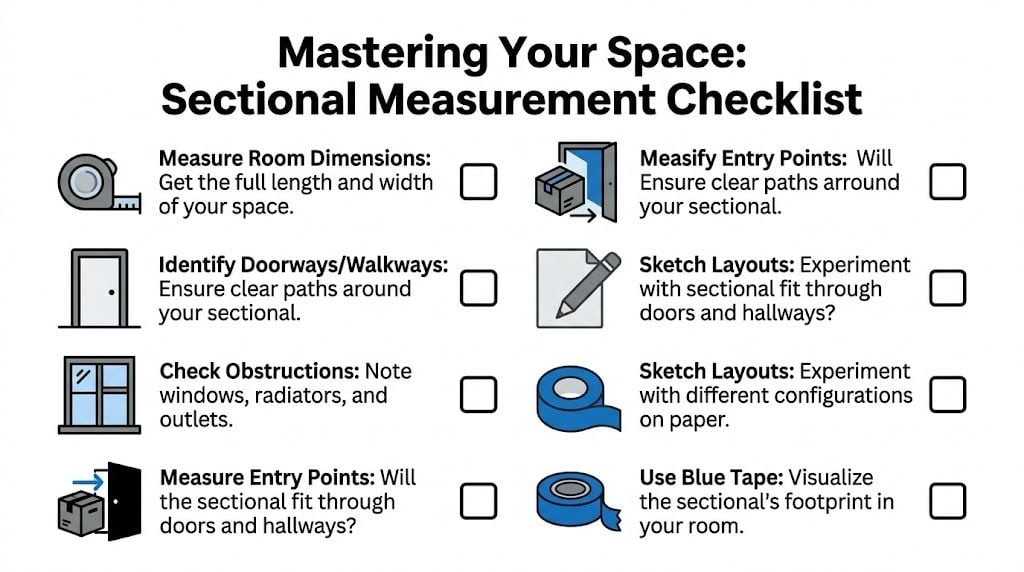
A practical starting point is this sectional measuring guide, especially if you’re trying to sort out room dimensions and delivery access before you commit.
Start with the room, not the sofa
Measure the full length and width of the room first. Then mark anything that interrupts placement or circulation. In coastal homes, that often means windows placed lower than expected, sliders, floor vents, radiators, outlets, or trim details that steal usable depth.
After that, map traffic. Don’t just ask, “Will it fit?” Ask, “Can people still move through the room without brushing the chaise end, clipping a coffee table, or squeezing behind the corner?”
Use blue tape before you buy
Painter’s tape is still one of the most reliable planning tools because it forces the layout into the actual room.
Use it to mark:
- The full sectional footprint, not just the long side.
- The wedge angle, which is where many layouts go wrong.
- The coffee table zone, so you can see whether reach and clearance still make sense.
- The walkway, especially in open-concept rooms that connect to dining or kitchen space.
Live with that taped outline for a day or two. Walk around it when carrying laundry, groceries, or a tray from the kitchen. You’ll notice quickly whether the sectional supports daily life or interrupts it.
A sectional can fit on paper and still fail in real life if the angled corner steals more movement space than expected.
Measure access points with the same discipline
The room can be perfect and the delivery can still fail if the components don’t make it through the home.
Check these before ordering:
- Front entry and storm door clearance: Screen doors, sidelights, and tight landings matter.
- Hallway width and turning points: A long component may clear a doorway but not the turn afterward.
- Stair geometry: Ceiling slope and railing placement often matter as much as width.
- Elevator dimensions if applicable: Especially important in condos and some multi-story properties near the coast.
Why angled sectionals get returned
A 2025 Houzz survey of 1,200 homeowners found that 42% returned angled sectionals due to poor fit predictions, especially in rooms with non-standard angles like bay windows. That’s the exact scenario where professional space planning helps, because wedge geometry is harder to judge by eye than a standard sofa or square-corner sectional.
For unusual rooms, 3D planning is worth it. A bay window, offset fireplace, or broad open plan can make a wedge feel either beautifully custom or oddly adrift. The difference usually comes down to precise placement and proportion, not the sectional itself.
Common planning errors in Virginia Beach homes
Open coastal layouts create a specific set of problems. The room may feel large, but much of that space is visual, not usable. Long sightlines, angled exterior walls, and multiple openings can limit where a sectional belongs.
A few mistakes show up often:
- Pushing the sectional too tight to the perimeter: That can make the center of the room feel empty and the seating feel disconnected.
- Ignoring diagonal depth: The wedge can project farther than expected once taped out.
- Choosing size by wall length alone: Window placement and circulation usually matter more.
If your room has awkward geometry, professional modeling often saves time, indecision, and a costly re-do.
Designing Your Dream Sectional Configuration and Style
The right configuration starts with behavior, not trend. A sectional with wedge can look polished in a showroom and still miss the mark if it doesn’t match how the room is used on a Tuesday night.
Some households want one expansive lounge zone for movies, naps, and everyday sprawl. Others need the room to feel composed enough for guests, with seating that encourages conversation instead of everybody facing one direction. The wedge can support either approach, but only if the overall layout is intentional.
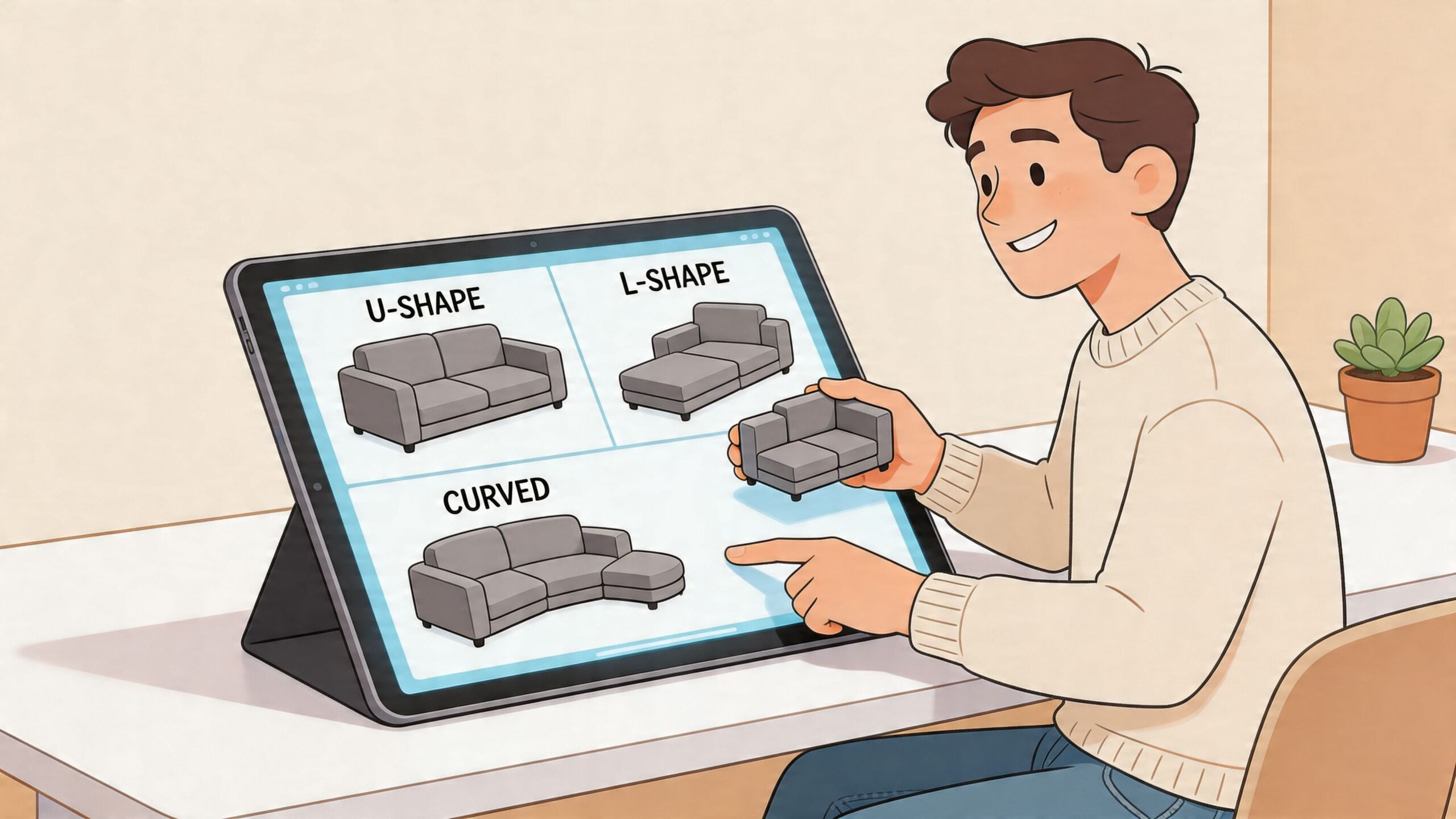
If you want to compare shapes and components before narrowing in on a final layout, a build-your-own sectional planner is a practical place to test combinations visually.
Three layouts that usually work
| Configuration | Best for | Watch for |
|---|---|---|
| Relaxed L-shape with wedge | Open family rooms | Don’t oversize the return |
| U-shape with wedge center flow | Media rooms or large gathering spaces | Keep table access practical |
| Balanced formal arrangement | Front rooms or polished living spaces | Avoid making it too stiff |
The L-shape is still the most versatile. It defines the room without swallowing it. In many Virginia Beach homes, this layout works well when the wedge softens a turn facing windows or a fireplace wall.
The U-shape can be excellent in a dedicated media room, especially when the goal is maximum seating in one zone. It needs more discipline than shoppers expect. If the opening gets too tight, the room starts to feel penned in.
A balanced or near-symmetrical arrangement suits homes where the living room needs more polish. That could mean a wedge used to keep the sectional welcoming while arms, legs, and back profile do the heavier stylistic lifting.
Style details that change the mood
Small design decisions have outsized impact on how a sectional reads.
- Track arms: Cleaner and more modern. Good for refined coastal interiors.
- Rolled arms: Softer and more traditional. Better when the room has classic millwork or warmer wood tones.
- Pillow arms: Casual and lounge-driven, but visually heavier.
- Wood legs: Usually feel warmer and more residential.
- Metal legs: Sharper, lighter, and more contemporary.
- Low backs: Keep sightlines open.
- Higher backs: Offer more visual presence and support.
A modern coastal room often benefits from a slimmer arm, lighter leg finish, and restrained silhouette. A traditional room can handle more shape and more detail.
Premium pieces need premium planning
Brand personality becomes significant. A Stressless sectional can support a cleaner, more ergonomic look. A Barclay Butera piece tends to lean more refined and classically dressed. Neither is automatically right. The room decides.
High-end customization also changes the buying conversation. Once you begin selecting arm shape, seat depth, upholstery, and sectional components, the piece becomes more personal and more exact. That’s usually the point where many clients prefer to spread the investment out with financing rather than compromise on fit or finish.
A premium sectional should solve a room problem and support your style at the same time. If it only does one of those jobs, keep looking.
Why setup matters as much as style
Modular wedge sectionals depend on correct alignment. According to West Elm’s Haven wedge sectional specifications and assembly details, successful assembly relies on hidden steel brackets and leveling glides on a hardwood frame, with premium models also using zoned coil systems and an 18-inch seat height for accessibility. That same source notes that improper wedge angling drives 30% of customer complaints, which is exactly why setup and placement matter as much as the design itself.
That’s one reason white-glove delivery is worth considering on a more complex sectional. A wedge that’s slightly off-angle rarely looks “slightly” off. It can make the whole arrangement feel unsettled.
The Finishing Touches Choosing Fabrics and Ensuring Comfort
Fabric is where many people start. It shouldn’t be.
Start with how the sectional will live in your home. A room used by kids, pets, overnight guests, and everyday lounging needs a different upholstery strategy than a formal sitting room with lighter use. The right fabric isn’t the most expensive one. It’s the one that matches the pressure your household will put on it.

If you’re comparing upholstery categories, this guide to upholstery fabric types is useful for narrowing down texture, maintenance, and day-to-day practicality.
Fabric choices by lifestyle
Some general rules hold up well in real homes:
- Performance fabrics: A strong fit for active households that need easier cleanup and less worry.
- Textured woven fabrics: Good for warmth and visual depth, but they can show wear patterns differently depending on the weave.
- Leather: Strong long-term option for many homes, especially when you want patina and easier surface cleanup.
- Light solids: Beautiful, but they demand confidence about maintenance and daily habits.
Swatches matter more than screen images. The same beige can read sandy, gray, cream, or pink depending on daylight, floor color, and surrounding finishes. In coastal interiors, that shift is especially noticeable.
Comfort comes from the inside
The feel of a sectional with wedge is mostly decided by what you don’t see. Frame, suspension, and cushion core determine whether the sofa still sits well after years of use.
Rejuvenation’s Wrenton wedge component details point to the construction standards worth watching for: kiln-dried, SFI-certified hardwood frames, mortise-and-tenon joints, sinuous springs, and high-resiliency foam with a density of at least 1.8 lb/ft³. That construction offers 20-30% better compression recovery than standard foam, which helps reduce sagging over time.
That’s the difference between a sectional that looks plush on day one and one that still supports you well later.
What comfort style suits you
Not everyone wants the same sit.
| Comfort preference | What to look for |
|---|---|
| More supportive, easier to get up from | Firmer HR foam core, cleaner seat profile |
| Plush, sink-in feel | Softer wrap over a supportive core |
| Balanced everyday comfort | Medium feel with resilient support under it |
The most common comfort mistake is choosing softness in the showroom without thinking about recovery, support, and how the cushions will behave after real use.
This is also where customization becomes practical, not decorative. Seeing and touching fabric and leather swatches in person removes a lot of guesswork. It also helps you match comfort to the actual way you sit, lounge, read, host, or nap.
From Showroom to Living Room The Willis Experience
Ordering a sectional with wedge is rarely an impulse decision, especially if you’re choosing custom upholstery or a specific configuration. The process works better when expectations are clear from the beginning.
Custom orders take coordination. Components have to be specified correctly, upholstery selections have to be confirmed, and the final footprint has to suit both the room and the path into it. That’s why a design-focused purchase tends to feel smoother when the planning, ordering, and delivery are connected.
A practical resource for that process is this furniture store with design services overview, which outlines how room planning and product selection can work together rather than as separate steps.
What white-glove delivery actually solves
The difference between curbside and full-service delivery is simple. One drops the furniture off. The other finishes the job.
For a sectional with wedge, white-glove delivery typically means:
- Inspection before placement: The team checks pieces before they’re fully set.
- Room-of-choice delivery: Components go where they belong, not just inside the front door.
- Assembly and alignment: Important for wedge sections that need proper connection and leveling.
- Packaging removal: No leftover cardboard or wrap to manage.
That service matters more with modular sectionals because a small setup error can affect the look and function of the whole arrangement.
Easy maintenance habits that protect the investment
Good upholstery lasts longer when owners stay ahead of wear instead of reacting to it.
A simple routine helps:
- Rotate and fluff cushions as needed so use stays more even.
- Vacuum creases and deck areas before grit settles into fibers.
- Address spills by fabric type rather than using one cleaner for everything.
- Keep direct sun in mind if the sectional sits near large coastal windows.
If you’re furnishing on a tighter budget, there’s another practical route. Floor samples, outlet finds, and discounted pieces can make a sectional update more accessible without abandoning quality. That’s the kind of shopping approach that makes sense when the priority is value and speed over full customization.
A Curated Home Starts with a Confident Choice
A sectional with wedge does more than add seats. It solves shape, flow, and comfort in one move when it’s chosen well. That’s why the smartest purchases usually come from equal parts inspiration and planning.
The room has to function. The sectional has to fit. The materials have to support how you live. And the surrounding details matter too. Once the seating is right, elements like rugs, lighting, and even how to choose window treatments for a luxurious home help the room feel complete rather than merely furnished.
A confident choice comes from seeing the whole picture. If your living room has awkward angles, open coastal flow, or a layout that never quite felt finished, a wedge sectional can be the piece that resolves it.
If you’re ready to turn ideas into a workable room plan, Willis Furniture & Mattress can help you compare configurations, explore custom upholstery, review financing options, and coordinate delivery so your sectional fits your space and your routine.


